

8 Reals – Chiloé Island
Chile
Context
Years: 1818–1819
Country: Chile 
Issuer: Chiloé Island
Ruler: Ferdinand VII
Currency:
(1541—1852)
Demonetized: Yes
Material
Diameter: 38 mm
Weight: 23.5 g
Silver weight: 22.79 g
Shape: Round
Composition: 97% Silver
Magnetic: No
Techniques: Cast, Countermarked
References
KM: #Click to copy to clipboard1
Numista: #483206
Value
Bullion value: $64.16
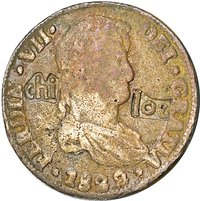
Obverse
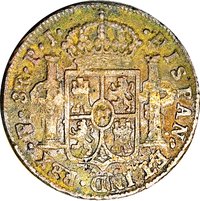
Reverse
Edge
Categories
| Person> Monarch |
| Symbols> Coat of Arms |
Mints
| Name | Mark |
|---|---|
| Lima | — |
Mintings
| Year | Mint Mark | Mintage | Quality | Collection |
|---|---|---|---|---|
| 1818 | — | — | ||
| 1819 | — | — |
Historical background
In 1818, Chiloé Island existed as the final, isolated bastion of royalist Spain in the heart of revolutionary South America. While the mainland Chilean patriots, under leaders like Bernardo O'Higgins, had declared independence and were consolidating their republic, Chiloé remained firmly under the control of a Spanish governor, Antonio de Quintanilla. This political separation created a profound economic and monetary schism. The island's economy was effectively cut off from the nascent Chilean state, forcing it to maintain direct, albeit strained, ties with the loyalist stronghold of Peru for supplies and official currency.
The currency situation on the island was one of severe scarcity and complexity. Official Spanish coinage, particularly silver reales and gold escudos, was the legal tender but was in critically short supply due to the naval blockades and the disruption of traditional trade routes. To fill this vacuum, a system of barter for goods and services remained prevalent. More significantly, various forms of provisional and substitute currency circulated, including senas (promissory notes or IOUs) issued by the royalist administration and even by local merchants and military commanders. These tokens were promises of future payment in proper coin, but their value was highly localized and contingent on the issuer's credibility.
This monetary instability reflected Chiloé’s precarious position as a besieged outpost. The lack of sound, centralized currency hampered the royalist administration's ability to pay its garrison and civil servants reliably, undermining morale and logistical efficiency. Ultimately, the chaotic currency situation was a symptom of the larger geopolitical reality: Chiloé in 1818 was a stranded fragment of a dying empire, struggling to sustain its economy through improvisation while under the looming threat of incorporation into the new Chilean nation, which would eventually bring its own, different monetary system.
The currency situation on the island was one of severe scarcity and complexity. Official Spanish coinage, particularly silver reales and gold escudos, was the legal tender but was in critically short supply due to the naval blockades and the disruption of traditional trade routes. To fill this vacuum, a system of barter for goods and services remained prevalent. More significantly, various forms of provisional and substitute currency circulated, including senas (promissory notes or IOUs) issued by the royalist administration and even by local merchants and military commanders. These tokens were promises of future payment in proper coin, but their value was highly localized and contingent on the issuer's credibility.
This monetary instability reflected Chiloé’s precarious position as a besieged outpost. The lack of sound, centralized currency hampered the royalist administration's ability to pay its garrison and civil servants reliably, undermining morale and logistical efficiency. Ultimately, the chaotic currency situation was a symptom of the larger geopolitical reality: Chiloé in 1818 was a stranded fragment of a dying empire, struggling to sustain its economy through improvisation while under the looming threat of incorporation into the new Chilean nation, which would eventually bring its own, different monetary system.
✨ Legendary