

2 centimes – France
Add to wishlist
France
Context
Years: 1853–1857
Issuer: France
Ruler: Napoleon III
Currency:
(1795—1959)
Demonetization: 24 November 1940
Total mintage: 42,143,183
Material
References
KM: #
Numista: #483
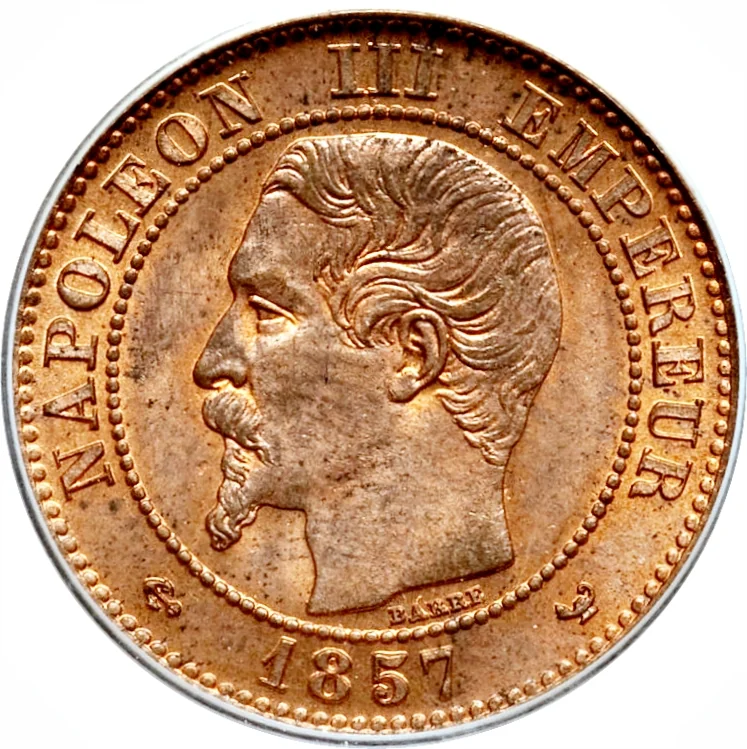
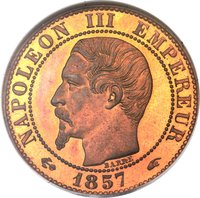
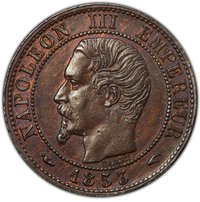
Obverse
Description:
Left-facing portrait within beaded circle, surrounded by lettering, date below.
Inscription:
NAPOLEON III EMPEREUR
BARRE
1857
BARRE
1857
Translation:
NAPOLEON III EMPEROR
BARRE
1857
BARRE
1857
Script: Latin
Language: French
Engraver: Jacques-Jean Barre
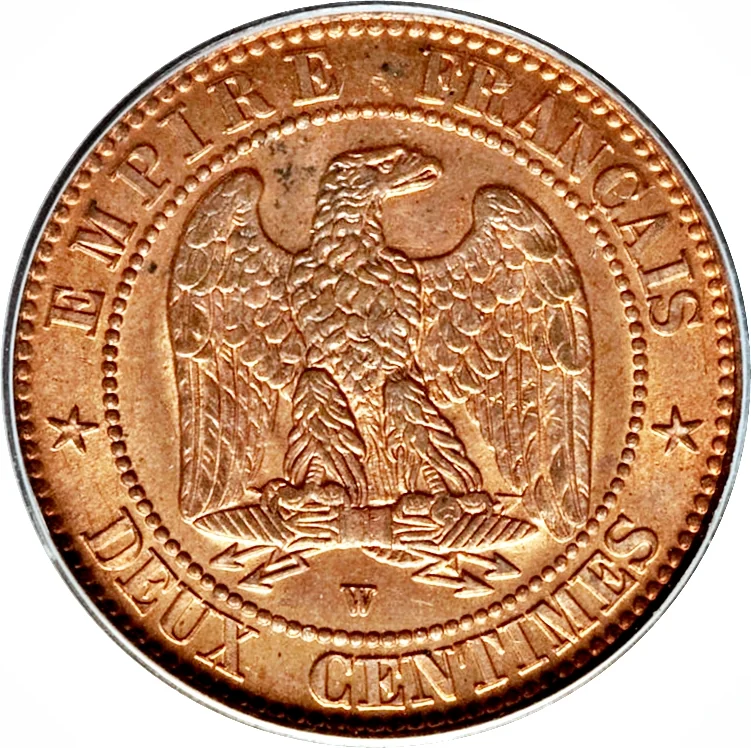
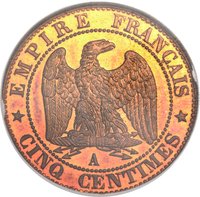
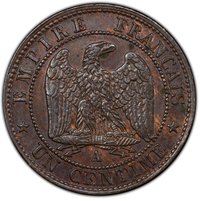
Reverse
Description:
Imperial eagle.
Inscription:
EMPIRE FRANÇAIS
W
* DEUX CENTIMES *
W
* DEUX CENTIMES *
Translation:
FRENCH EMPIRE
W
* TWO CENTIMES *
W
* TWO CENTIMES *
Script: Latin
Language: French
Engraver: Jacques-Jean Barre
Edge
Plain
Mints
| Name | Mark |
|---|---|
| Monnaie de Paris | A |
| Rouen | B |
| Strasbourg | BB |
| Lyon | D |
| Bordeaux | K |
| Marseille | MA |
| Lille | W |
Mintings
| Year | Mint Mark | Mintage | Quality | Collection |
|---|---|---|---|---|
| 1853 | A | 657,550 | ||
| 1853 | B | 538,580 | ||
| 1853 | BB | 211,996 | ||
| 1853 | D | — | ||
| 1853 | K | 116,625 | ||
| 1853 | MA | 192,046 | ||
| 1853 | W | 70,239 | ||
| 1854 | A | 3,360,354 | ||
| 1854 | MA | 1,282,292 | ||
| 1854 | W | 3,401,758 | ||
| 1854 | K | 1,545,169 | ||
| 1854 | B | 1,995,174 | ||
| 1854 | BB | 1,988,420 | ||
| 1854 | D | 2,523,954 | ||
| 1855 | BB | — | ||
| 1855 | D | — | ||
| 1855 | A | — | ||
| 1855 | B | — | ||
| 1855 | K | — | ||
| 1855 | MA | — | ||
| 1855 | W | 939,230 | ||
| 1856 | A | 1,737,739 | ||
| 1856 | B | 4,461,561 | ||
| 1856 | BB | 1,281,437 | ||
| 1856 | K | 2,280,342 | ||
| 1856 | MA | 2,712,188 | ||
| 1856 | W | 2,485,446 | ||
| 1857 | A | 1,249,740 | ||
| 1857 | B | 1,861,940 | ||
| 1857 | D | 999,880 | ||
| 1857 | K | 749,922 | ||
| 1857 | MA | 1,249,831 | ||
| 1857 | W | 2,249,770 |
Historical background
In 1853, France's currency system was firmly rooted in a bimetallic standard, established by the landmark Loi du 7 germinal an XI (1803). This law legally fixed the values of both gold and silver coins, defining the franc germinal and setting a mint ratio of 15.5 ounces of silver to 1 ounce of gold. This system aimed to provide stability and facilitate international trade, and for decades it succeeded, making the French franc a trusted benchmark in Europe. However, by the early 1850s, this equilibrium was under growing strain due to global shifts in the supply and market price of precious metals.
The period was marked by significant monetary expansion and inflationary pressure. The discovery of vast gold deposits in California (1848) and later Australia increased the global gold supply, subtly disrupting the fixed 15.5:1 ratio and making silver relatively more valuable. Concurrently, France was experiencing a major economic boom under Napoleon III, fueled by railroad construction and industrialization. This surge in economic activity increased the demand for circulating coinage, leading to a proliferation of banknotes issued by the Banque de France and smaller regional banks, which further expanded the money supply.
Consequently, authorities were grappling with the practical challenges of managing a bimetallic system in a changing world. While a full-blown crisis was not yet apparent, the pressures were clear: the fixed legal ratio was increasingly out of sync with fluctuating global market values, risking the disappearance of one metal from circulation (Gresham's Law). This precarious situation would culminate in the 1860s in the Latin Monetary Union, but in 1853, France was still operating on the venerable, yet increasingly stressed, foundations of the franc germinal, navigating an economic boom with a currency system whose long-term vulnerabilities were becoming evident.
The period was marked by significant monetary expansion and inflationary pressure. The discovery of vast gold deposits in California (1848) and later Australia increased the global gold supply, subtly disrupting the fixed 15.5:1 ratio and making silver relatively more valuable. Concurrently, France was experiencing a major economic boom under Napoleon III, fueled by railroad construction and industrialization. This surge in economic activity increased the demand for circulating coinage, leading to a proliferation of banknotes issued by the Banque de France and smaller regional banks, which further expanded the money supply.
Consequently, authorities were grappling with the practical challenges of managing a bimetallic system in a changing world. While a full-blown crisis was not yet apparent, the pressures were clear: the fixed legal ratio was increasingly out of sync with fluctuating global market values, risking the disappearance of one metal from circulation (Gresham's Law). This precarious situation would culminate in the 1860s in the Latin Monetary Union, but in 1853, France was still operating on the venerable, yet increasingly stressed, foundations of the franc germinal, navigating an economic boom with a currency system whose long-term vulnerabilities were becoming evident.
Series: 1853 France circulation coins
🌱 Very Common