

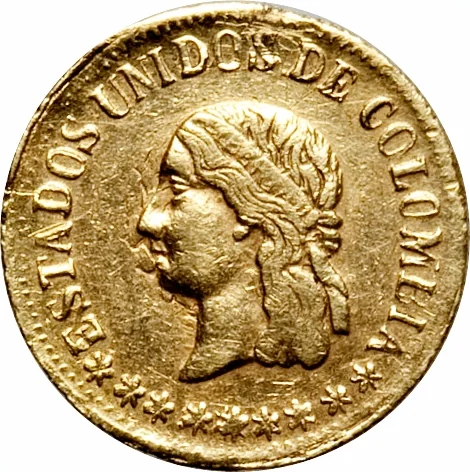
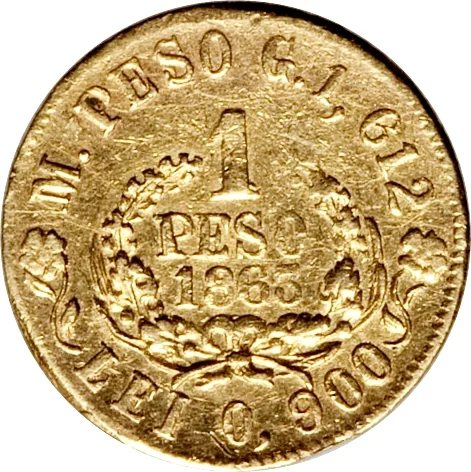
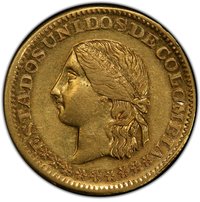
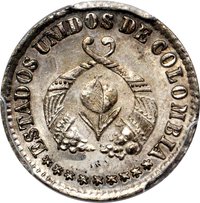
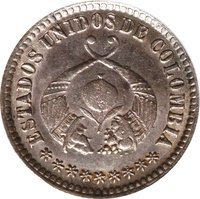
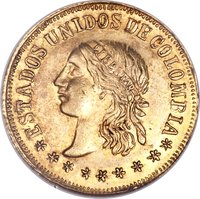
Obverse
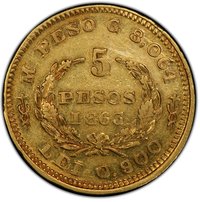
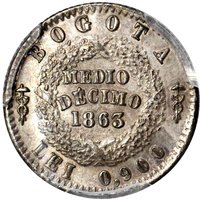
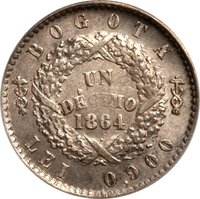
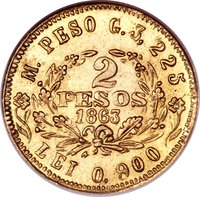
Reverse
Description:
Denomination and year inside wreath; mint letter, weight, and fineness outside.
Inscription:
M. PESO G.1,612
1
PESO
1863
LEI 0,900
1
PESO
1863
LEI 0,900
Script: Latin
Edge
Mints
| Name | Mark |
|---|---|
| Casa de Moneda de Colombia | — |
Mintings
| Year | Mint Mark | Mintage | Quality | Collection |
|---|---|---|---|---|
| 1863 | — | 11,000 |
Historical background
Between 1863 and 1886, Colombia existed as the United States of Colombia, a decentralized federal republic where each of the nine sovereign states held significant economic power, including the right to issue their own currency. This period, known as the "Radical Olympus," was defined by liberal ideals and a deliberate weakening of the central government in Bogotá. Consequently, there was no single, unified national currency, leading to a complex and often chaotic monetary landscape.
The currency situation was characterized by a proliferation of diverse banknotes and coins issued by individual state banks, private banks, and even some commercial entities. States like Antioquia, Cundinamarca, and Cauca circulated their own pesos, which often had differing values and limited acceptance outside their borders. This fragmentation severely hampered domestic trade and created confusion, as merchants and citizens had to constantly negotiate exchange rates and assess the credibility of numerous note issuers, some of which were unstable.
Furthermore, the era was plagued by chronic fiscal instability. The federal government, deprived of robust taxation powers, resorted to printing its own paper money to finance budgets, leading to episodes of inflation and devaluation. Simultaneously, the global price of silver—the metal backing many coins—declined sharply in the 1870s, exacerbating monetary disorder. This unstable system of competing currencies and weak fiscal control ultimately contributed to the economic crises and political tensions that led to the dissolution of the federation in 1886 and the re-establishment of a centralized republic.
The currency situation was characterized by a proliferation of diverse banknotes and coins issued by individual state banks, private banks, and even some commercial entities. States like Antioquia, Cundinamarca, and Cauca circulated their own pesos, which often had differing values and limited acceptance outside their borders. This fragmentation severely hampered domestic trade and created confusion, as merchants and citizens had to constantly negotiate exchange rates and assess the credibility of numerous note issuers, some of which were unstable.
Furthermore, the era was plagued by chronic fiscal instability. The federal government, deprived of robust taxation powers, resorted to printing its own paper money to finance budgets, leading to episodes of inflation and devaluation. Simultaneously, the global price of silver—the metal backing many coins—declined sharply in the 1870s, exacerbating monetary disorder. This unstable system of competing currencies and weak fiscal control ultimately contributed to the economic crises and political tensions that led to the dissolution of the federation in 1886 and the re-establishment of a centralized republic.
Series: 1863 Colombia circulation coins
✨ Legendary