

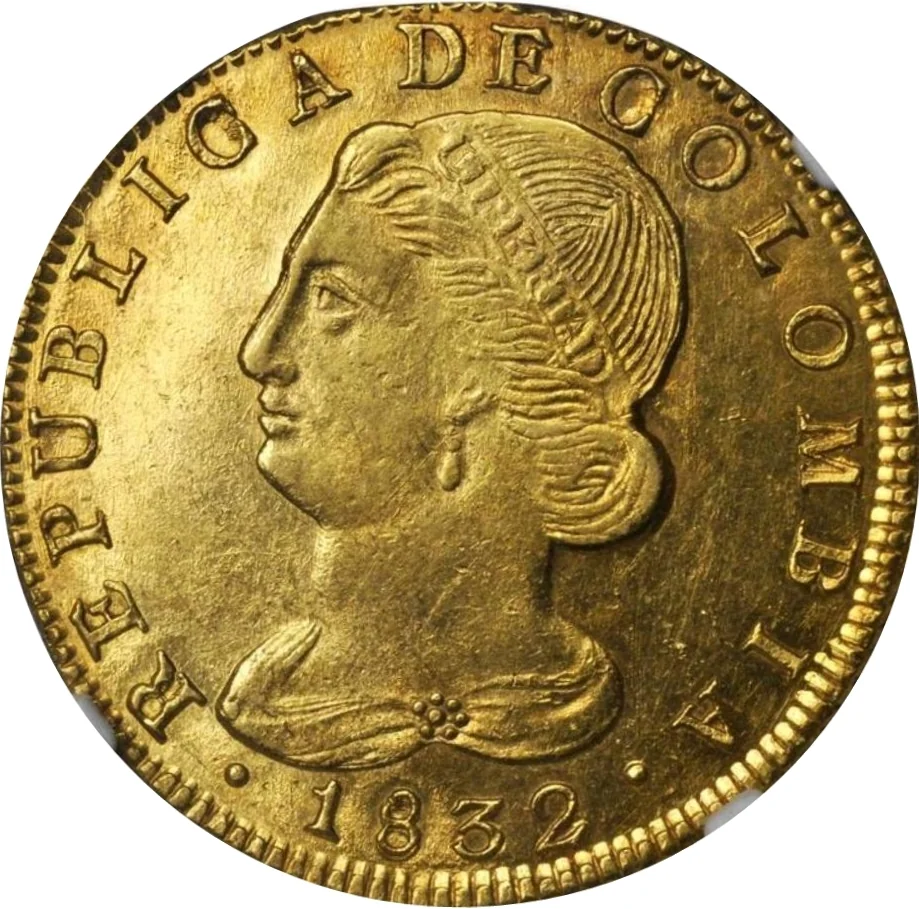
Obverse
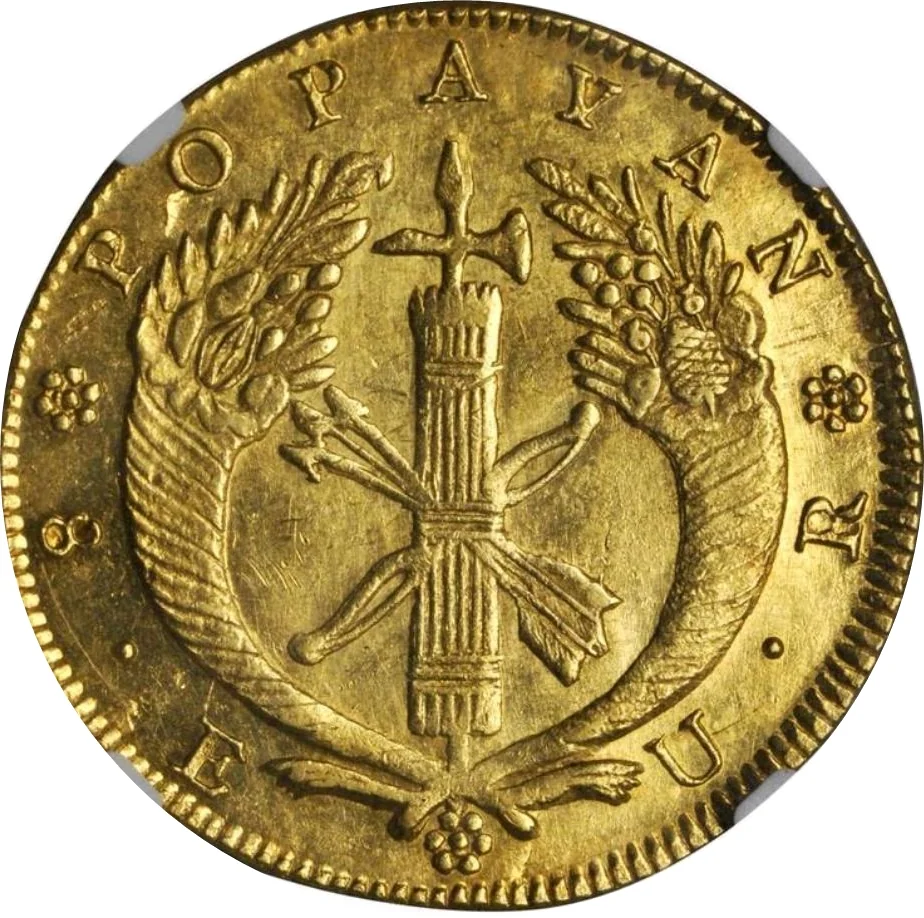
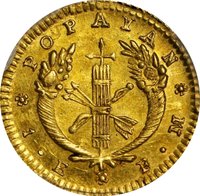
Reverse
Description:
Fasces between cornucopias, crossed by a bow and arrow.
Inscription:
POPAYAN
8 · E U · R
8 · E U · R
Script: Latin
Edge
Oblique stripes
Mints
| Name | Mark |
|---|---|
| Bogota Mint | Bogota |
| Casa de Moneda de Colombia | Popaya |
Mintings
| Year | Mint Mark | Mintage | Quality | Collection |
|---|---|---|---|---|
| 1822 | FM | — | ||
| 1822 | JF | — | ||
| 1823 | FM | — | ||
| 1823 | JF | — | ||
| 1824 | FM | — | ||
| 1824 | JF | — | ||
| 1825 | FM | — | ||
| 1825 | JF | — | ||
| 1826 | FM | — | ||
| 1826 | JF | — | ||
| 1827 | JF | — | ||
| 1827 | RR | — | ||
| 1827 | UR | — | ||
| 1827 | FM | — | ||
| 1828 | RS | — | ||
| 1828 | UR | — | ||
| 1828 | RR | — | ||
| 1829 | FM | — | ||
| 1829 | RS | — | ||
| 1829 | UR | — | ||
| 1830 | FM | — | ||
| 1830 | FW | — | ||
| 1830 | RS | — | ||
| 1830 | UR | — | ||
| 1831 | UR | — | ||
| 1831 | RS | — | ||
| 1832 | RS | — | ||
| 1832 | UR | — | ||
| 1833 | RS | — | ||
| 1833 | UR | — | ||
| 1834 | RS | — | ||
| 1834 | UR | — | ||
| 1835 | RS | — | ||
| 1835 | UR | — | ||
| 1836 | RS | — | ||
| 1836 | UR | — | ||
| 1838 | UR | — |
Historical background
In 1822, Colombia existed as the fledgling Republic of Gran Colombia, a vast nation forged by Simón Bolívar that encompassed present-day Colombia, Venezuela, Ecuador, and Panama. The currency situation was one of profound disorder and transition, a direct legacy of the recently concluded wars for independence from Spain (1810-1824). The colonial monetary system had collapsed, leaving in circulation a chaotic mix of coins: old Spanish colonial reales, coins minted by various patriot governments during the war, and foreign currencies like British sovereigns and pesos from other Latin American nations. This patchwork lacked uniformity in weight and fineness, crippling commerce and state finances.
Recognizing that a stable currency was essential for national sovereignty and economic recovery, the Gran Colombian government took decisive action in 1822. It formally adopted the peso as the national unit of account, divided into 8 reales, and initiated plans for a centralized mint. Most importantly, that same year, Congress authorized a major foreign loan, known as the "English Loan," for £2 million. A significant portion of this capital was specifically earmarked for the purchase of minting machinery and bullion to produce a new, unified national coinage, aiming to displace the chaotic mix of circulating mediums.
Thus, 1822 stands as a pivotal year of foundation rather than resolution. The immediate reality remained one of monetary confusion, which hampered trade and tax collection. However, the legal and financial groundwork was laid. The laws passed and the foreign credit secured set in motion the creation of an official Gran Colombian currency, a critical step in Bolívar's project of transforming a war-torn region into a functional, modern republic. The tangible results—the first consistent coins bearing the republic’s insignia—would begin to emerge from the newly equipped Bogotá mint in the years immediately following.
Recognizing that a stable currency was essential for national sovereignty and economic recovery, the Gran Colombian government took decisive action in 1822. It formally adopted the peso as the national unit of account, divided into 8 reales, and initiated plans for a centralized mint. Most importantly, that same year, Congress authorized a major foreign loan, known as the "English Loan," for £2 million. A significant portion of this capital was specifically earmarked for the purchase of minting machinery and bullion to produce a new, unified national coinage, aiming to displace the chaotic mix of circulating mediums.
Thus, 1822 stands as a pivotal year of foundation rather than resolution. The immediate reality remained one of monetary confusion, which hampered trade and tax collection. However, the legal and financial groundwork was laid. The laws passed and the foreign credit secured set in motion the creation of an official Gran Colombian currency, a critical step in Bolívar's project of transforming a war-torn region into a functional, modern republic. The tangible results—the first consistent coins bearing the republic’s insignia—would begin to emerge from the newly equipped Bogotá mint in the years immediately following.
💎 Extremely Rare