

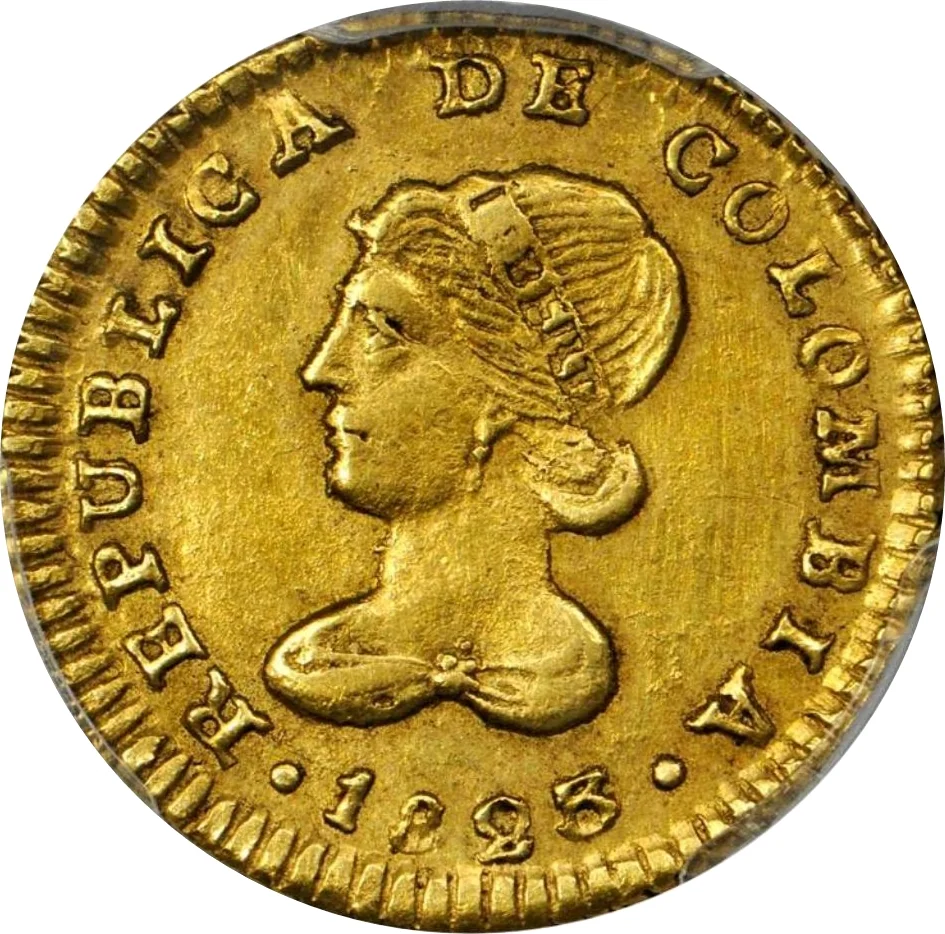
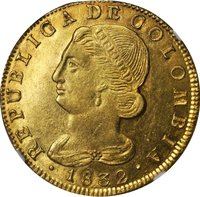
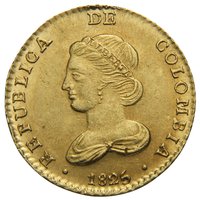
Obverse
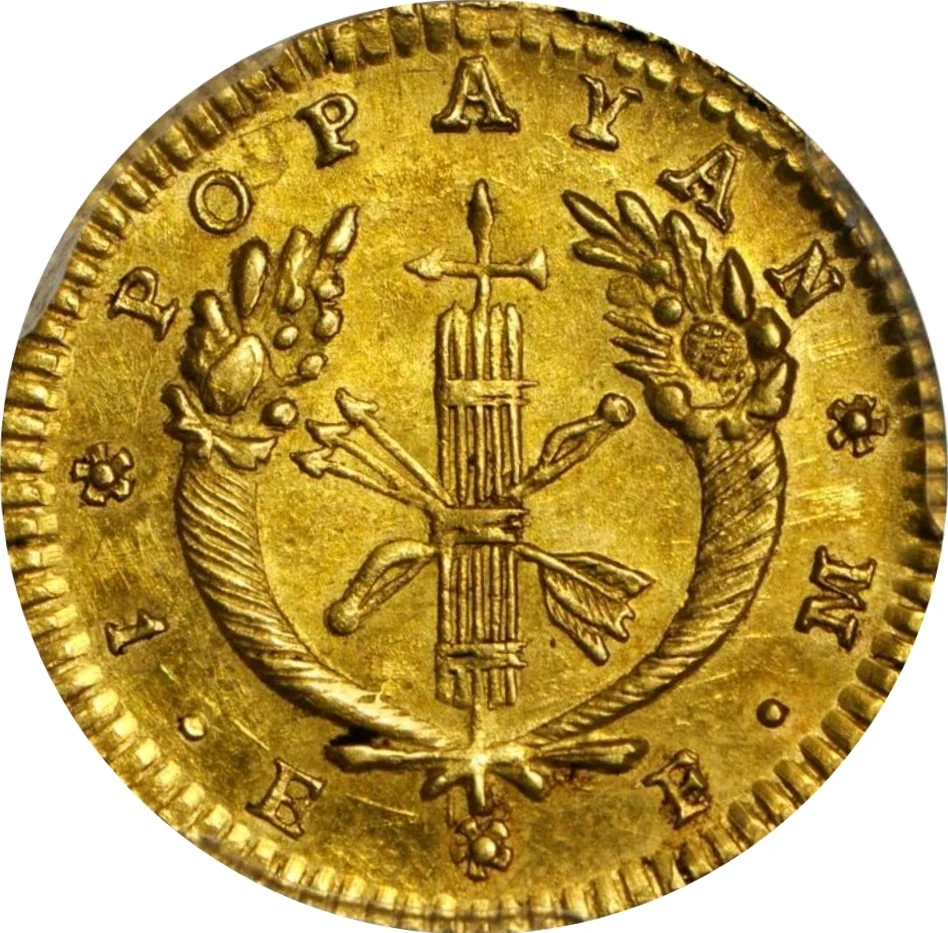
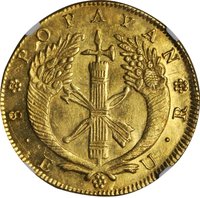
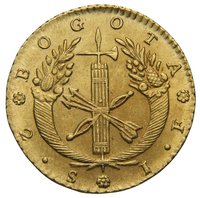
Reverse
Description:
Fasces between cornucopias, crossed by a bow and arrow.
Inscription:
POPAYAN
1 • E * F • M
1 • E * F • M
Script: Latin
Edge
Mints
| Name | Mark |
|---|---|
| Bogota Mint | Bogota |
| Casa de Moneda de Colombia | Popayan |
Mintings
| Year | Mint Mark | Mintage | Quality | Collection |
|---|---|---|---|---|
| 1823 | FM | — | ||
| 1823 | JF | — | ||
| 1824 | FM | — | ||
| 1825 | FM | — | ||
| 1825 | JF | — | ||
| 1826 | FM | — | ||
| 1827 | FM | — | ||
| 1827 | RU | — | ||
| 1828 | RU | — | ||
| 1829 | RU | — | ||
| 1830 | RU | — | ||
| 1831 | RU | — | ||
| 1832 | RU | — | ||
| 1833 | RU | — | ||
| 1834 | RU | — | ||
| 1836 | RU | — |
Historical background
In 1823, Colombia was a nascent republic, known as Gran Colombia, struggling to establish its economic foundations after the protracted and devastating War of Independence against Spain. The conflict had left the treasury depleted, infrastructure in ruins, and the old colonial monetary system fractured. The new government, under President Simón Bolívar, faced the urgent task of creating a unified national currency to replace the chaotic mix of Spanish coins, crude locally minted "macuquinas," and foreign specie that circulated, which hindered commerce and symbolized the lack of centralized authority.
The cornerstone of the monetary reform was the law of May 31, 1823, which officially created the Colombian peso. This new decimal-based currency was divided into 10 reales (a deliberate break from the Spanish 8-real system) and was pegged to the silver standard. The government authorized the minting of high-quality, machine-struck coins in denominations of 1, 2, 8, and 16 reales in silver, and 1 peso in gold, featuring the republican coat of arms. This was a bold statement of sovereignty, aimed at driving out worn Spanish coinage and instilling confidence in the new state's institutions.
However, the ambitious 1823 reforms immediately encountered severe practical challenges. The Bogotá mint lacked sufficient precious metal bullion and modern machinery, leading to chronic production shortages. Consequently, the old Spanish coins, particularly the widely trusted "peso fuerte," remained the dominant medium of exchange in practice. The gap between the formal monetary law and the reality in circulation underscored the profound difficulties of post-war state-building, where political will was often thwarted by economic scarcity and logistical limitations, setting the stage for ongoing monetary instability throughout the 1820s.
The cornerstone of the monetary reform was the law of May 31, 1823, which officially created the Colombian peso. This new decimal-based currency was divided into 10 reales (a deliberate break from the Spanish 8-real system) and was pegged to the silver standard. The government authorized the minting of high-quality, machine-struck coins in denominations of 1, 2, 8, and 16 reales in silver, and 1 peso in gold, featuring the republican coat of arms. This was a bold statement of sovereignty, aimed at driving out worn Spanish coinage and instilling confidence in the new state's institutions.
However, the ambitious 1823 reforms immediately encountered severe practical challenges. The Bogotá mint lacked sufficient precious metal bullion and modern machinery, leading to chronic production shortages. Consequently, the old Spanish coins, particularly the widely trusted "peso fuerte," remained the dominant medium of exchange in practice. The gap between the formal monetary law and the reality in circulation underscored the profound difficulties of post-war state-building, where political will was often thwarted by economic scarcity and logistical limitations, setting the stage for ongoing monetary instability throughout the 1820s.
💎 Extremely Rare