

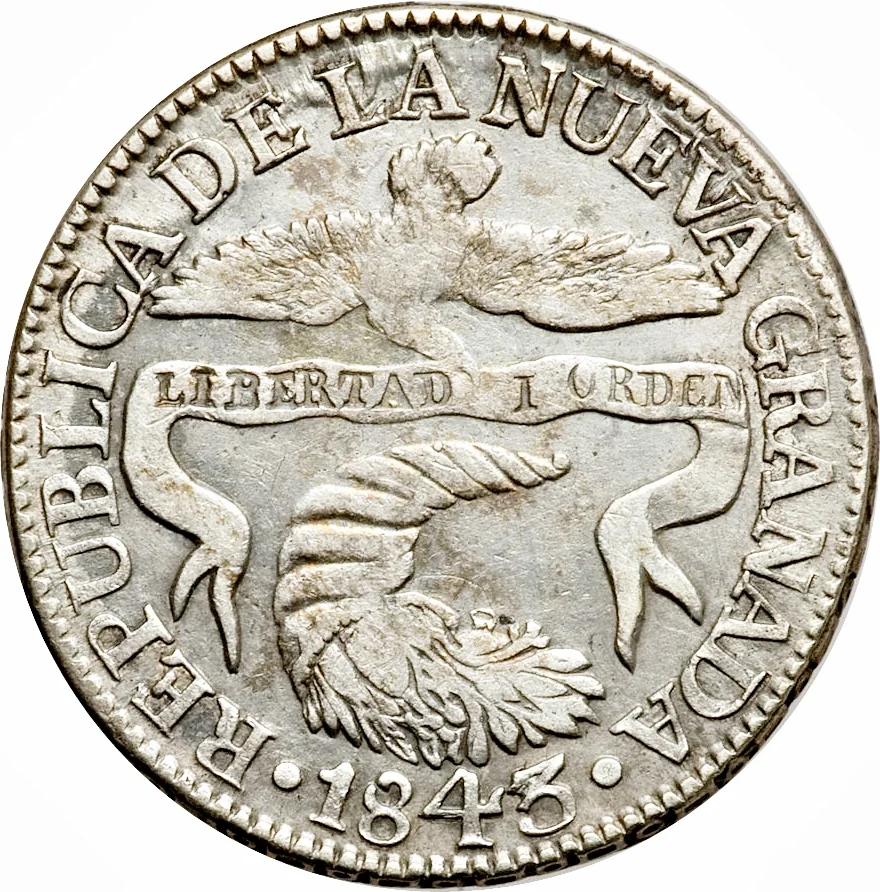

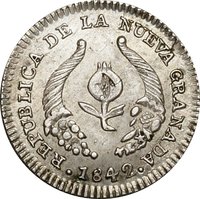
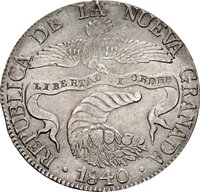
Obverse
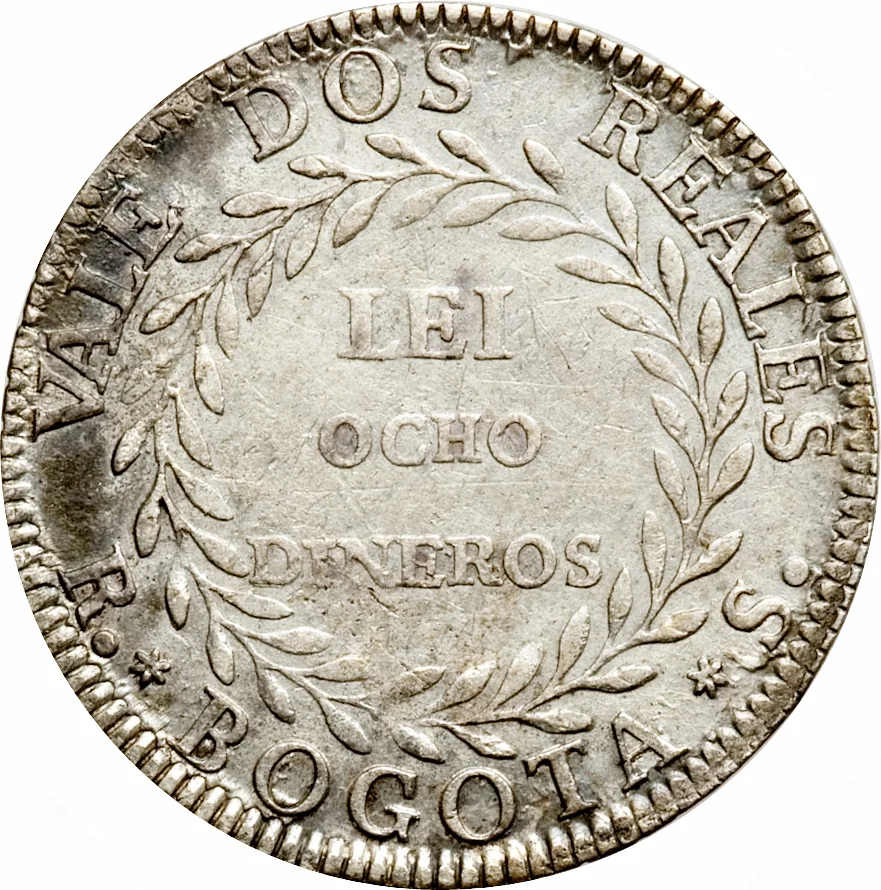
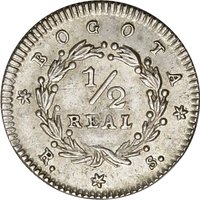
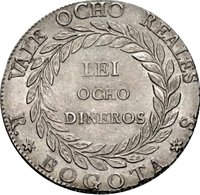
Reverse
Description:
Wreath denomination
Inscription:
VALE DOS REALES
LEI
OCHO
DINEROS
R. BOGOTA S.
LEI
OCHO
DINEROS
R. BOGOTA S.
Script: Latin
Edge
Categories
| Animal> Bird |
| Symbol> Cornucopia |
Mints
| Name | Mark |
|---|---|
| Bogota Mint | — |
| Casa de Moneda de Colombia | — |
Mintings
| Year | Mint Mark | Mintage | Quality | Collection |
|---|---|---|---|---|
| 1839 | RS | — | ||
| 1840 | RS | — | ||
| 1840 | RU | — | ||
| 1841 | RS | — | ||
| 1841 | VU | — | ||
| 1842 | UM | — | ||
| 1842 | VU | — | ||
| 1843 | UM | — | ||
| 1843 | RS | — | ||
| 1844 | RS | — | ||
| 1844 | UM | — | ||
| 1845 | RS | — | ||
| 1846 | UM | — | ||
| 1846 | RS | — | ||
| 1849 | UM | — |
Historical background
In 1839, Colombia was navigating a complex and unstable currency landscape, a direct legacy of the post-independence era and the recent dissolution of Gran Colombia in 1831. The newly independent Republic of New Granada (as Colombia was then known) inherited a chaotic monetary system with a severe shortage of specie (gold and silver coin). This scarcity was exacerbated by years of war, economic disruption, and the outflow of precious metals. Consequently, the economy relied heavily on a patchwork of foreign coins, primarily Spanish, English, and French, which circulated at varying and often arbitrary rates set by local merchants and officials, leading to widespread confusion and commercial friction.
The government attempted to impose order by establishing a national mint and defining a new monetary unit, the real, based on a bimetallic standard (gold and silver). However, the official coinage struggled to enter general circulation in sufficient quantities. A more pressing and destabilizing factor was the proliferation of paper money, or billetes, issued not by a central bank (which did not exist) but by private banks and even regional governmental bodies. This paper was often poorly backed, leading to significant fluctuations in value and a deep public distrust in anything other than metallic currency.
This monetary disarray was not merely an economic issue but a central political fault line. The Conservative government, favoring hard money and fiscal orthodoxy, viewed the unregulated paper issues with alarm, associating them with debt and instability. This stance clashed with the needs of merchants and regional interests who required more flexible mediums of exchange for commerce. The currency question thus became entangled in the rising tensions between centralists and federalists, and between Conservative and Liberal ideologies, contributing to the political unrest that would erupt into the War of the Supremes (1839-1841), a conflict where control over fiscal and monetary policy was a key point of contention.
The government attempted to impose order by establishing a national mint and defining a new monetary unit, the real, based on a bimetallic standard (gold and silver). However, the official coinage struggled to enter general circulation in sufficient quantities. A more pressing and destabilizing factor was the proliferation of paper money, or billetes, issued not by a central bank (which did not exist) but by private banks and even regional governmental bodies. This paper was often poorly backed, leading to significant fluctuations in value and a deep public distrust in anything other than metallic currency.
This monetary disarray was not merely an economic issue but a central political fault line. The Conservative government, favoring hard money and fiscal orthodoxy, viewed the unregulated paper issues with alarm, associating them with debt and instability. This stance clashed with the needs of merchants and regional interests who required more flexible mediums of exchange for commerce. The currency question thus became entangled in the rising tensions between centralists and federalists, and between Conservative and Liberal ideologies, contributing to the political unrest that would erupt into the War of the Supremes (1839-1841), a conflict where control over fiscal and monetary policy was a key point of contention.
💎 Very Rare