

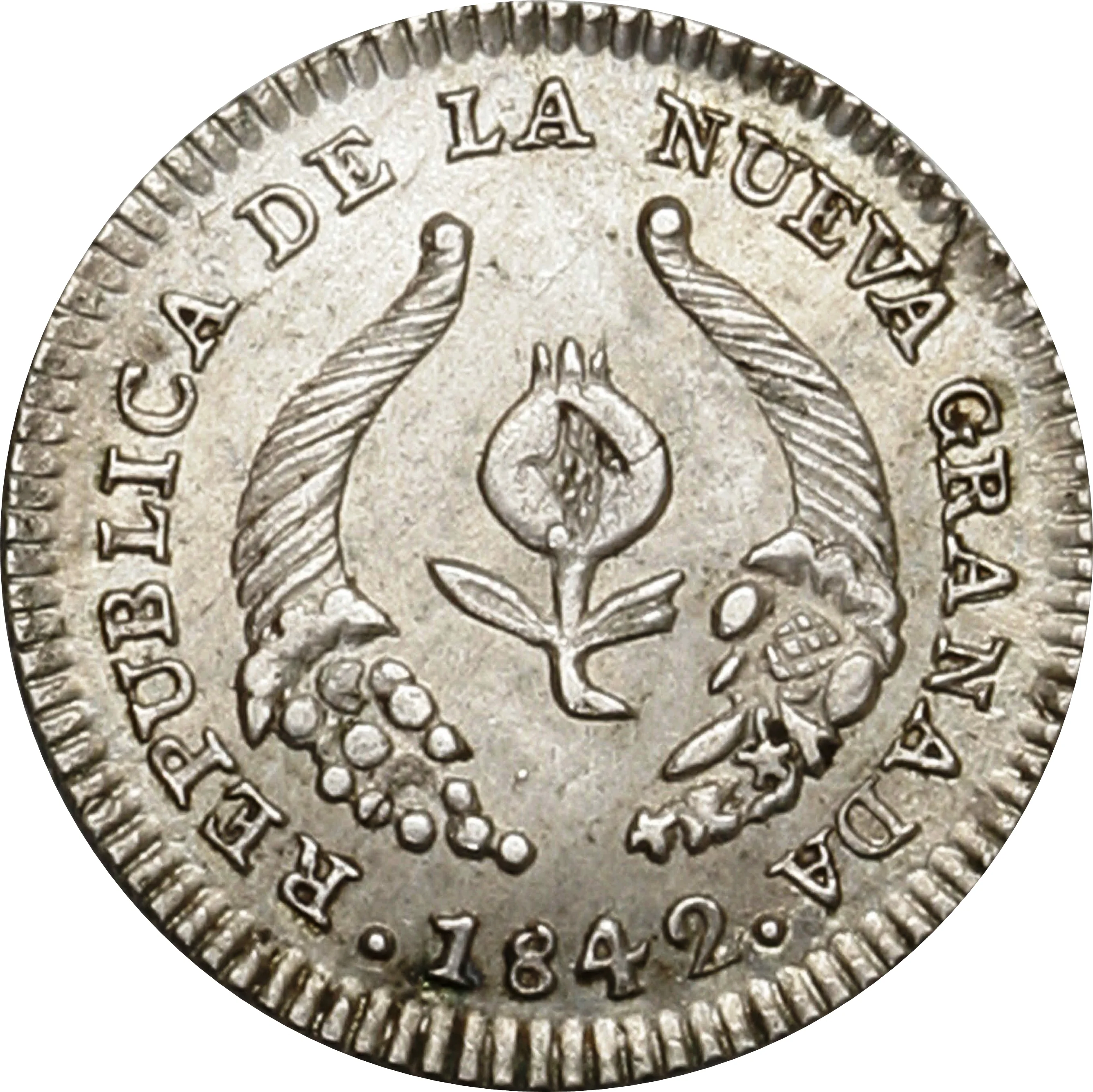

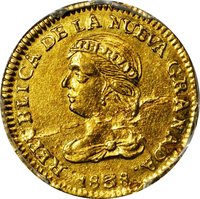
Obverse
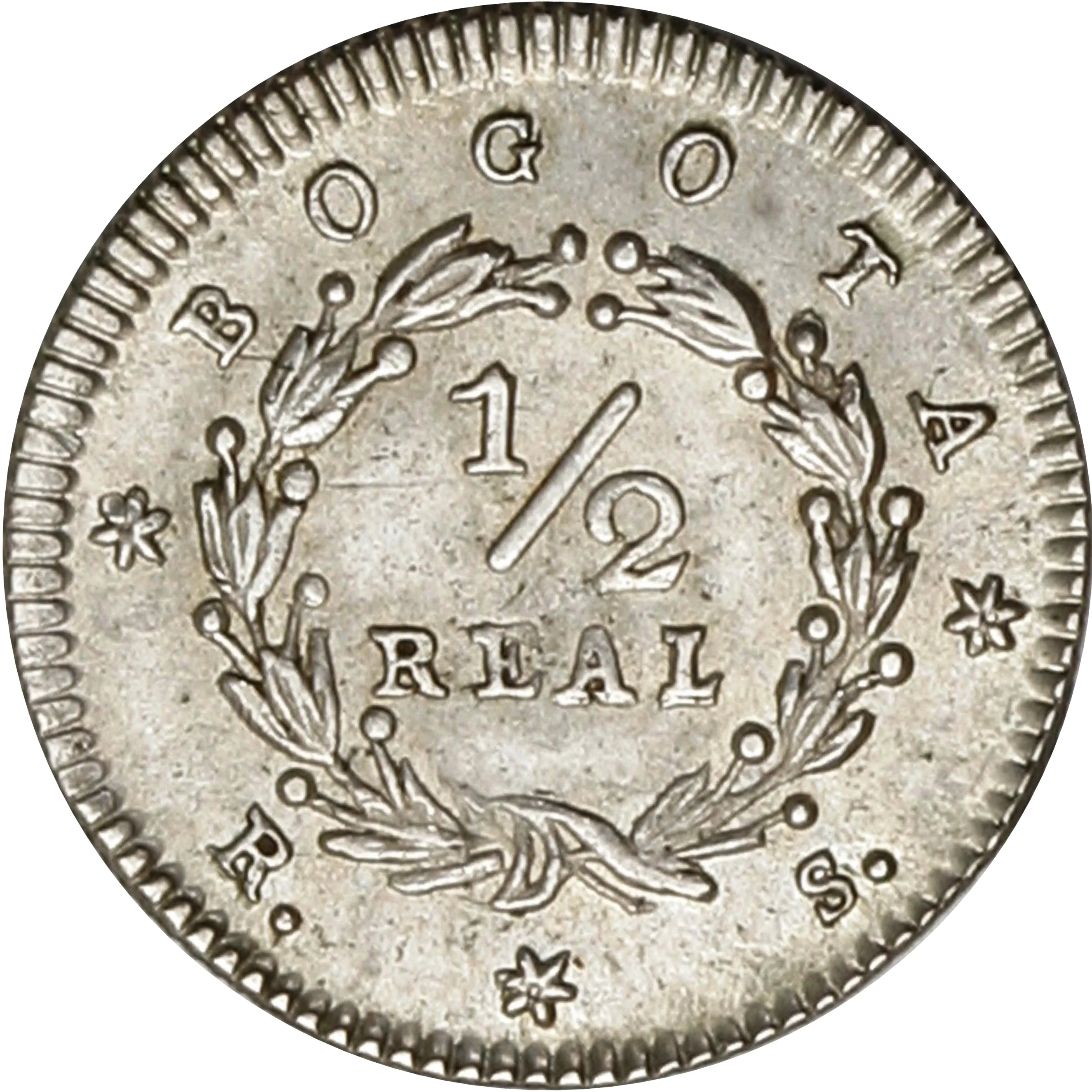
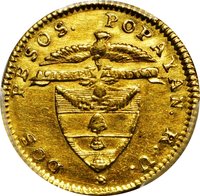
Reverse
Edge
Reeded
Mints
| Name | Mark |
|---|---|
| Bogota Mint | — |
| Casa de Moneda de Colombia | — |
Mintings
| Year | Mint Mark | Mintage | Quality | Collection |
|---|---|---|---|---|
| 1838 | RS | — | ||
| 1838 | RU | — | ||
| 1839 | RS | — | ||
| 1839 | RU | — | ||
| 1840 | RS | — | ||
| 1840 | RU | — | ||
| 1841 | RU | — | ||
| 1841 | VU | — | ||
| 1842 | UM | — | ||
| 1842 | RS | — | ||
| 1843 | RS | — | ||
| 1843 | UM | — | ||
| 1844 | UM | — | ||
| 1844 | RS | — | ||
| 1844 | UE | — | ||
| 1845 | RS | — | ||
| 1845 | UE | — | ||
| 1846 | RS | — | ||
| 1846 | UE | — | ||
| 1846 | UM | — | ||
| 1847 | RS | — | ||
| 1848 | UE | — |
Historical background
In 1838, Colombia was navigating a complex and unstable currency landscape as a young republic. The nation, then known as the Republic of New Granada following the dissolution of Gran Colombia in 1831, inherited a monetary system in disarray. The economy relied on a chaotic mix of coins: Spanish colonial reales, debased republican coinage, and a significant circulation of foreign coins, particularly from Britain, France, and the United States. The lack of a unified, trusted national currency severely hampered commerce and state finances, creating a environment where the intrinsic metal value of a coin was often more important than its face value.
The government attempted to impose order through the Monetary Law of 1836, which was in its early implementation stages by 1838. This law aimed to decimalize the currency, formally establishing the real as the base unit, with the goal of introducing a new national coinage. However, the transition was fraught with difficulty. Public distrust in paper money was absolute following hyperinflation under the previous regime, and the state's limited capacity to mint sufficient quantities of new, high-quality coinage meant the old heterogeneous mix remained in daily use. This period was characterized by a severe shortage of small-denomination coins, causing practical hardships for everyday transactions.
Consequently, the monetary situation in 1838 was one of transition and frustration. While legislative frameworks for a modern system were on the books, the tangible reality for merchants and citizens was a fragmented and inefficient system. The scarcity of sound coinage stifled economic activity and limited the central government's fiscal authority, reflecting the broader challenges of building stable institutions in the post-independence era. The success of the 1836 reforms remained uncertain, as the nation grappled with the practical task of replacing a deeply entrenched colonial monetary legacy.
The government attempted to impose order through the Monetary Law of 1836, which was in its early implementation stages by 1838. This law aimed to decimalize the currency, formally establishing the real as the base unit, with the goal of introducing a new national coinage. However, the transition was fraught with difficulty. Public distrust in paper money was absolute following hyperinflation under the previous regime, and the state's limited capacity to mint sufficient quantities of new, high-quality coinage meant the old heterogeneous mix remained in daily use. This period was characterized by a severe shortage of small-denomination coins, causing practical hardships for everyday transactions.
Consequently, the monetary situation in 1838 was one of transition and frustration. While legislative frameworks for a modern system were on the books, the tangible reality for merchants and citizens was a fragmented and inefficient system. The scarcity of sound coinage stifled economic activity and limited the central government's fiscal authority, reflecting the broader challenges of building stable institutions in the post-independence era. The success of the 1836 reforms remained uncertain, as the nation grappled with the practical task of replacing a deeply entrenched colonial monetary legacy.
⭐ Rare