

40000 Pesetas – Spain
Spain
Context
Year: 2000
Issuer: Spain 
Ruler: Juan Carlos I
Currency:
(1868—2001)
Demonetization: 28 February 2002
Total mintage: 5,000
Material
References
Numista: #150031
Value
Exchange value: 40000 ESP
Bullion value: $2254.20
Inflation-adjusted value: 72488.80 ESP
Obverse
Description:
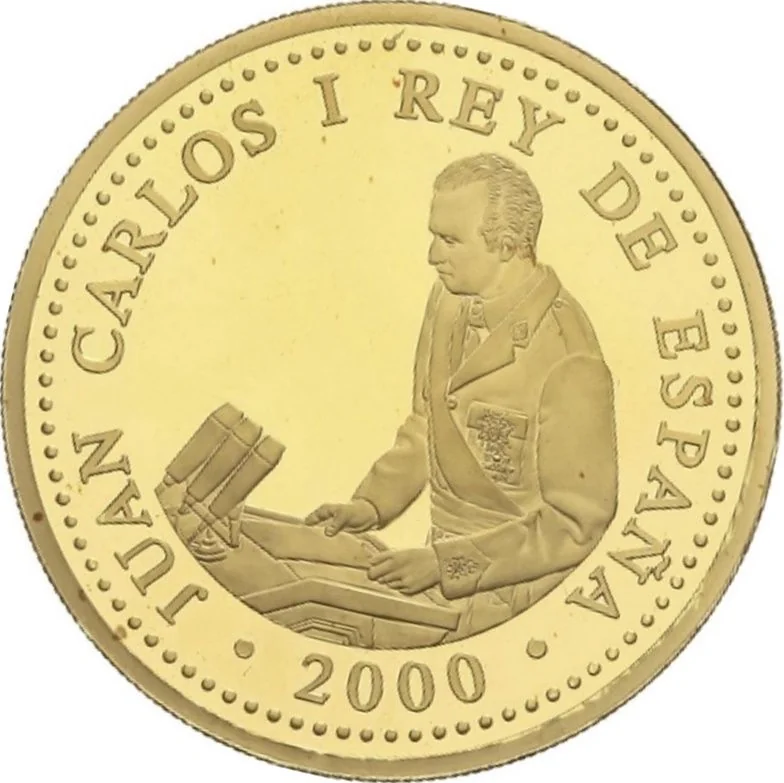
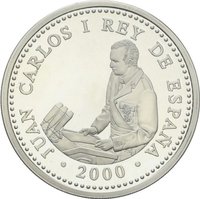
King Juan Carlos I reading his proclamation speech.
Inscription:
JUAN CARLOS I REY DE ESPAÑA
· 2000 ·
· 2000 ·
Translation:
Juan Carlos I King of Spain
· 2000 ·
· 2000 ·
Script: Latin
Language: Spanish
Engraver: Alfonso Morales Muñoz
Reverse
Description:
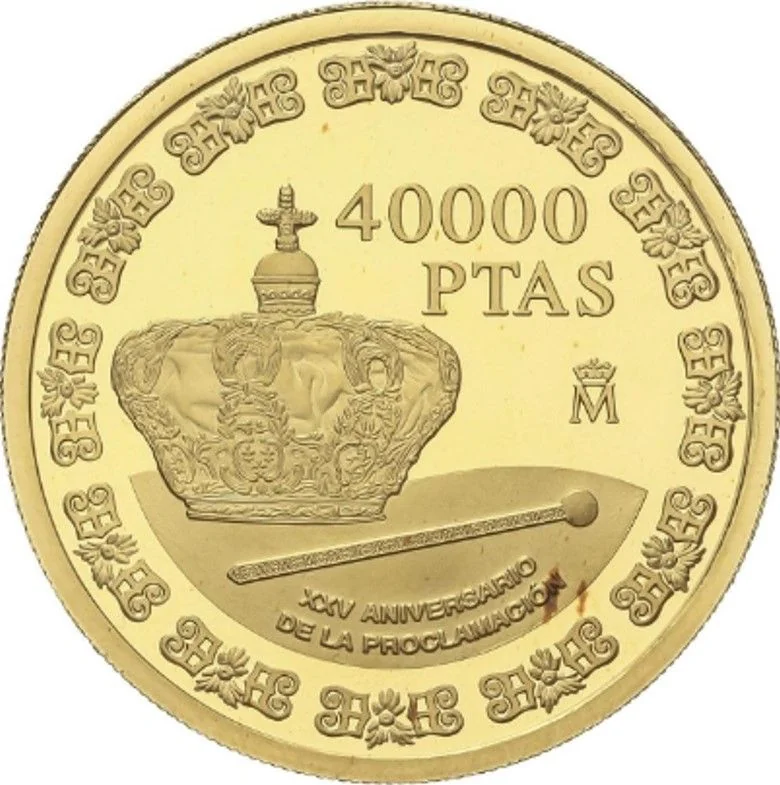
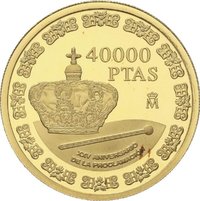
Royal Crown and Sceptre on a table.
Inscription:
40000 PTAS
M
XXV ANIVERSARIO DE LA PROCLAMACIÓN
M
XXV ANIVERSARIO DE LA PROCLAMACIÓN
Translation:
40000 Pesetas
M
25th Anniversary of the Proclamation
M
25th Anniversary of the Proclamation
Script: Latin
Language: Spanish
Engraver: Alfonso Morales Muñoz
Edge
Reeded
Mints
| Name | Mark |
|---|---|
| Royal Mint of Madrid | (M) |
Mintings
| Year | Mint Mark | Mintage | Quality | Collection |
|---|---|---|---|---|
| 2000 | M | 5,000 | Proof |
Historical background
In the year 2000, Spain was in a period of significant economic transition, operating under the framework of the European Exchange Rate Mechanism (ERM II) as it prepared for full adoption of the euro. The national currency, the peseta, was still in physical circulation, but its exchange rate was irrevocably fixed against other Eurozone currencies. On January 1, 1999, the conversion rate had been permanently set at 166.386 pesetas to one euro, making the peseta essentially a non-decimal subdivision of the new single currency during this three-year transitional phase.
This period was characterized by a dual-display economy, where prices were legally required to be shown in both pesetas and euros to familiarize the public with the new currency and ensure transparency. While electronic payments and banking could be conducted in euros, cash transactions remained exclusively in pesetas until the physical changeover scheduled for January 1, 2002. The Spanish government and financial institutions were deeply engaged in a massive logistical operation, producing billions of euro notes and coins while simultaneously withdrawing the old currency, all aimed at ensuring a smooth transition.
Economically, Spain benefited from the stability provided by the fixed exchange rate and the low-interest-rate environment set by the European Central Bank, which helped fuel domestic demand and economic growth. However, this also meant that Spain had fully ceded control of its monetary policy to the European Central Bank, a fundamental shift in economic sovereignty. The year 2000 thus represented the calm before the physical storm of the cash changeover, a final chapter for the historic peseta as Spain stood on the brink of fully integrating into the European Monetary Union.
This period was characterized by a dual-display economy, where prices were legally required to be shown in both pesetas and euros to familiarize the public with the new currency and ensure transparency. While electronic payments and banking could be conducted in euros, cash transactions remained exclusively in pesetas until the physical changeover scheduled for January 1, 2002. The Spanish government and financial institutions were deeply engaged in a massive logistical operation, producing billions of euro notes and coins while simultaneously withdrawing the old currency, all aimed at ensuring a smooth transition.
Economically, Spain benefited from the stability provided by the fixed exchange rate and the low-interest-rate environment set by the European Central Bank, which helped fuel domestic demand and economic growth. However, this also meant that Spain had fully ceded control of its monetary policy to the European Central Bank, a fundamental shift in economic sovereignty. The year 2000 thus represented the calm before the physical storm of the cash changeover, a final chapter for the historic peseta as Spain stood on the brink of fully integrating into the European Monetary Union.
✨ Legendary