

20 reales vellon – Spain
Add to wishlist
Spain
Context
Material
References
KM: #
Numista: #103184
Value
Bullion value: $60.85
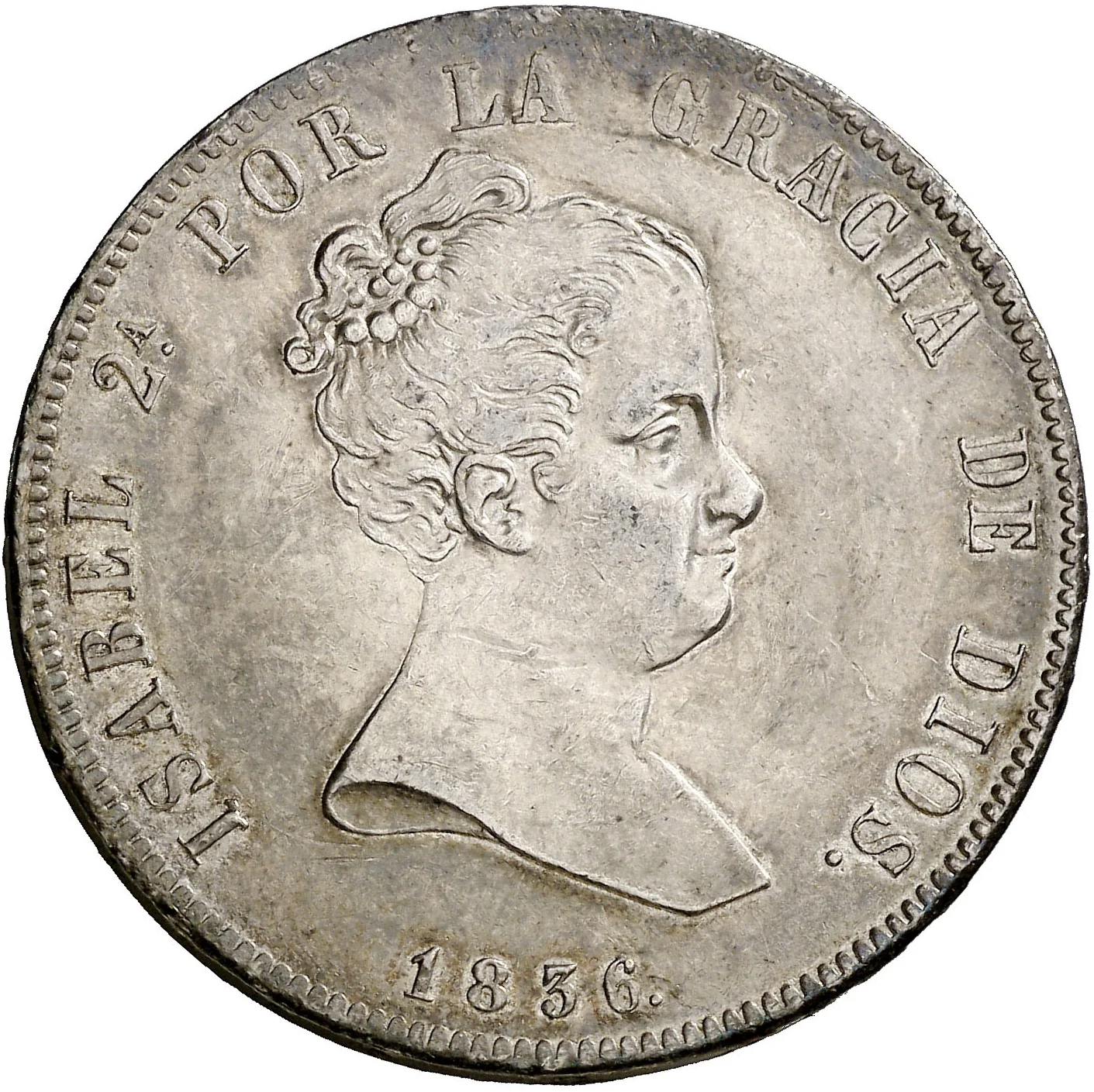
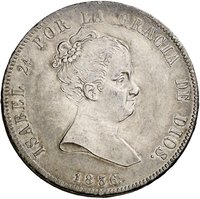
Obverse
Description:
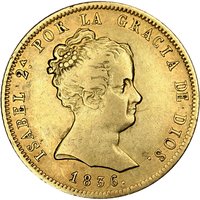
Queen Isabella II facing right.
Inscription:
ISABEL 2A. POR LA GRACIA DE DIOS.
1836.
1836.
Translation:
ISABELLA 2ND. BY THE GRACE OF GOD.
1836.
1836.
Script: Latin
Language: Spanish
Engraver: Mariano González de Sepúlveda Salazar
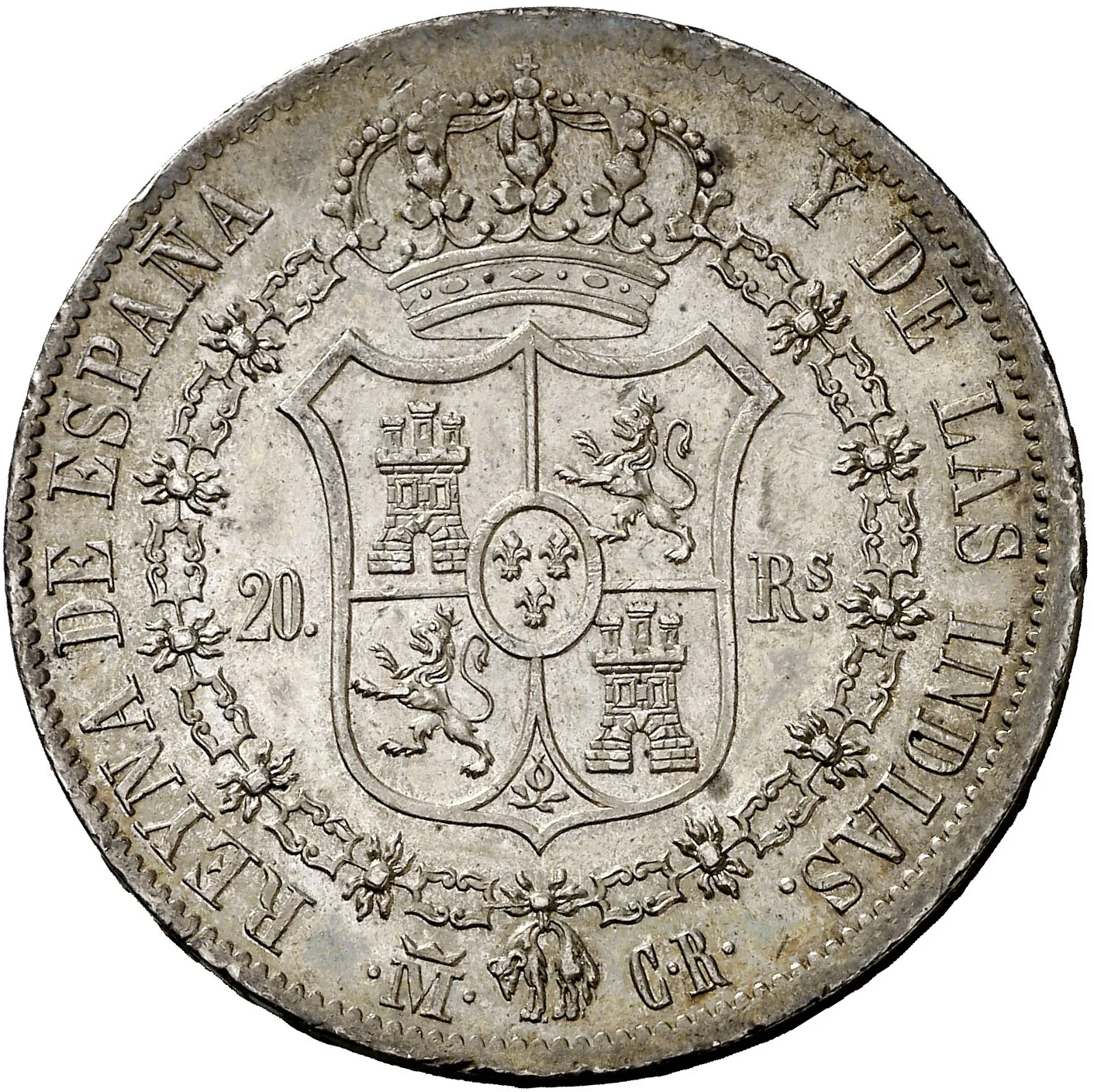
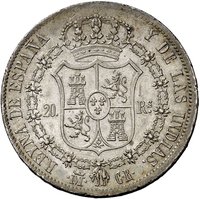
Reverse
Description:
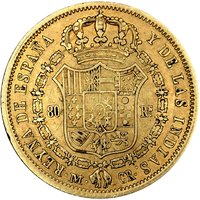
Crowned Spanish coat of arms with the Golden Fleece.
Inscription:
REYNA DE ESPAÑA Y DE LAS INDIAS.
20. RS.
· M · C·R·
20. RS.
· M · C·R·
Translation:
Queen of Spain and of the Indies.
20 Reales.
M C R
20 Reales.
M C R
Script: Latin
Language: Spanish
Engraver: Mariano González de Sepúlveda Salazar
Edge
Categories
| Symbols> Coat of Arms |
Mints
| Name | Mark |
|---|---|
| Royal Mint of Madrid | (M) |
Mintings
| Year | Mint Mark | Mintage | Quality | Collection |
|---|---|---|---|---|
| 1834 | DG | — | ||
| 1834 | NC | — | ||
| 1835 | CR | — | ||
| 1836 | CR | — |
Historical background
In 1834, Spain was in a period of profound political and economic transition following the death of King Ferdinand VII in 1833, which had triggered the First Carlist War. The currency system reflected this instability, being a complex and fragmented inheritance from the Old Regime. The official unit of account was the real, but in practice, a multitude of different coins circulated simultaneously, including older Spanish issues like the silver peso and gold escudo, alongside a significant quantity of foreign coins, particularly French francs and British sovereigns, which were often preferred for their reliable metallic content. This monetary chaos hindered commerce and state finance, as the value of coins depended on their weight, fineness, and origin rather than a stable, unified standard.
The liberal government of Queen Isabella II's regency, led by ministers like Juan Álvarez Mendizábal, recognized that monetary reform was essential for modernizing the economy and funding the war effort against the Carlists. However, 1834 itself was a year of preparatory crisis rather than decisive change. The state's finances were dire, with debt payments suspended and revenue scarce, leading to a reliance on expedients like confiscating and selling church lands (desamortización). While plans for a unified national currency were being debated, the immediate reality was one of inflationary pressure, coin shortages in some regions, and a lack of public confidence in the paper money (vales reales) that had been issued in prior decades and had drastically depreciated.
Therefore, the currency situation in 1834 was characterized by a disjointed and unreliable metallic circulation awaiting systemic reform. This groundwork would eventually lead to the pivotal decree of October 19, 1848, which established the modern Spanish monetary system based on the escudo and, later, the peseta. But in 1834, Spain remained monetarily fractured, its coinage a physical symbol of the struggle between an old, decaying order and a new, centralized nation-state yet to be fully realized amidst civil war.
The liberal government of Queen Isabella II's regency, led by ministers like Juan Álvarez Mendizábal, recognized that monetary reform was essential for modernizing the economy and funding the war effort against the Carlists. However, 1834 itself was a year of preparatory crisis rather than decisive change. The state's finances were dire, with debt payments suspended and revenue scarce, leading to a reliance on expedients like confiscating and selling church lands (desamortización). While plans for a unified national currency were being debated, the immediate reality was one of inflationary pressure, coin shortages in some regions, and a lack of public confidence in the paper money (vales reales) that had been issued in prior decades and had drastically depreciated.
Therefore, the currency situation in 1834 was characterized by a disjointed and unreliable metallic circulation awaiting systemic reform. This groundwork would eventually lead to the pivotal decree of October 19, 1848, which established the modern Spanish monetary system based on the escudo and, later, the peseta. But in 1834, Spain remained monetarily fractured, its coinage a physical symbol of the struggle between an old, decaying order and a new, centralized nation-state yet to be fully realized amidst civil war.
Series: 1834 Spain circulation coins
✨ Legendary