

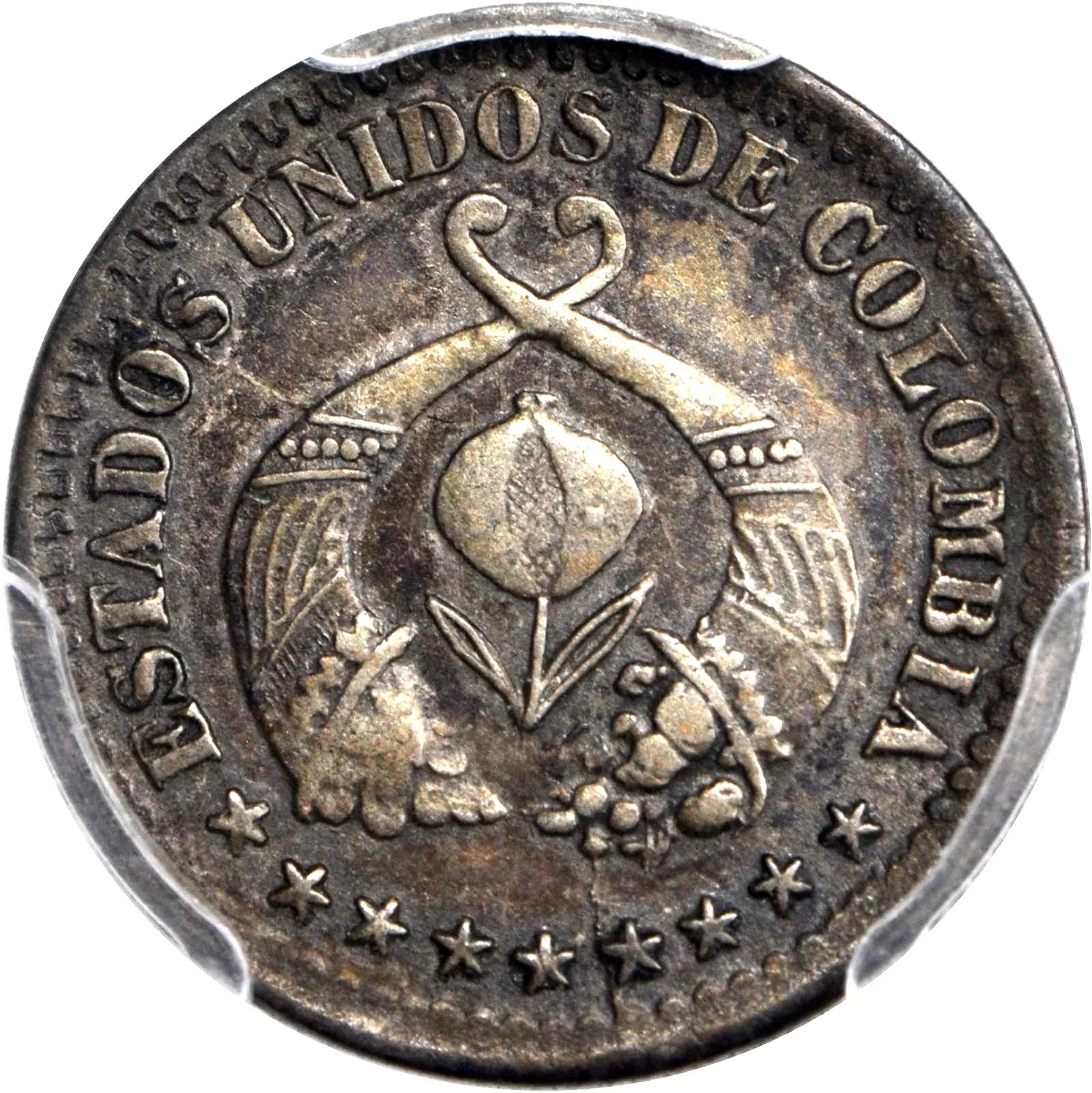
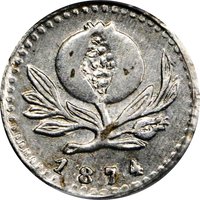
Obverse
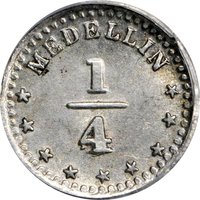
Reverse
Description:
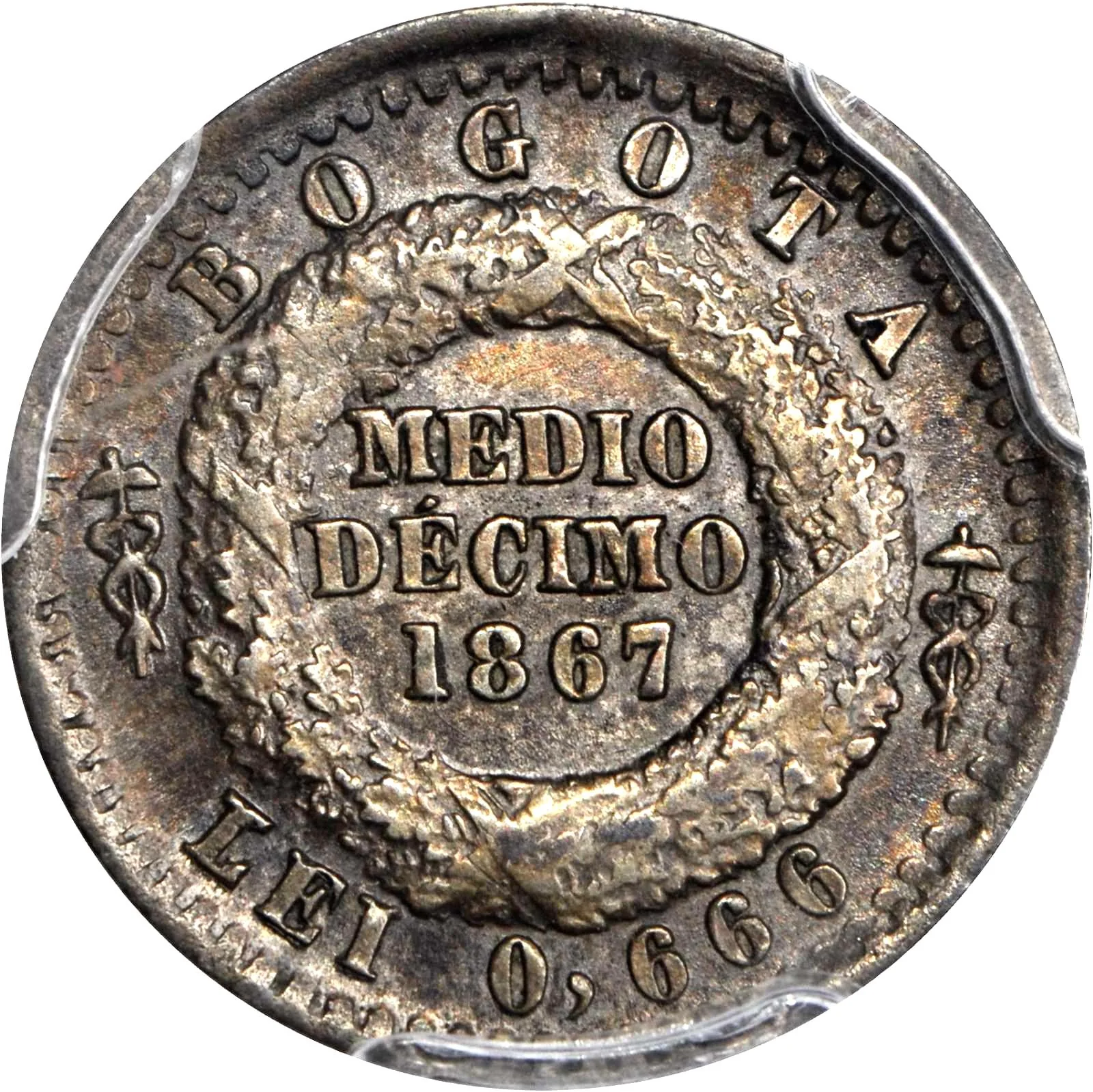
Top mint, centre wreath with date and denomination, flanked by caducei, bottom fineness.
Inscription:
BOGOTA
MEDIO
DECIMO
1867
LEI 0,666
MEDIO
DECIMO
1867
LEI 0,666
Script: Latin
Edge
Mints
| Name | Mark |
|---|---|
| Bogota Mint | — |
Mintings
| Year | Mint Mark | Mintage | Quality | Collection |
|---|---|---|---|---|
| 1867 | — | 363,000 |
Historical background
In 1867, Colombia existed as the United States of Colombia, a federal republic established under the 1863 constitution of Rionegro. This political framework was one of the most radically decentralized in Latin American history, granting immense sovereignty to its nine constituent states. This decentralization directly dictated the currency situation, as the federal government had relinquished its exclusive power to mint coinage. Consequently, multiple states operated their own mints, leading to a proliferation of heterogeneous gold and silver coins of varying weights, fineness, and designs circulating simultaneously across the national territory.
The monetary landscape was therefore characterized by significant complexity and inconsistency. While the peso was the official unit of account, the coins in daily use included Colombian condor gold coins, silver pesos from the Bogotá, Medellín, or Popayán mints, and even a substantial volume of foreign coinage, particularly from Peru, Bolivia, and France. This lack of uniformity created chronic problems for commerce, as merchants and banks had to constantly assess and discount coins based on their perceived intrinsic metal value and origin, hindering efficient trade and economic integration between the states.
This chaotic system was widely recognized as a major obstacle to national economic development. The period was marked by ongoing debates between centralists, who advocated for a unified national currency under federal control, and federalists, who defended the states' monetary prerogatives. The situation in 1867 thus represents a critical point in a prolonged monetary struggle that would not be resolved until the constitutional reversal of 1886, which recentralized the nation and paved the way for the eventual creation of a single, national currency under the Bank of the Republic in the 20th century.
The monetary landscape was therefore characterized by significant complexity and inconsistency. While the peso was the official unit of account, the coins in daily use included Colombian condor gold coins, silver pesos from the Bogotá, Medellín, or Popayán mints, and even a substantial volume of foreign coinage, particularly from Peru, Bolivia, and France. This lack of uniformity created chronic problems for commerce, as merchants and banks had to constantly assess and discount coins based on their perceived intrinsic metal value and origin, hindering efficient trade and economic integration between the states.
This chaotic system was widely recognized as a major obstacle to national economic development. The period was marked by ongoing debates between centralists, who advocated for a unified national currency under federal control, and federalists, who defended the states' monetary prerogatives. The situation in 1867 thus represents a critical point in a prolonged monetary struggle that would not be resolved until the constitutional reversal of 1886, which recentralized the nation and paved the way for the eventual creation of a single, national currency under the Bank of the Republic in the 20th century.
✨ Legendary