

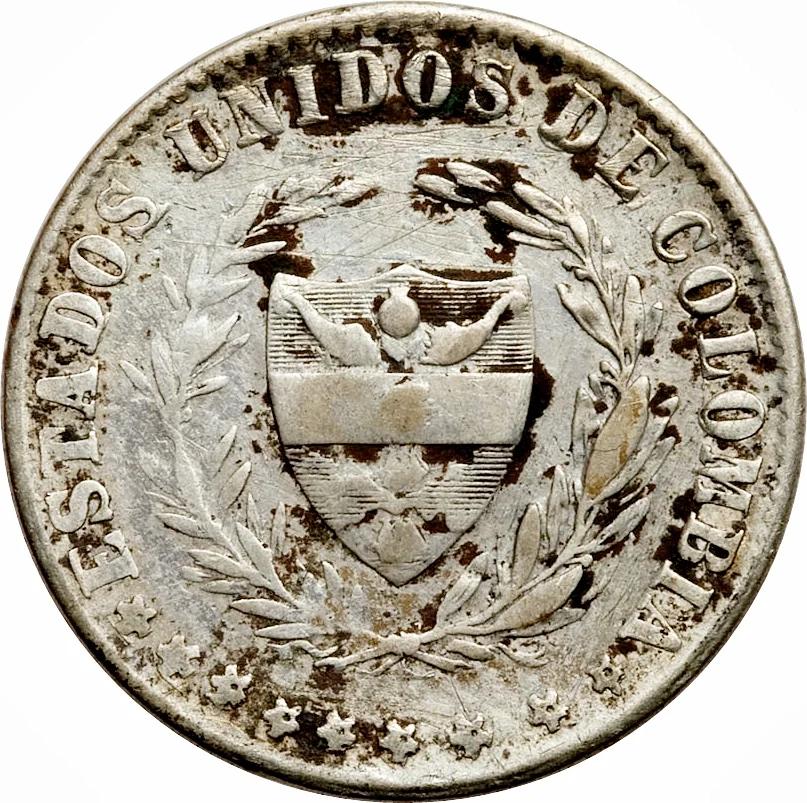
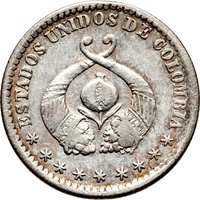
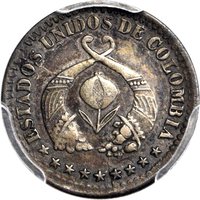
Obverse
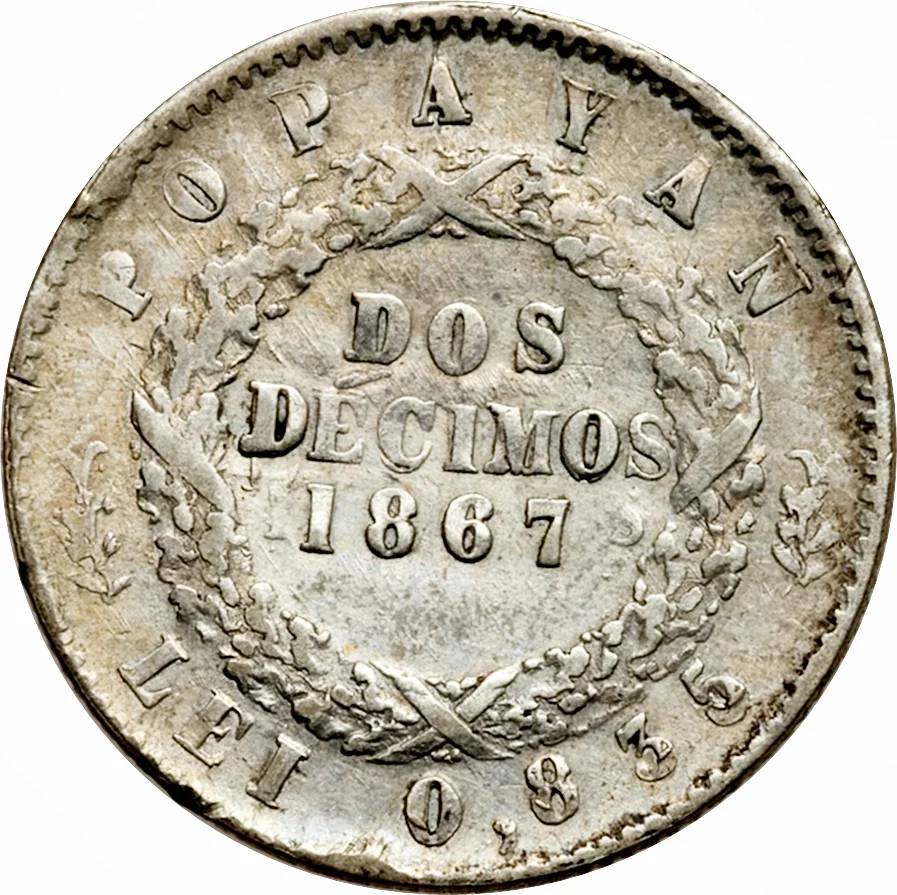
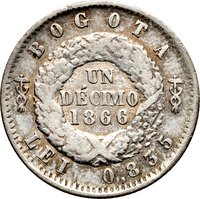
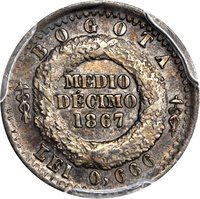
Reverse
Description:
Denomination and year in wreath, mint above, fineness below.
Inscription:
POPAYAN
DOS
DECIMOS
1867
LEI 0,835
DOS
DECIMOS
1867
LEI 0,835
Script: Latin
Edge
Mints
| Name | Mark |
|---|---|
| Bogota Mint | BOGOTA |
| Casa de Moneda de Colombia | POPAYAN |
Mintings
| Year | Mint Mark | Mintage | Quality | Collection |
|---|---|---|---|---|
| 1866 | — | — | ||
| 1867 | — | — |
Historical background
In 1866, Colombia was navigating the complex monetary landscape of the post-independence "Republic of New Granada," a period marked by political instability and fiscal fragmentation. The country lacked a unified national currency, leading to a chaotic circulation of diverse coins. These included remnants of Spanish colonial reales, coins from other Latin American nations, and even counterfeits, all valued by their intrinsic metal content (primarily silver and gold). This system was cumbersome and hindered domestic trade and economic integration, as the value of money could vary significantly between regions.
The government attempted to impose order by decreeing a decimal-based national currency, the peso, divided into 10 reales or 100 décimos, and by authorizing the minting of new gold and silver coins at the Bogotá mint. However, these official issues were insufficient to drive out the plethora of foreign and obsolete coins in circulation. The fundamental problem was a chronic shortage of state-issued specie, exacerbated by limited precious metal production and the government's weak authority, which prevented it from enforcing a monopoly on coinage.
Consequently, the monetary situation in 1866 was one of de facto bimetallism with a strong reliance on imported coin. Transactions often required weighing and assaying coins rather than simply counting them at face value. This environment created significant uncertainty for commerce and public finance, highlighting the urgent need for a stronger central banking authority and a more robust, exclusive national currency—a goal that would remain elusive for decades amid ongoing civil wars and political upheaval.
The government attempted to impose order by decreeing a decimal-based national currency, the peso, divided into 10 reales or 100 décimos, and by authorizing the minting of new gold and silver coins at the Bogotá mint. However, these official issues were insufficient to drive out the plethora of foreign and obsolete coins in circulation. The fundamental problem was a chronic shortage of state-issued specie, exacerbated by limited precious metal production and the government's weak authority, which prevented it from enforcing a monopoly on coinage.
Consequently, the monetary situation in 1866 was one of de facto bimetallism with a strong reliance on imported coin. Transactions often required weighing and assaying coins rather than simply counting them at face value. This environment created significant uncertainty for commerce and public finance, highlighting the urgent need for a stronger central banking authority and a more robust, exclusive national currency—a goal that would remain elusive for decades amid ongoing civil wars and political upheaval.
⭐ Rare