

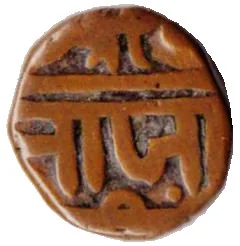
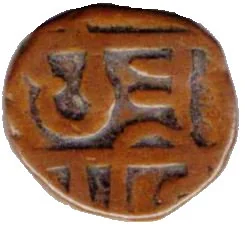
1 Paisa – Maratha Empire
India
Context
Years: 1820–1830
Country: India 
Issuer: Maratha Empire
Issuing organization: Bhonsla Rajas
Currency:
(1674—1818)
Demonetized: Yes
Material
Diameter: 20 mm
Weight: 11 g
Thickness: 4 mm
Shape: Irregular round
Composition: Copper
Magnetic: No
References
KM: #Click to copy to clipboard72
Numista: #48138
Obverse
Reverse
Edge
Plain
Mintings
| Year | Mint Mark | Mintage | Quality | Collection |
|---|---|---|---|---|
| 1830 | — | — | ||
| — | — | — | ||
| 1820 | — | — | ||
| 1821 | — | — | ||
| 1822 | — | — | ||
| 1823 | — | — | ||
| 1824 | — | — | ||
| 1825 | — | — | ||
| 1827 | — | — | ||
| 1828 | — | — |
Historical background
By 1820, the currency situation within the Maratha Confederacy was one of profound fragmentation and decline, reflecting the empire's diminished political power. Following their decisive defeat in the Third Anglo-Maratha War (1817-1818), the Peshwa's direct authority was abolished, and the Maratha heartland was annexed into the British Bombay Presidency. The remaining Maratha rulers of states like Indore, Gwalior, Nagpur, and Jhansi were reduced to subsidiary allies under British paramountcy, losing their right to independent foreign policy and facing severe financial constraints, including heavy tributes and the maintenance of British-led troops.
This political subjugation directly disrupted the unified monetary system that had once existed under strong Peshwas. While the British introduced their own standardized rupee (the Bombay rupee) and copper coinage in annexed territories, the surviving Maratha states continued to mint their own local currencies. These issues, however, were often of inconsistent weight and purity, as the princely states struggled with depleted treasuries. The landscape became a complex patchwork where British rupees, older Maratha hons and rupees, and a variety of local feudal and personal issues circulated simultaneously, causing confusion in trade and exchange.
Consequently, the period was marked by a slow but inexorable shift towards British monetary hegemony. The East India Company, actively reforming its own currency systems, sought to establish its rupees as the dominant standard for revenue collection and commerce. While the old Maratha coinage remained in circulation, particularly in rural areas, its economic importance waned. The currency situation of 1820 thus encapsulates the transition from Maratha sovereignty to colonial integration, with monetary fragmentation symbolizing the broader disintegration of the Confederacy and the steady imposition of British economic order across central India.
This political subjugation directly disrupted the unified monetary system that had once existed under strong Peshwas. While the British introduced their own standardized rupee (the Bombay rupee) and copper coinage in annexed territories, the surviving Maratha states continued to mint their own local currencies. These issues, however, were often of inconsistent weight and purity, as the princely states struggled with depleted treasuries. The landscape became a complex patchwork where British rupees, older Maratha hons and rupees, and a variety of local feudal and personal issues circulated simultaneously, causing confusion in trade and exchange.
Consequently, the period was marked by a slow but inexorable shift towards British monetary hegemony. The East India Company, actively reforming its own currency systems, sought to establish its rupees as the dominant standard for revenue collection and commerce. While the old Maratha coinage remained in circulation, particularly in rural areas, its economic importance waned. The currency situation of 1820 thus encapsulates the transition from Maratha sovereignty to colonial integration, with monetary fragmentation symbolizing the broader disintegration of the Confederacy and the steady imposition of British economic order across central India.
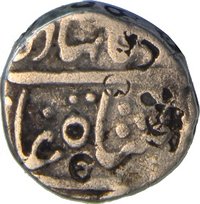
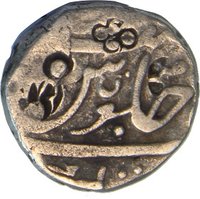

⭐ Somewhat Rare