

2 euro (Finland-Sweden Athletics International) – Finland
Add to wishlist
Non-circulating coins
Commemoration: Finland-Sweden Athletics International 100 years
Finland
Obverse
Description:
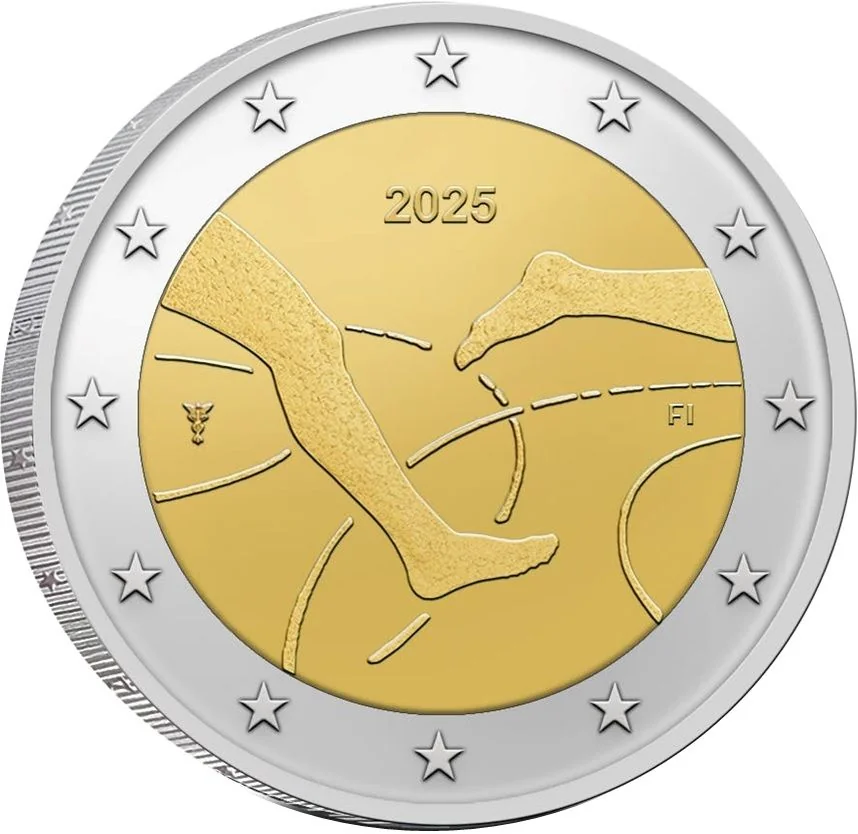
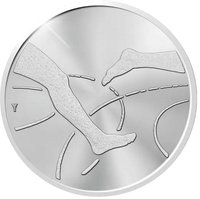
Two legs in motion against dynamic lines represent the competing nations of Finland and Sweden.
Inscription:
2025
FI
FI
Script: Latin
Designer: Pertti Mäkinen
Reverse
Mints
| Name | Mark |
|---|---|
| Royal Dutch Mint | — |
Mintings
| Year | Mint Mark | Mintage | Quality | Collection |
|---|---|---|---|---|
| 2025 | FI | 75,000 | ||
| 2025 | FI | 125,000 | BU | |
| 2025 | FI | 5,000 | Proof |
Historical background
In 2025, Finland remains a committed and integral member of the Eurozone, with the euro (€) as its sole legal tender. The country's monetary policy is set by the European Central Bank (ECB), with Finland's economic stability deeply intertwined with the broader Eurozone's performance. Domestically, the digitalization of payments continues at a world-leading pace, with cash use declining to niche levels. The Finnish financial ecosystem is characterized by nearly universal adoption of mobile and card payments, even for minor transactions, a trend solidified by the pandemic years and sustained by a highly tech-savvy population and robust digital infrastructure.
The primary economic focus regarding currency is not on adoption of a new one, but on navigating the challenges of the common currency within a changing global landscape. Key issues include managing the impact of ECB interest rate decisions on Finland's economic growth, high public debt, and an aging demographic. Furthermore, the geopolitical tensions following the 2022 Russian invasion of Ukraine continue to influence economic policy, with Finland's NATO membership reshaping trade and energy security considerations, indirectly affecting the euro's stability and Finland's position within it.
There is no significant political movement or public debate advocating for a return to the Finnish markka. The national discussion instead centers on leveraging the euro's stability to foster competitiveness in green technology and digital exports. Concurrently, Finland is actively participating in the EU's exploration of a digital euro, viewing it as a potential evolution of the existing currency system rather than a replacement. The currency situation in 2025 is thus one of consolidated euro integration, with Finland focusing on fiscal adaptability and innovation within the single currency framework to address its unique economic challenges.
The primary economic focus regarding currency is not on adoption of a new one, but on navigating the challenges of the common currency within a changing global landscape. Key issues include managing the impact of ECB interest rate decisions on Finland's economic growth, high public debt, and an aging demographic. Furthermore, the geopolitical tensions following the 2022 Russian invasion of Ukraine continue to influence economic policy, with Finland's NATO membership reshaping trade and energy security considerations, indirectly affecting the euro's stability and Finland's position within it.
There is no significant political movement or public debate advocating for a return to the Finnish markka. The national discussion instead centers on leveraging the euro's stability to foster competitiveness in green technology and digital exports. Concurrently, Finland is actively participating in the EU's exploration of a digital euro, viewing it as a potential evolution of the existing currency system rather than a replacement. The currency situation in 2025 is thus one of consolidated euro integration, with Finland focusing on fiscal adaptability and innovation within the single currency framework to address its unique economic challenges.
🌟 Uncommon