

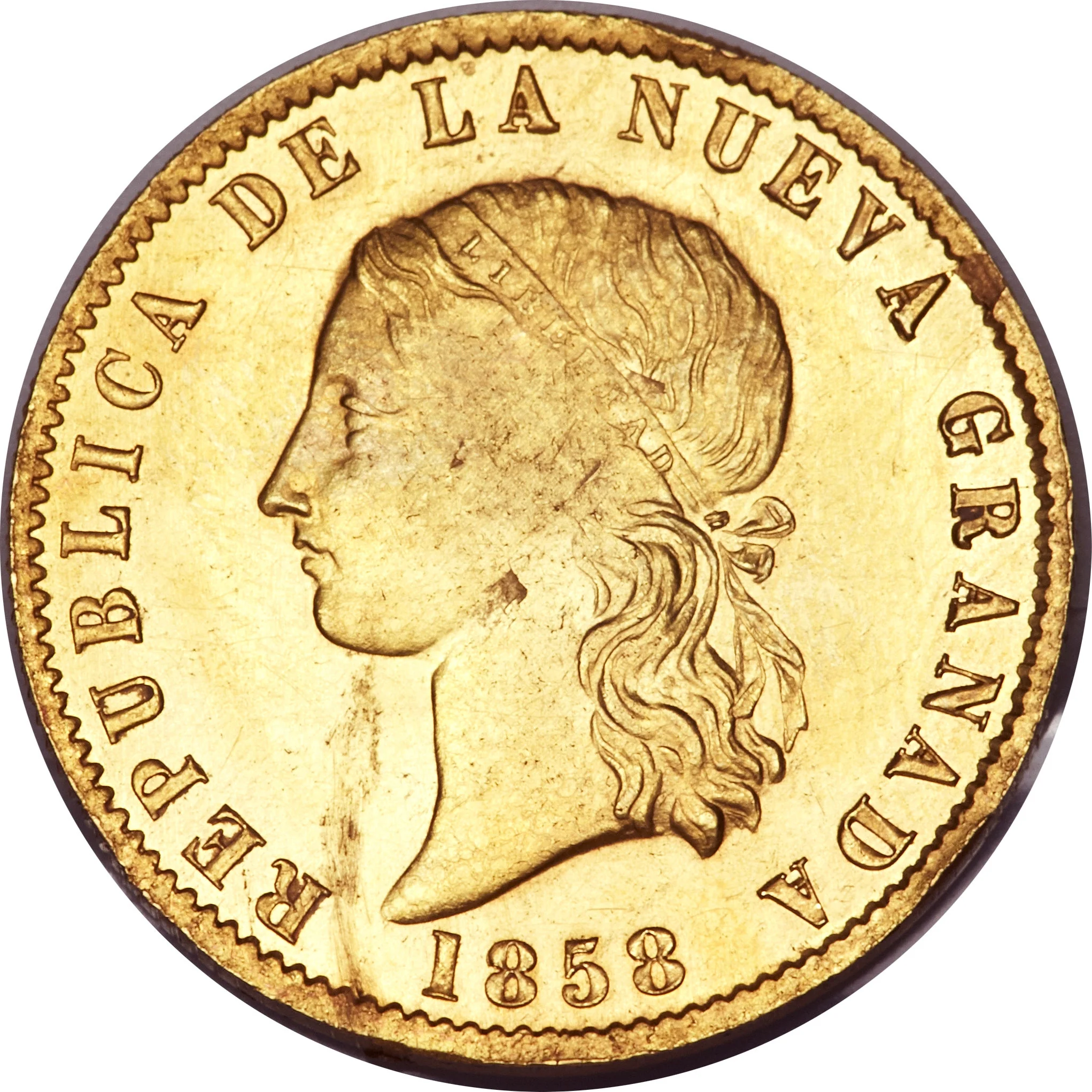
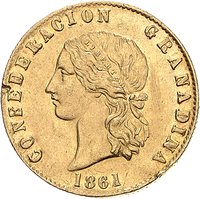
Obverse
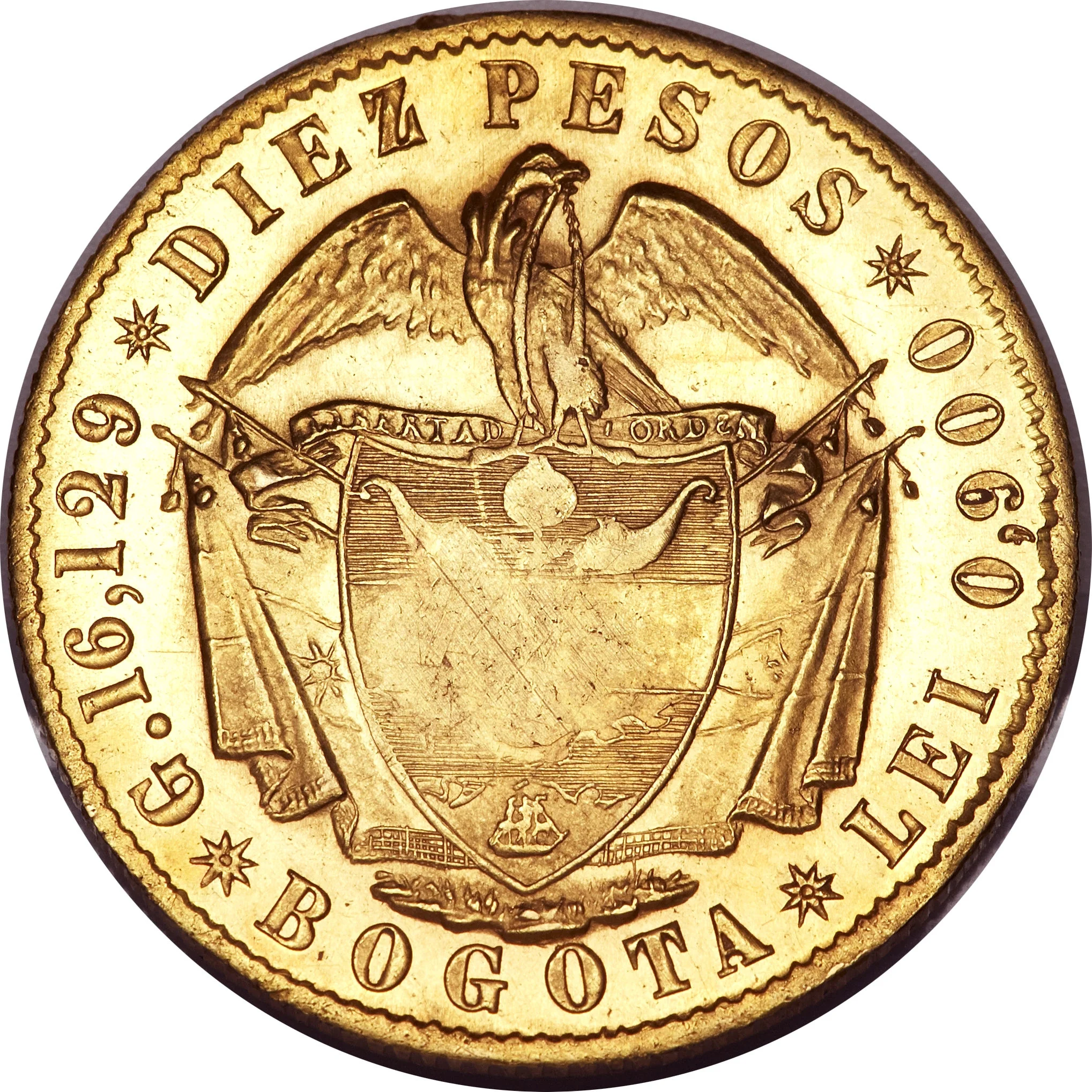
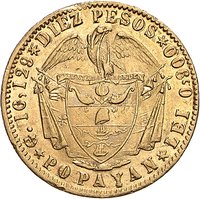
Reverse
Description:
A condor crowns Colombia's coat of arms.
Inscription:
⁕ G.16,129 ⁕ DIEZ PESOS ⁕
LIBERTAD ORDEN
BOGOTA ⁕ LEI 0,900
LIBERTAD ORDEN
BOGOTA ⁕ LEI 0,900
Script: Latin
Edge
Mintings
| Year | Mint Mark | Mintage | Quality | Collection |
|---|---|---|---|---|
| 1857 | — | — | ||
| 1858 | — | — |
Historical background
In 1857, Colombia existed as the Granadine Confederation, a decentralized federal republic grappling with profound monetary disorder. The period was characterized by a chaotic proliferation of currency, as the sovereign power to mint coins was held not only by the central government but also by individual states. This resulted in a bewildering array of coins of varying weights, metallic purity, and designs circulating simultaneously, including old colonial Spanish coins, republican-era coinage from the defunct Republic of New Granada, and new issues from states like Antioquia, Cauca, and Cundinamarca. The lack of a uniform national currency severely hampered commerce and created widespread confusion in everyday transactions.
The fundamental problem was the absence of a strong central banking authority and a unified monetary policy. The federal constitution of 1853 had devolved minting powers to the states, leading to competitive devaluations and a loss of confidence in the currency's value. While the central government attempted to maintain a standard based on the peso (divided into 10 reales), the reality was a market where coins were valued by their actual metallic content (silver or gold) rather than their face value. This effectively created a system of commodity money, where merchants and citizens had to constantly assess and negotiate the worth of each coin, stifling economic integration and growth.
This monetary anarchy was a direct reflection of the broader political instability of the era. The Granadine Confederation was fragile, marked by regional rivalries and ideological conflicts between Conservatives and Liberals that would soon erupt into civil war. The currency chaos of 1857 was therefore both a symptom and a cause of national weakness, highlighting the urgent need for financial centralization—a goal that would only begin to be addressed in the following decades as the country evolved into the United States of Colombia and, eventually, the Republic of Colombia.
The fundamental problem was the absence of a strong central banking authority and a unified monetary policy. The federal constitution of 1853 had devolved minting powers to the states, leading to competitive devaluations and a loss of confidence in the currency's value. While the central government attempted to maintain a standard based on the peso (divided into 10 reales), the reality was a market where coins were valued by their actual metallic content (silver or gold) rather than their face value. This effectively created a system of commodity money, where merchants and citizens had to constantly assess and negotiate the worth of each coin, stifling economic integration and growth.
This monetary anarchy was a direct reflection of the broader political instability of the era. The Granadine Confederation was fragile, marked by regional rivalries and ideological conflicts between Conservatives and Liberals that would soon erupt into civil war. The currency chaos of 1857 was therefore both a symptom and a cause of national weakness, highlighting the urgent need for financial centralization—a goal that would only begin to be addressed in the following decades as the country evolved into the United States of Colombia and, eventually, the Republic of Colombia.
✨ Legendary