

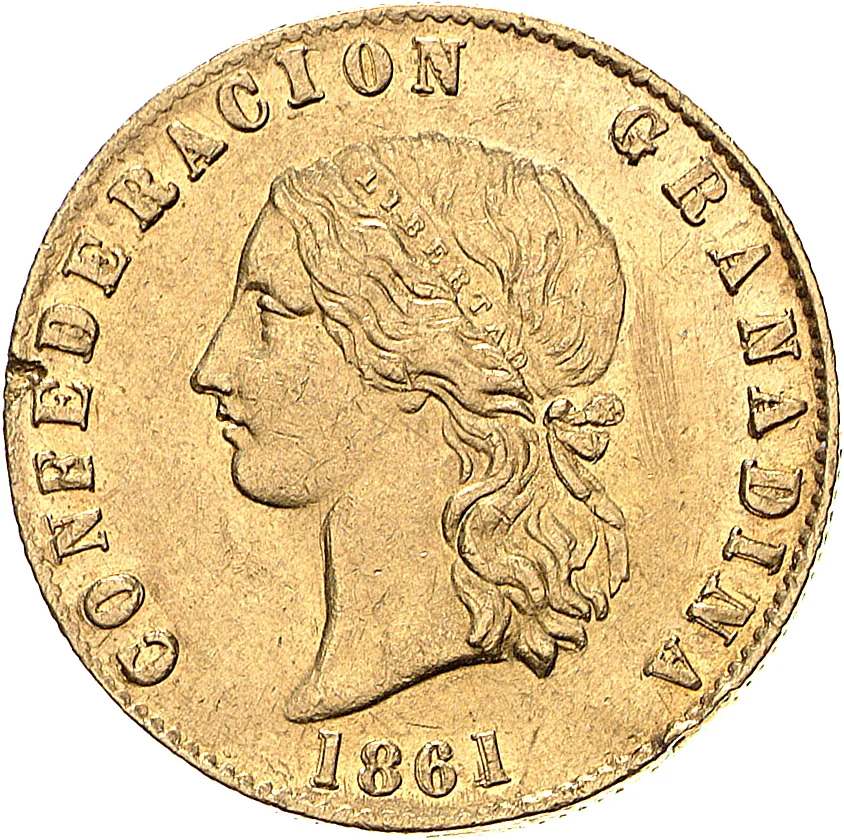
Obverse
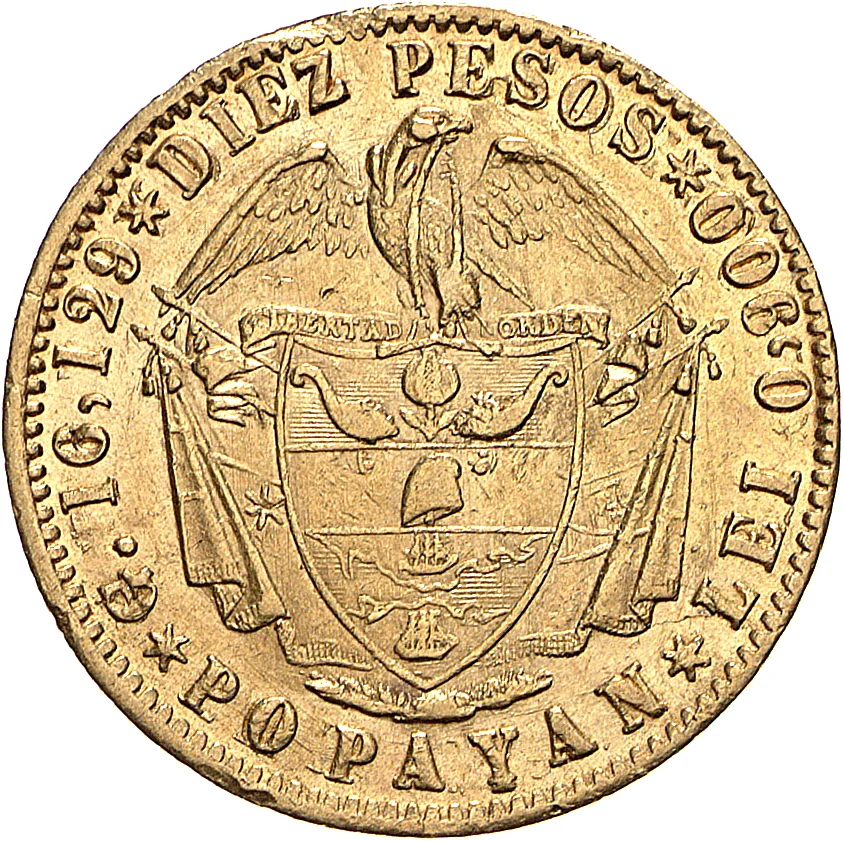
Reverse
Description:
A condor crowns Colombia's coat of arms.
Inscription:
⁕ G.16,129 ⁕ DIEZ PESOS ⁕
LIBERTAD ORDEN
BOGOTA ⁕ LEI 0,900
LIBERTAD ORDEN
BOGOTA ⁕ LEI 0,900
Script: Latin
Edge
Categories
| Symbol> Allegory |
| Symbols> Coat of Arms |
Mintings
| Year | Mint Mark | Mintage | Quality | Collection |
|---|---|---|---|---|
| 1858 | — | — | ||
| 1859 | — | — | ||
| 1860 | — | — | ||
| 1861 | — | — | ||
| 1862 | — | — |
Historical background
In 1858, Colombia’s currency situation was a direct reflection of its profound political fragmentation. The country was officially known as the Granadine Confederation, a decentralized republic where powerful regional states (like Antioquia, Cauca, and Cundinamarca) held significant sovereignty, including the authority to mint their own coinage. Consequently, a chaotic multitude of coins circulated, primarily from the old colonial mints of Bogotá, Popayán, and Medellín, alongside a substantial amount of foreign silver, especially Peruvian and Bolivian coins. This lack of a unified national monetary system severely hampered interregional trade and national economic integration.
The primary unit of account was the silver peso, but its value and purity varied from state to state, creating confusion and exchange rate disparities. To complicate matters, the value of gold coins fluctuated independently against this silver standard. Furthermore, the chronic shortage of small-denomination coinage (known as moneda menuda) for everyday transactions was a persistent problem, often addressed by cutting larger silver coins into pieces. This practice further degraded the currency's reliability and facilitated widespread counterfeiting.
This monetary disarray was widely recognized as a major obstacle to national progress. The centralist government under President Mariano Ospina Rodríguez sought to assert greater control, and the 1858 constitution, while confirming federalism, began a slow push toward centralization. However, tangible reform of the coinage itself would not begin until the following decade, most notably with the establishment of the Bogotá Mint in 1861 and the later attempts to decimalize the currency under the United States of Colombia. Thus, 1858 stands as a point of peak monetary disorder, immediately preceding a long and contentious struggle for financial unification.
The primary unit of account was the silver peso, but its value and purity varied from state to state, creating confusion and exchange rate disparities. To complicate matters, the value of gold coins fluctuated independently against this silver standard. Furthermore, the chronic shortage of small-denomination coinage (known as moneda menuda) for everyday transactions was a persistent problem, often addressed by cutting larger silver coins into pieces. This practice further degraded the currency's reliability and facilitated widespread counterfeiting.
This monetary disarray was widely recognized as a major obstacle to national progress. The centralist government under President Mariano Ospina Rodríguez sought to assert greater control, and the 1858 constitution, while confirming federalism, began a slow push toward centralization. However, tangible reform of the coinage itself would not begin until the following decade, most notably with the establishment of the Bogotá Mint in 1861 and the later attempts to decimalize the currency under the United States of Colombia. Thus, 1858 stands as a point of peak monetary disorder, immediately preceding a long and contentious struggle for financial unification.
✨ Legendary