

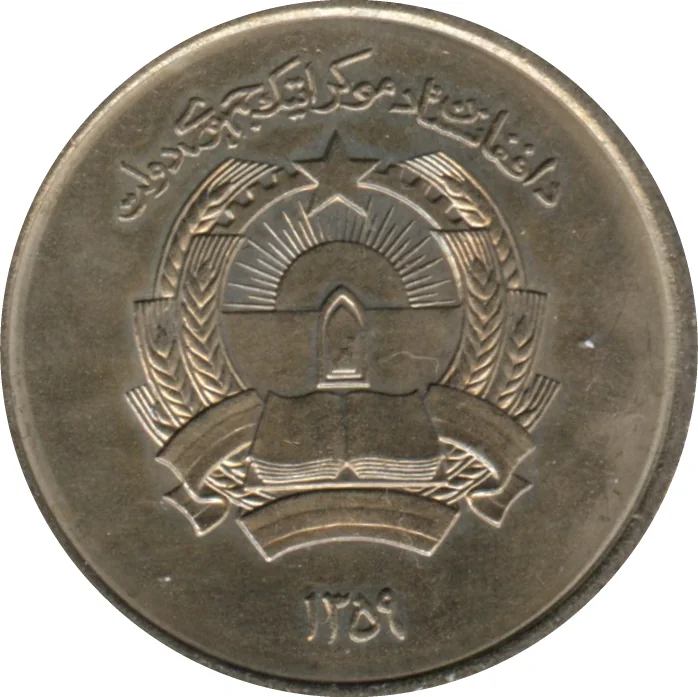
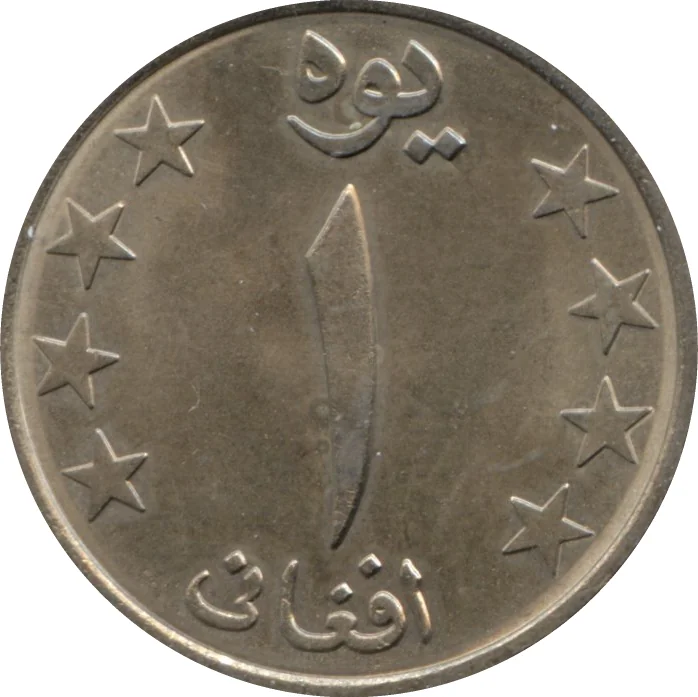
1 afghani – Afghanistan
Add to wishlist
Afghanistan
Context
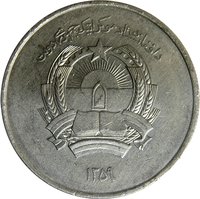
Year: 1980
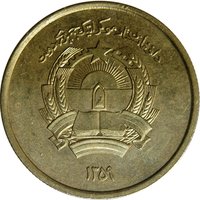
Iranian - Persian Year:: 1359
Issuer: Afghanistan
Period:
(1978—1992)
Currency:
(1923—2003)
Demonetized: Yes
Total mintage: 12,000,000
Material
Diameter: 23 mm
Weight: 4.5 g
Thickness: 1.53 mm
Shape: Round
Composition: Copper-nickel
Technique: Milled
Alignment: Coin alignment
flip
References
KM: #
Numista: #4805
Value
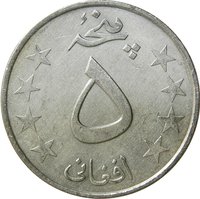
Exchange value: 1 AFA
Obverse
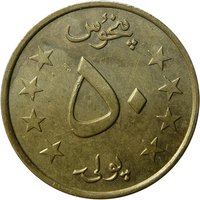
Reverse
Edge
Reeded
Mints
| Name | Mark |
|---|---|
| Saint Petersburg | — |
Mintings
| Year | Mint Mark | Mintage | Quality | Collection |
|---|---|---|---|---|
| 1980 | — | 12,000,000 |
Historical background
In 1980, Afghanistan's currency situation was defined by the political and economic turmoil following the Soviet invasion of December 1979. The official currency, the Afghani (AFA), was managed by Da Afghanistan Bank, the central bank, but its stability was severely undermined. The new Soviet-backed government, led by Babrak Karmal, faced a collapsing economy, widespread insurgency, and crippling international sanctions. Consequently, the government resorted to printing money to cover massive budget deficits, fueling inflation and eroding the Afghani's value on the official market.
Alongside the official economy, a robust black market for foreign exchange emerged as the primary determinant of the Afghani's real value. While the government maintained an artificial official exchange rate, the black market rate diverged dramatically, offering significantly more Afghanis for hard currencies like the US dollar. This disparity reflected a severe lack of confidence in the regime and the currency, driven by capital flight, trade disruption, and the diversion of economic activity into the informal sector. Ordinary Afghans and traders relied on this parallel market for most transactions, effectively sidelining the official banking system.
The currency instability was both a cause and a symptom of the broader economic breakdown. Agricultural and industrial production faltered due to war, while traditional trade routes were disrupted. The influx of Soviet aid and currency, used to pay for imports and support the administration, further complicated the monetary landscape. Thus, in 1980, the Afghani existed in a dual state: a largely symbolic official currency propped up by the state, and a depreciated black-market currency that reflected the harsh realities of a nation at war, setting a pattern of monetary dysfunction that would persist for decades.
Alongside the official economy, a robust black market for foreign exchange emerged as the primary determinant of the Afghani's real value. While the government maintained an artificial official exchange rate, the black market rate diverged dramatically, offering significantly more Afghanis for hard currencies like the US dollar. This disparity reflected a severe lack of confidence in the regime and the currency, driven by capital flight, trade disruption, and the diversion of economic activity into the informal sector. Ordinary Afghans and traders relied on this parallel market for most transactions, effectively sidelining the official banking system.
The currency instability was both a cause and a symptom of the broader economic breakdown. Agricultural and industrial production faltered due to war, while traditional trade routes were disrupted. The influx of Soviet aid and currency, used to pay for imports and support the administration, further complicated the monetary landscape. Thus, in 1980, the Afghani existed in a dual state: a largely symbolic official currency propped up by the state, and a depreciated black-market currency that reflected the harsh realities of a nation at war, setting a pattern of monetary dysfunction that would persist for decades.
🌱 Common