

50 Puls – Afghanistan
Afghanistan
Context
Year: 1978
Iranian - Persian Year: 1357
Issuer: Afghanistan 
Period:
(1978—1992)
Currency:
(1923—2003)
Demonetized: Yes
Total mintage: 11,286,000
Material
Diameter: 20.9 mm
Weight: 3.1 g
Thickness: 1.3 mm
Shape: Round
Composition: Manganese brass
Standard: Gold tenth ounce
Technique: Milled
Alignment: Coin alignment
flip
References
KM: #Click to copy to clipboard992
Numista: #4802
Value
Exchange value: 0.50 AFA
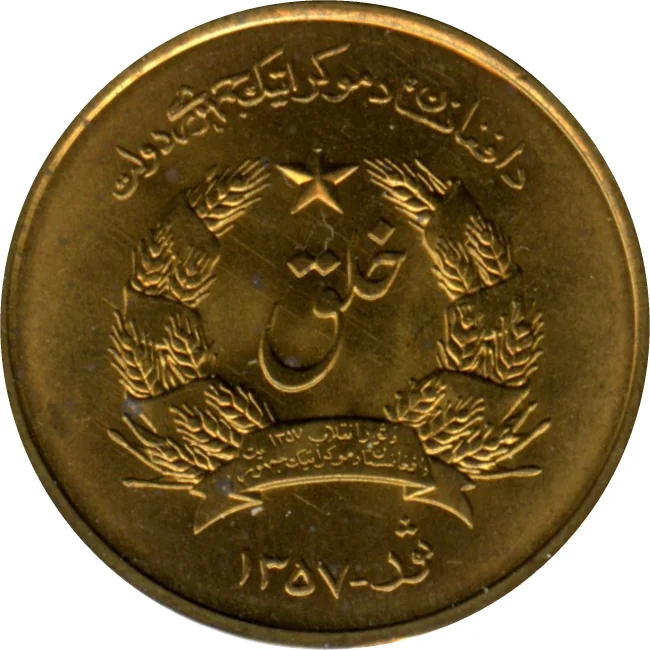
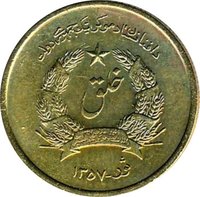
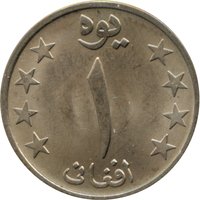
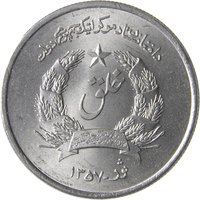
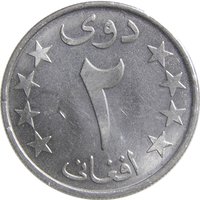
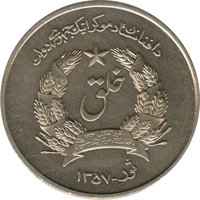
Obverse
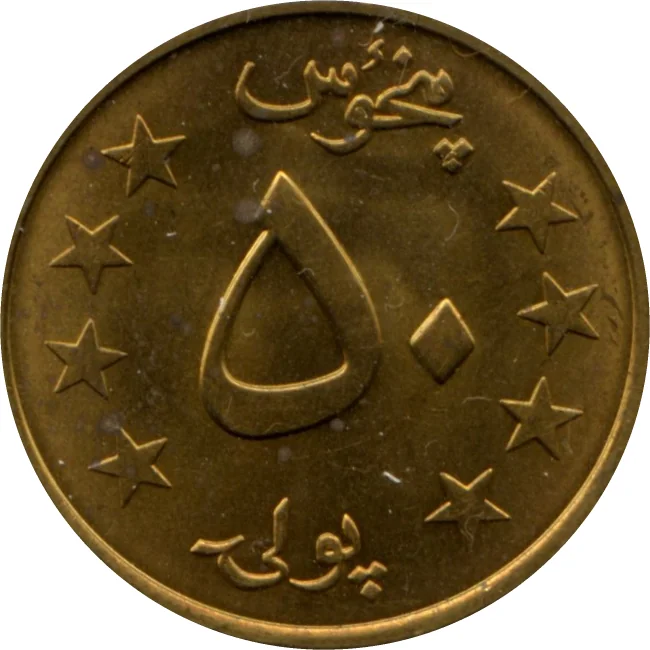
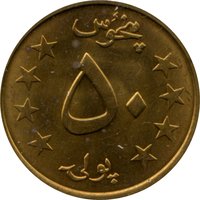
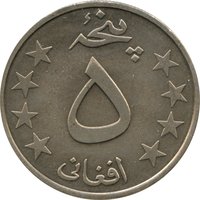
Reverse
Description:
Centered denomination
Inscription:
پنځوس
٥۰
پولی
٥۰
پولی
Translation:
Fifty
50
Polis
50
Polis
Script: Arabic
Languages: Arabic numeral, Pashto
Edge
Reeded
Mints
| Name | Mark |
|---|---|
| Saint Petersburg | — |
Mintings
| Year | Mint Mark | Mintage | Quality | Collection |
|---|---|---|---|---|
| 1978 | — | 11,286,000 |
Historical background
In 1978, Afghanistan's currency, the afghani (AFA), was in a period of controlled stability but underlying fragility, directly tied to the nation's dramatic political upheaval. The year began under the rule of President Mohammed Daoud Khan, whose republic had maintained a relatively stable, state-managed economy. The afghani was pegged to the US dollar at a fixed, overvalued official rate of 45 afghanis per dollar, with a complex system of multiple exchange rates used to control imports, subsidize essentials, and manage foreign reserves, which were heavily reliant on agricultural exports and foreign aid. This system, however, fostered a thriving black market where the afghani traded significantly weaker, reflecting the economy's true pressures.
The pivotal event was the Saur Revolution in April 1978, when the communist People's Democratic Party of Afghanistan (PDPA) seized power, overthrowing and killing Daoud. The new Marxist government, led by Nur Muhammad Taraki, immediately embarked on a radical program of socialist reforms, including land redistribution and the cancellation of rural debt. These policies, imposed hastily and often violently, disrupted the traditional agricultural economy—the country's backbone—and eroded the production base that supported the afghani's value. While the official exchange rate was maintained, confidence in the currency plummeted.
Consequently, by the end of 1978, the fundamental disconnect between the official and black-market rates widened sharply as the economy began to destabilize. The government's ideological policies alienated the population, stifled production, and increased dependence on the Soviet Union for financial and technical support. The currency situation thus became a monetary reflection of the growing political and social crisis, setting the stage for severe inflation, increased smuggling, and economic hardship that would escalate throughout the subsequent Soviet invasion and decade-long war.
The pivotal event was the Saur Revolution in April 1978, when the communist People's Democratic Party of Afghanistan (PDPA) seized power, overthrowing and killing Daoud. The new Marxist government, led by Nur Muhammad Taraki, immediately embarked on a radical program of socialist reforms, including land redistribution and the cancellation of rural debt. These policies, imposed hastily and often violently, disrupted the traditional agricultural economy—the country's backbone—and eroded the production base that supported the afghani's value. While the official exchange rate was maintained, confidence in the currency plummeted.
Consequently, by the end of 1978, the fundamental disconnect between the official and black-market rates widened sharply as the economy began to destabilize. The government's ideological policies alienated the population, stifled production, and increased dependence on the Soviet Union for financial and technical support. The currency situation thus became a monetary reflection of the growing political and social crisis, setting the stage for severe inflation, increased smuggling, and economic hardship that would escalate throughout the subsequent Soviet invasion and decade-long war.
🌱 Fairly Common