

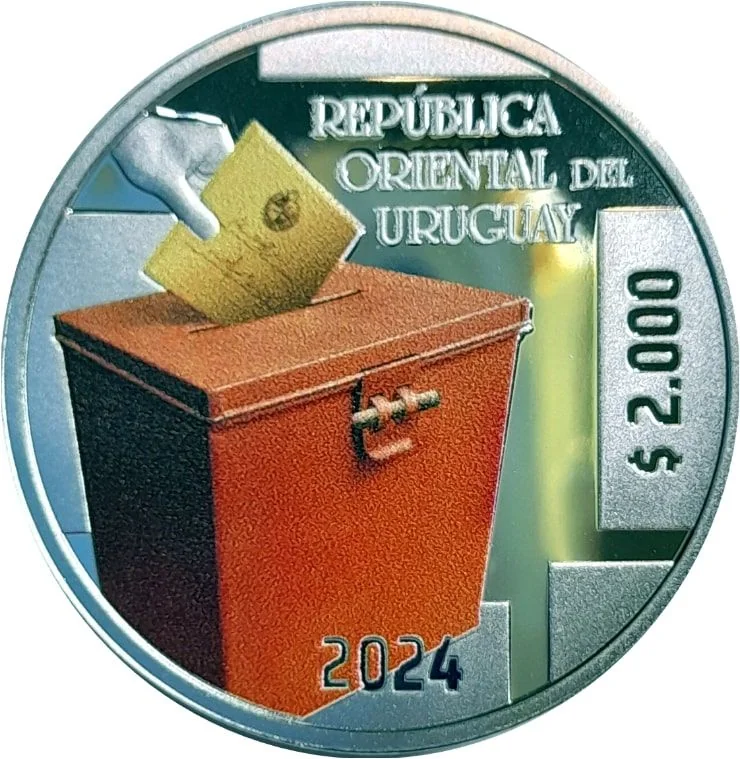

2000 pesos uruguayos (Electoral Court) – Uruguay
Add to wishlist
Circulating commemorative coins
Commemoration: Electoral Court Centenary
Uruguay

Obverse
Reverse
Edge
Plain
Mints
| Name | Mark |
|---|---|
| Royal Dutch Mint | — |
Mintings
| Year | Mint Mark | Mintage | Quality | Collection |
|---|---|---|---|---|
| 2024 | — | 2,500 |
Historical background
In 2024, Uruguay maintains a unique and stable dual-currency system, with the Uruguayan Peso (UYU) and the US Dollar (USD) circulating freely alongside each other. This formalized "bimonetarism" is a legacy of past hyperinflation and economic crises, which eroded public trust in the peso. Consequently, a significant portion of financial transactions, savings, and real estate contracts are denominated in dollars, providing a hedge against inflation and devaluation. The Central Bank of Uruguay (BCU) manages this system by allowing the peso to float freely while holding substantial foreign reserves, primarily in USD, to ensure liquidity and market confidence.
The economic context in 2024 is characterized by moderate inflation and a managed exchange rate. After a peak in 2022, inflation has been gradually receding, with the BCU's target range around 3% to 6%. The exchange rate is not fixed but is influenced by BCU interventions to prevent excessive volatility. A key ongoing challenge is the gradual "de-dollarization" of the economy—a long-term policy aim to strengthen the peso's role and reduce financial risks associated with widespread foreign currency debt. However, this process is slow, as dollar usage remains deeply ingrained in both psychology and practice for large-scale transactions and savings.
Looking forward, the main monetary policy focus remains on anchoring inflation expectations and fostering economic growth, which is projected to be modest in 2024. The BCU continues its strategy of cautious interest rate adjustments in response to global monetary trends and domestic price pressures. The stability of the dual system is a strength, but policymakers remain attentive to external vulnerabilities, such as fluctuations in the US Federal Reserve's policy and the economic performance of major trading partners like Argentina and Brazil, which can impact trade flows and exchange rate stability.
The economic context in 2024 is characterized by moderate inflation and a managed exchange rate. After a peak in 2022, inflation has been gradually receding, with the BCU's target range around 3% to 6%. The exchange rate is not fixed but is influenced by BCU interventions to prevent excessive volatility. A key ongoing challenge is the gradual "de-dollarization" of the economy—a long-term policy aim to strengthen the peso's role and reduce financial risks associated with widespread foreign currency debt. However, this process is slow, as dollar usage remains deeply ingrained in both psychology and practice for large-scale transactions and savings.
Looking forward, the main monetary policy focus remains on anchoring inflation expectations and fostering economic growth, which is projected to be modest in 2024. The BCU continues its strategy of cautious interest rate adjustments in response to global monetary trends and domestic price pressures. The stability of the dual system is a strength, but policymakers remain attentive to external vulnerabilities, such as fluctuations in the US Federal Reserve's policy and the economic performance of major trading partners like Argentina and Brazil, which can impact trade flows and exchange rate stability.



✨ Legendary