

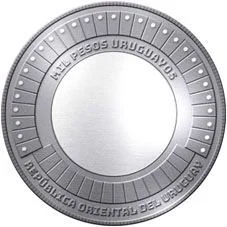
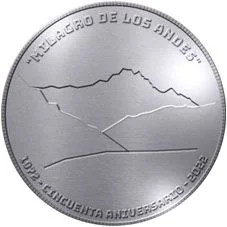
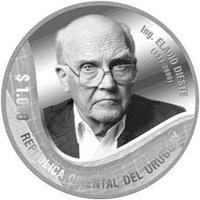
1000 pesos uruguayos – Uruguay
Add to wishlist
Circulating commemorative coins
Commemoration: Andean Miracle
Uruguay
Context
Year: 2022
Issuer: Uruguay
Issuing organization: Central Bank of Uruguay
Period:
(since 1825)
Currency:
(since 1993)
Demonetization: 8 November 2023
Total mintage: 1,500
Material

References
Numista: #342656
Value
Exchange value: 1000 UYU
Bullion value: $27.38
Obverse
Reverse
Edge
Plain
Mints
| Name | Mark |
|---|---|
| Mint of Poland | — |
Mintings
| Year | Mint Mark | Mintage | Quality | Collection |
|---|---|---|---|---|
| 2022 | — | 1,500 | Proof |
Historical background
In 2022, Uruguay's currency situation was characterized by a sustained period of significant depreciation of the Uruguayan peso (UYU) against the US dollar, continuing a trend that began in 2020. The peso weakened from approximately UYU 44 to the dollar at the start of the year to around UYU 40 by year's end, representing a depreciation of roughly 10%. This decline was driven by a combination of global and domestic factors, including a strong US dollar fueled by aggressive Federal Reserve interest rate hikes, which prompted capital outflows from emerging markets like Uruguay. Domestically, a historic drought severely impacted agricultural exports, a key source of dollar inflows, while robust domestic consumption and imports increased demand for foreign currency.
The Central Bank of Uruguay (BCU) adopted a non-interventionist stance towards the exchange rate, allowing the peso to float freely and absorb external shocks. Its primary focus remained on anchoring inflation, which peaked at over 10% in mid-2022, through a cycle of interest rate increases. This policy divergence with the US, however, contributed to the peso's weakness. The depreciation had a dual effect: it boosted the competitiveness of Uruguayan exports and tourism in dollar terms but also raised the cost of imported goods and services, contributing to inflationary pressures and affecting purchasing power.
Despite the currency volatility, the broader macroeconomic framework remained stable. Uruguay maintained access to international credit markets, foreign direct investment continued, and the country's sovereign risk spreads were among the lowest in the region. The depreciation was largely viewed as a market correction rather than a crisis, with strong fundamentals like a credible central bank, a solid banking system, and a manageable public debt level providing a buffer. The situation underscored the economy's exposure to commodity prices and global financial conditions, while also testing the resilience of its inflation-targeting regime in a challenging international environment.
The Central Bank of Uruguay (BCU) adopted a non-interventionist stance towards the exchange rate, allowing the peso to float freely and absorb external shocks. Its primary focus remained on anchoring inflation, which peaked at over 10% in mid-2022, through a cycle of interest rate increases. This policy divergence with the US, however, contributed to the peso's weakness. The depreciation had a dual effect: it boosted the competitiveness of Uruguayan exports and tourism in dollar terms but also raised the cost of imported goods and services, contributing to inflationary pressures and affecting purchasing power.
Despite the currency volatility, the broader macroeconomic framework remained stable. Uruguay maintained access to international credit markets, foreign direct investment continued, and the country's sovereign risk spreads were among the lowest in the region. The depreciation was largely viewed as a market correction rather than a crisis, with strong fundamentals like a credible central bank, a solid banking system, and a manageable public debt level providing a buffer. The situation underscored the economy's exposure to commodity prices and global financial conditions, while also testing the resilience of its inflation-targeting regime in a challenging international environment.

💎 Extremely Rare