

1 skilling – Denmark
Add to wishlist
Denmark
Context
Material
References
KM: #
Numista: #47922
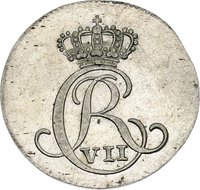
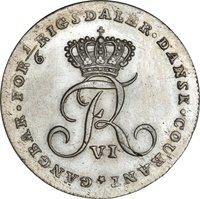
Obverse
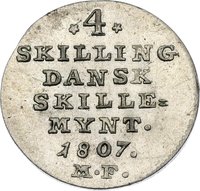
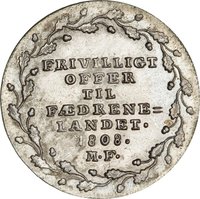
Reverse
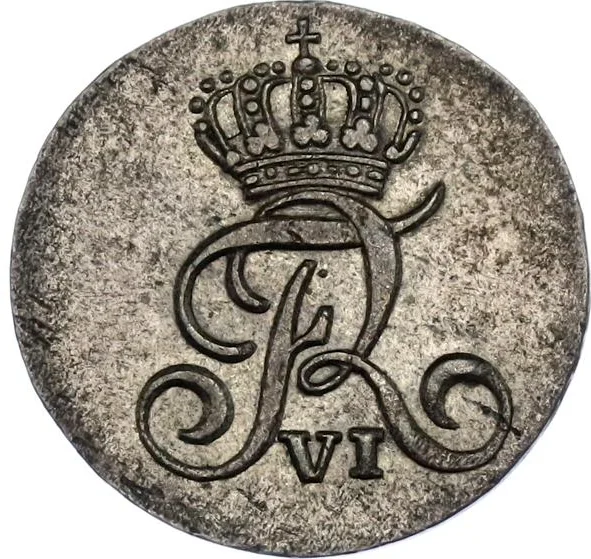
Description:
Value and date
on four lines.
Mintmaster initials
below.
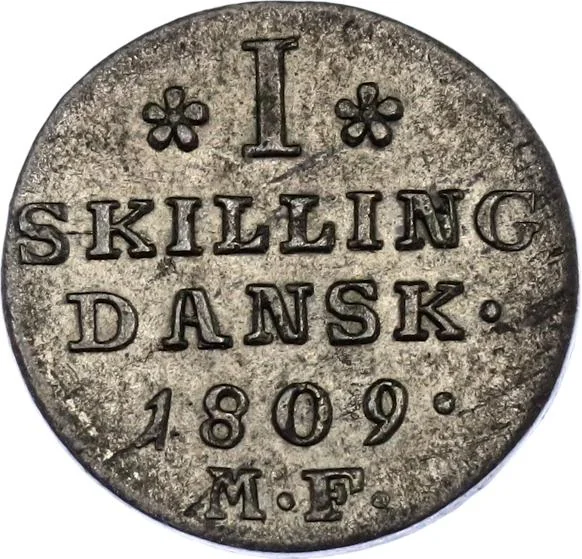
on four lines.
Mintmaster initials
below.
Inscription:
*1*
SKILLING
DANSK.
1809.
M.F.
SKILLING
DANSK.
1809.
M.F.
Script: Latin
Edge
Plain
Mints
| Name | Mark |
|---|---|
| Altona, Schleswig-Holstein | — |
Mintings
| Year | Mint Mark | Mintage | Quality | Collection |
|---|---|---|---|---|
| 1808 | — | — | ||
| 1809 | — | — | ||
| 1810 | — | — | ||
| 1819 | — | — |
Historical background
In 1808, Denmark found itself in a precarious monetary crisis, deeply entangled in the Napoleonic Wars. Following the British bombardment of Copenhagen in 1807, Denmark had firmly aligned itself with France, leading to a devastating British naval blockade. This isolation severed Denmark from its vital overseas trade and colonial income, creating a severe shortage of essential goods and, crucially, precious metals like silver and gold needed to back its currency. The state treasury was drained by war expenditures, leaving the government with few options to finance its military and administrative functions.
To address the shortfall, the Danish government resorted to the large-scale issuance of inconvertible paper money, known as kurantsedler. These were not backed by silver reserves, making them a fiat currency reliant on government decree. As the war dragged on and more notes were printed to cover deficits, the predictable consequence was rapid inflation and a steep decline in the value of this paper money relative to silver. This created a chaotic dual-system where transactions were often calculated in stable silver rigsdaler but paid in depreciating paper notes, with a fluctuating and unfavorable exchange rate between the two.
The situation eroded public confidence and caused significant economic hardship, particularly for those on fixed incomes. Merchants and the populace hoarded tangible assets and specie, exacerbating the scarcity. This period of "paper money without cover" laid bare the vulnerabilities of the Danish economy under wartime pressure and set the stage for a protracted monetary reform that would only begin after the wars concluded in 1814, with the painful process of stabilizing the currency and restoring public trust lasting for decades.
To address the shortfall, the Danish government resorted to the large-scale issuance of inconvertible paper money, known as kurantsedler. These were not backed by silver reserves, making them a fiat currency reliant on government decree. As the war dragged on and more notes were printed to cover deficits, the predictable consequence was rapid inflation and a steep decline in the value of this paper money relative to silver. This created a chaotic dual-system where transactions were often calculated in stable silver rigsdaler but paid in depreciating paper notes, with a fluctuating and unfavorable exchange rate between the two.
The situation eroded public confidence and caused significant economic hardship, particularly for those on fixed incomes. Merchants and the populace hoarded tangible assets and specie, exacerbating the scarcity. This period of "paper money without cover" laid bare the vulnerabilities of the Danish economy under wartime pressure and set the stage for a protracted monetary reform that would only begin after the wars concluded in 1814, with the painful process of stabilizing the currency and restoring public trust lasting for decades.
⭐ Somewhat Rare