

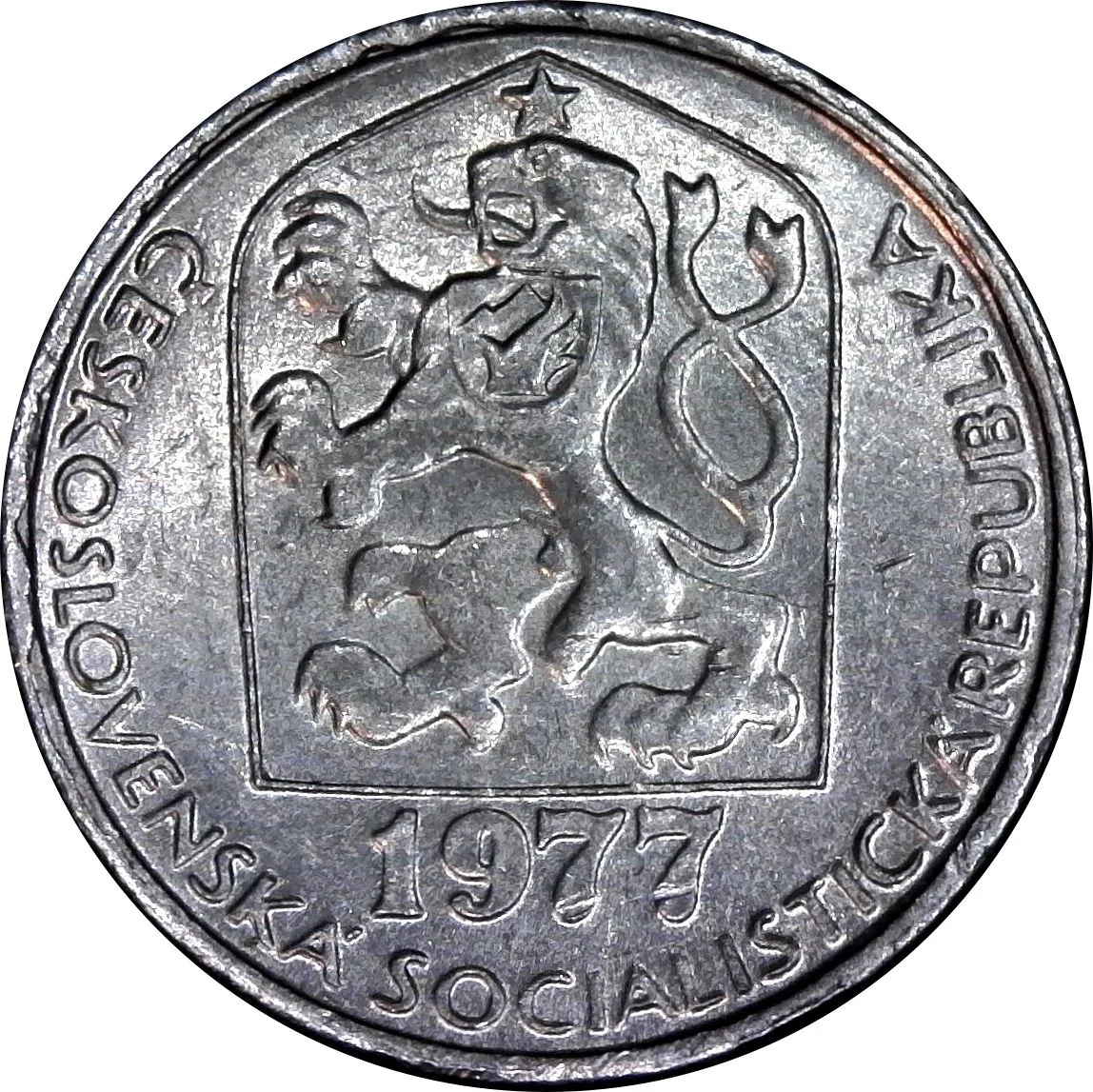
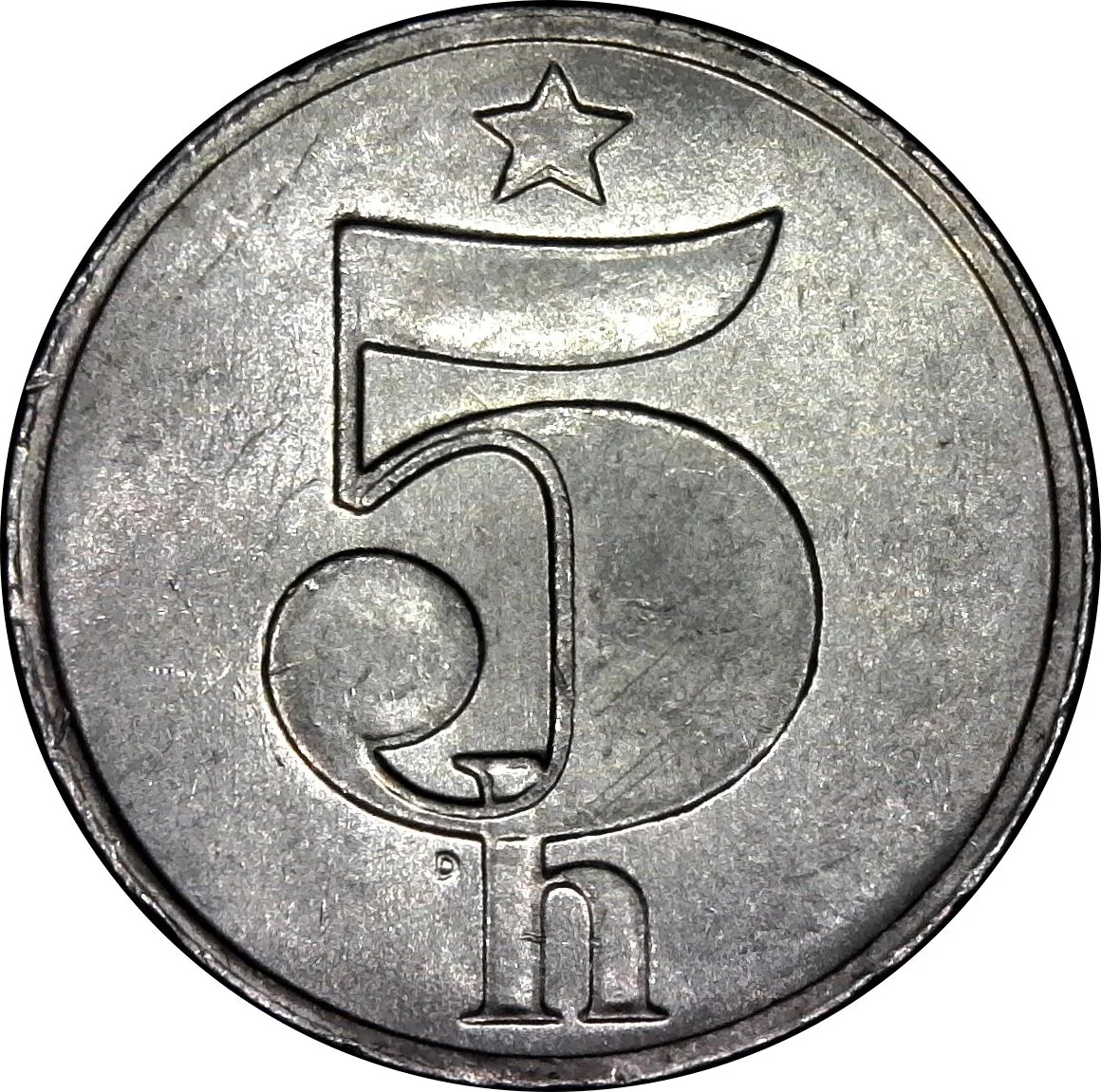
5 Haléřů / Halierov – Czechoslovakia
Context
Years: 1977–1990
Issuer: Czechoslovakia 
Issuing organization: Czechoslovak State Bank
Period:
(1960—1990)
Currency:
(1953—1992)
Demonetization: 31 July 1993
Total mintage: 193,140,354
Material
References
KM: #Click to copy to clipboard86
Numista: #4788
Value
Exchange value: 0.05 CSK
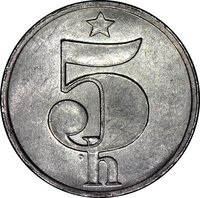
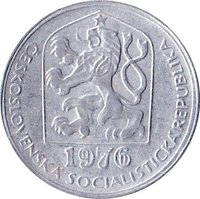
Obverse
Description:
Czech lion, socialist shield.
Inscription:
ČESKOSLOVENSKÁ SOCIALISTICKÁ REPUBLIKA
1979
1979
Translation:
Czechoslovak Socialist Republic
1979
1979
Script: Latin
Engraver: František David
Reverse
Edge
Plain
Categories
| Symbols> Coat of Arms |
Mints
| Name | Mark |
|---|---|
| Kremnica | — |
Mintings
| Year | Mint Mark | Mintage | Quality | Collection |
|---|---|---|---|---|
| 1977 | — | 26,710,000 | ||
| 1978 | — | 51,110,000 | ||
| 1979 | — | 72,380,000 | ||
| 1980 | — | 50,600 | In sets | |
| 1981 | — | 66,160 | In sets | |
| 1982 | — | 53,847 | In sets | |
| 1983 | — | 60,000 | In sets | |
| 1984 | — | 39,957 | In sets | |
| 1985 | — | 39,791 | In sets | |
| 1986 | — | 20,020,000 | ||
| 1987 | — | 520,000 | ||
| 1988 | — | 8,029,999 | ||
| 1989 | — | 110,000 | ||
| 1990 | — | 13,950,000 |
Historical background
In 1977, Czechoslovakia operated under a rigid, centrally planned economy where the Czechoslovak koruna (KCS) was a non-convertible currency. Its value was administratively set by the state, bearing no relation to market forces or its purchasing power internationally. Domestically, this system created a facade of price stability for basic goods, but it masked chronic shortages, suppressed inflation, and a growing black market where the koruna traded at a fraction of its official rate for desirable or Western goods.
Internationally, the koruna was part of the Soviet-led "transferable ruble" system for trade within the Council for Mutual Economic Assistance (COMECON). For trade with Western nations, the state used a separate set of "foreign exchange korunas" and hard currency reserves. Ordinary citizens were legally barred from holding foreign currencies like US dollars or Deutsche Marks under severe penalty. Access to Western goods was only possible through special, poorly stocked Tuzex stores, which required purchasers to use "Tuzex vouchers" (bony) bought with hard currency sent from abroad or obtained illegally.
This dual monetary environment reflected the broader economic stagnation and political repression of the Normalization era following the 1968 Prague Spring. The currency regime was a tool of state control, isolating the population from the global economy and reinforcing the regime's authority. However, it also fueled a pervasive underground economy and widespread cynicism, as the disparity between the official fiction of the koruna's value and the reality of economic life became increasingly apparent to the populace.
Internationally, the koruna was part of the Soviet-led "transferable ruble" system for trade within the Council for Mutual Economic Assistance (COMECON). For trade with Western nations, the state used a separate set of "foreign exchange korunas" and hard currency reserves. Ordinary citizens were legally barred from holding foreign currencies like US dollars or Deutsche Marks under severe penalty. Access to Western goods was only possible through special, poorly stocked Tuzex stores, which required purchasers to use "Tuzex vouchers" (bony) bought with hard currency sent from abroad or obtained illegally.
This dual monetary environment reflected the broader economic stagnation and political repression of the Normalization era following the 1968 Prague Spring. The currency regime was a tool of state control, isolating the population from the global economy and reinforcing the regime's authority. However, it also fueled a pervasive underground economy and widespread cynicism, as the disparity between the official fiction of the koruna's value and the reality of economic life became increasingly apparent to the populace.
🌱 Very Common