

10 Haléřů / Halierov – Czechoslovakia
Context
Years: 1974–1990
Issuer: Czechoslovakia 
Period:
(1960—1990)
Currency:
(1953—1992)
Demonetization: 15 October 1993
Total mintage: 1,052,707,354
Material
References
KM: #Click to copy to clipboard80
Numista: #3274
Value
Exchange value: 0.10 CSK
Obverse
Description:
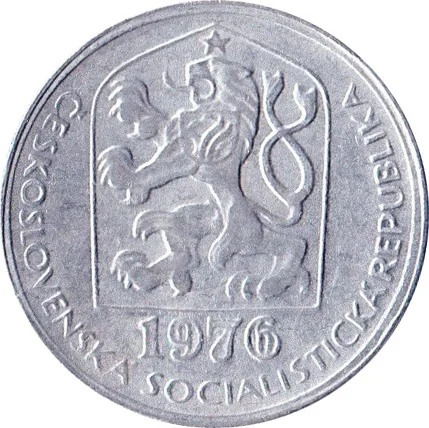
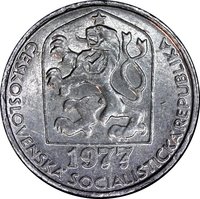
Czechoslovak coat of arms with date.
Inscription:
ČESKOSLOVENSKÁ SOCIALISTICKÁ REPUBLIKA
1976
1976
Translation:
Czechoslovak Socialist Republic
1976
1976
Script: Latin
Engraver: František David
Reverse
Description:
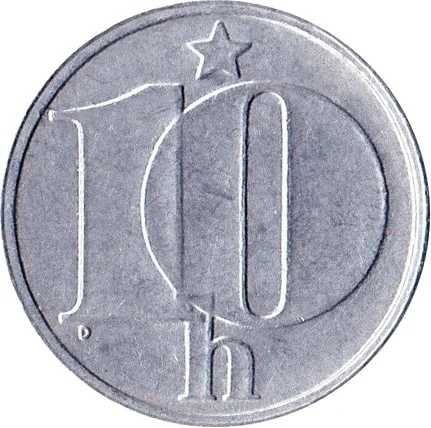
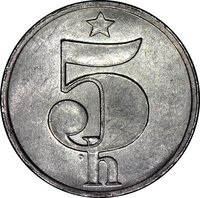
Star above value, engraver's initial left.
Inscription:
10
h
D
h
D
Script: Latin
Engraver: František David
Edge
Plain
Categories
| Symbols> Coat of Arms |
Mints
| Name | Mark |
|---|---|
| Kremnica | — |
Mintings
| Year | Mint Mark | Mintage | Quality | Collection |
|---|---|---|---|---|
| 1974 | — | 11,470,000 | ||
| 1975 | — | 41,002,000 | ||
| 1976 | — | 182,000,000 | ||
| 1977 | — | 151,760,000 | ||
| 1978 | — | 62,620,000 | ||
| 1979 | — | 30,240,000 | ||
| 1980 | — | 31,280,600 | ||
| 1981 | — | 43,616,160 | ||
| 1982 | — | 74,568,847 | ||
| 1983 | — | 50,560,000 | ||
| 1984 | — | 40,369,957 | ||
| 1985 | — | 92,929,791 | ||
| 1986 | — | 87,260,000 | ||
| 1987 | — | 30,030,000 | ||
| 1988 | — | 47,479,999 | ||
| 1989 | — | 50,300,000 | ||
| 1990 | — | 25,220,000 |
Historical background
In 1974, Czechoslovakia operated under a rigid, centrally planned economy and a complex dual-currency system, a hallmark of the Soviet Bloc. Officially, the Czechoslovak koruna (Kčs) was a non-convertible currency, its exchange rate set arbitrarily by the state rather than market forces. For international trade within the Council for Mutual Economic Assistance (COMECON), a separate "transferable ruble" was used, while hard currency transactions with the West were tightly controlled by the state bank to manage scarce foreign reserves, primarily earned through exports of machinery, arms, and consumer goods like footwear and glass.
Domestically, the currency situation reflected the broader economic stagnation of the "Normalization" period following the 1968 Prague Spring. While the koruna was stable in a superficial sense—with fixed prices for basic goods and no open inflation—this stability masked growing inefficiencies, suppressed inflationary pressures, and chronic shortages of desirable consumer items. A significant black market existed where foreign currencies, particularly US dollars and West German marks, circulated at rates far above the official parity, facilitating access to imported goods or travel to the West for those with connections or illegal means.
Thus, the currency landscape of 1974 was one of controlled facade and underlying dysfunction. The state maintained a firm grip on all official monetary flows to prioritize heavy industry and maintain political control, but the system was increasingly isolated from the global economy and unable to satisfy consumer demand. This contributed to a growing "currency overhang," where citizens held koruna savings with little to spend them on, storing up latent inflationary problems that would contribute to the economy's eventual crisis in the late 1980s.
Domestically, the currency situation reflected the broader economic stagnation of the "Normalization" period following the 1968 Prague Spring. While the koruna was stable in a superficial sense—with fixed prices for basic goods and no open inflation—this stability masked growing inefficiencies, suppressed inflationary pressures, and chronic shortages of desirable consumer items. A significant black market existed where foreign currencies, particularly US dollars and West German marks, circulated at rates far above the official parity, facilitating access to imported goods or travel to the West for those with connections or illegal means.
Thus, the currency landscape of 1974 was one of controlled facade and underlying dysfunction. The state maintained a firm grip on all official monetary flows to prioritize heavy industry and maintain political control, but the system was increasingly isolated from the global economy and unable to satisfy consumer demand. This contributed to a growing "currency overhang," where citizens held koruna savings with little to spend them on, storing up latent inflationary problems that would contribute to the economy's eventual crisis in the late 1980s.
🌱 Very Common