

100 escudos (King Afonso Henriques) – Portugal
Add to wishlist
Non-circulating coins
Commemoration: 800th Anniversary of the Death of King Afonso Henriques
Series: System 1981-2001
Portugal
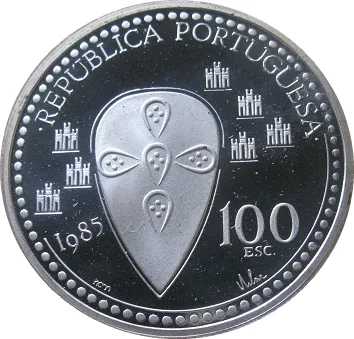
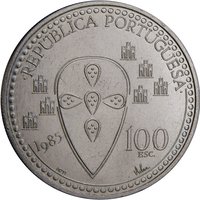
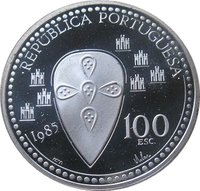
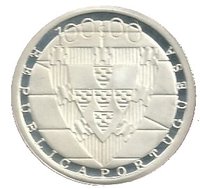
Obverse
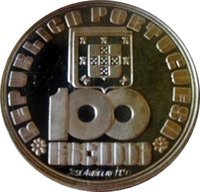
Inscription:
REPUBLICA PORTUGUESA
100 ESC.
1985
100 ESC.
1985
Translation:
Portuguese Republic
100 Escudos
1985
100 Escudos
1985
Script: Latin
Language: Portuguese
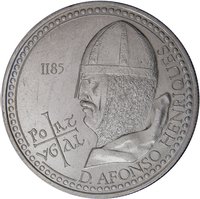
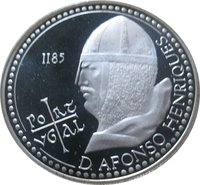
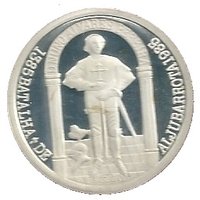
Reverse
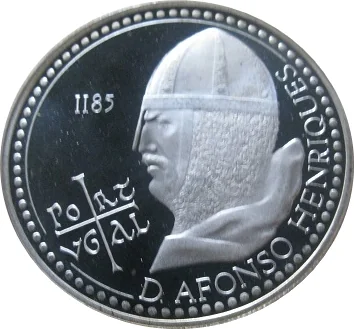
Inscription:
1185
D. AFONSO HENRIQUES
D. AFONSO HENRIQUES
Script: Latin
Edge
Reeded
Mints
| Name | Mark |
|---|---|
| Imprensa Nacional - Casa da Moeda | incm |
Mintings
| Year | Mint Mark | Mintage | Quality | Collection |
|---|---|---|---|---|
| 1985 | INCM | 20,000 | ||
| 1985 | INCM | 5,000 | Proof |
Historical background
In 1985, Portugal's currency situation was defined by its recent entry into the European Monetary System (EMS) in April 1984. This move pegged the Portuguese escudo to a basket of European currencies within the Exchange Rate Mechanism (ERM), a critical step toward aligning with the economic core of Europe. The primary goals were to import monetary stability, curb the high inflation inherited from the revolutionary and post-revolutionary period, and signal Portugal's commitment to European integration following its 1986 accession to the European Economic Community.
However, this commitment came with significant domestic strain. The escudo's fixed parity required maintaining high interest rates to defend its value, which stifled economic growth and investment at a time when the country was still grappling with structural weaknesses. Inflation, though declining from the extreme highs of the late 1970s, remained stubbornly in the double digits (around 19% in 1985), eroding purchasing power and creating social tension. The currency peg also limited the government's ability to use devaluation as a tool to boost competitiveness, placing the full burden of adjustment on internal austerity.
Consequently, 1985 represented a transitional year of painful adjustment. The center-right government under Prime Minister Mário Soares, and later Aníbal Cavaco Silva, pursued tight monetary policies to support the escudo within the EMS framework. This period set the stage for the deeper structural reforms of the late 1980s, sacrificing short-term ease for the long-term goal of macroeconomic stability and European convergence, a foundation upon which Portugal would later build its path to adopting the euro.
However, this commitment came with significant domestic strain. The escudo's fixed parity required maintaining high interest rates to defend its value, which stifled economic growth and investment at a time when the country was still grappling with structural weaknesses. Inflation, though declining from the extreme highs of the late 1970s, remained stubbornly in the double digits (around 19% in 1985), eroding purchasing power and creating social tension. The currency peg also limited the government's ability to use devaluation as a tool to boost competitiveness, placing the full burden of adjustment on internal austerity.
Consequently, 1985 represented a transitional year of painful adjustment. The center-right government under Prime Minister Mário Soares, and later Aníbal Cavaco Silva, pursued tight monetary policies to support the escudo within the EMS framework. This period set the stage for the deeper structural reforms of the late 1980s, sacrificing short-term ease for the long-term goal of macroeconomic stability and European convergence, a foundation upon which Portugal would later build its path to adopting the euro.
Series: System 1981-2001
⭐ Rare