

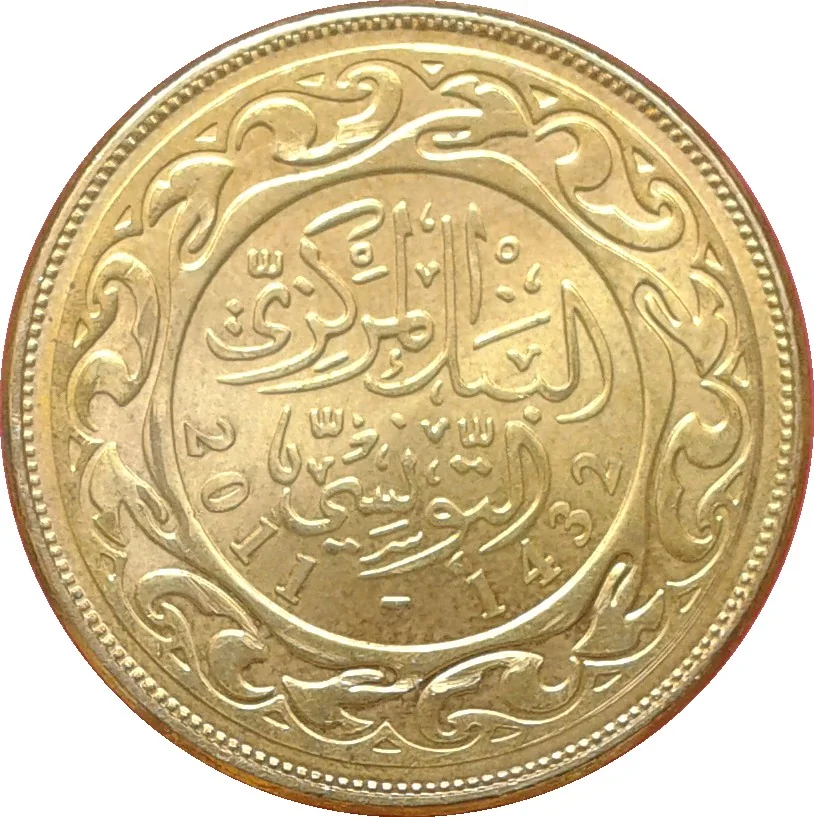
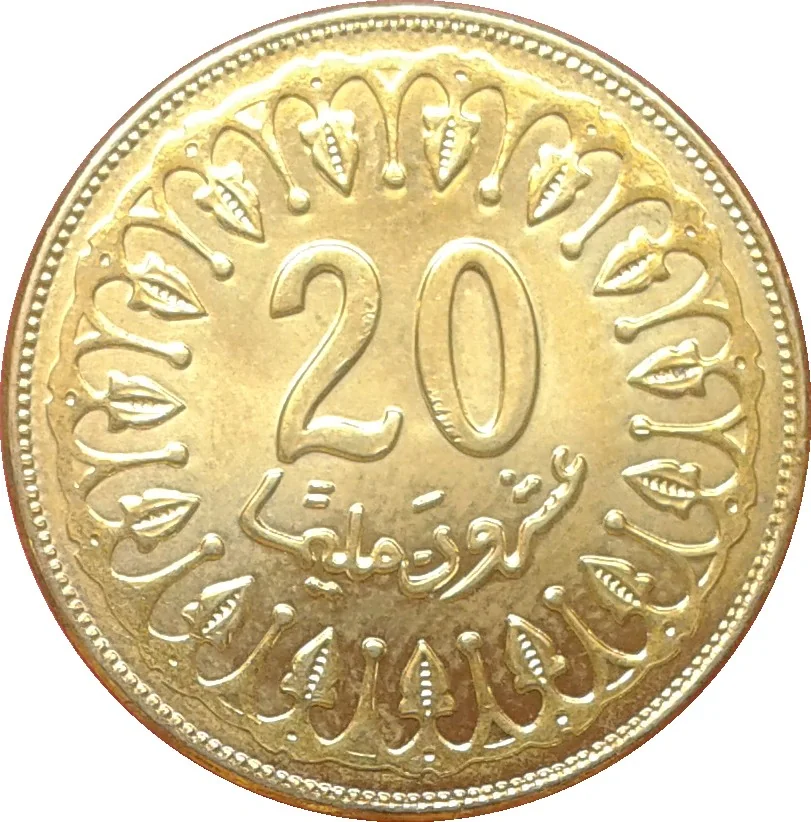
20 millimes – Tunisia
Add to wishlist
Tunisia
Obverse
Edge
Reeded
Mintings
| Year | Mint Mark | Mintage | Quality | Collection |
|---|---|---|---|---|
| 2007 | — | — | ||
| 2009 | — | — | ||
| 2011 | — | — | ||
| 2013 | — | — | ||
| 2017 | — | — |
Historical background
In 2007, Tunisia's currency situation was characterized by a tightly managed exchange rate regime and mounting economic pressures. The Tunisian dinar (TND) was, and remains, not freely convertible and was pegged to a weighted basket of currencies, heavily weighted toward the euro with a smaller US dollar component. The Central Bank of Tunisia (BCT) maintained strict control over the exchange rate, allowing only a very narrow band of fluctuation. This policy aimed to provide stability for trade, control inflation, and attract foreign investment, but it also limited monetary policy flexibility.
Economically, 2007 fell within the latter years of President Zine El Abidine Ben Ali's rule, a period marked by gradual trade liberalization but persistent structural issues. While the country experienced moderate GDP growth (around 6.3% in 2007), driven by textiles, tourism, and phosphates, it faced a growing trade deficit. The strong linkage to the euro also meant external shocks could be transmitted directly to the Tunisian economy. Furthermore, the managed rate created a disconnect with market fundamentals, leading to the emergence of a parallel black market for foreign currency, particularly euros and US dollars, where premiums were paid outside official channels.
Overall, the 2007 currency framework prioritized stability over flexibility. The BCT successfully maintained low and stable inflation (around 3.1% that year) and adequate foreign exchange reserves. However, the system masked underlying competitiveness problems and discouraged necessary economic adjustments. The rigidity of this managed peg, combined with the country's structural economic challenges, would later be cited as a contributing factor to the deeper financial and economic difficulties Tunisia faced in the years following the 2011 revolution.
Economically, 2007 fell within the latter years of President Zine El Abidine Ben Ali's rule, a period marked by gradual trade liberalization but persistent structural issues. While the country experienced moderate GDP growth (around 6.3% in 2007), driven by textiles, tourism, and phosphates, it faced a growing trade deficit. The strong linkage to the euro also meant external shocks could be transmitted directly to the Tunisian economy. Furthermore, the managed rate created a disconnect with market fundamentals, leading to the emergence of a parallel black market for foreign currency, particularly euros and US dollars, where premiums were paid outside official channels.
Overall, the 2007 currency framework prioritized stability over flexibility. The BCT successfully maintained low and stable inflation (around 3.1% that year) and adequate foreign exchange reserves. However, the system masked underlying competitiveness problems and discouraged necessary economic adjustments. The rigidity of this managed peg, combined with the country's structural economic challenges, would later be cited as a contributing factor to the deeper financial and economic difficulties Tunisia faced in the years following the 2011 revolution.
🌱 Very Common