

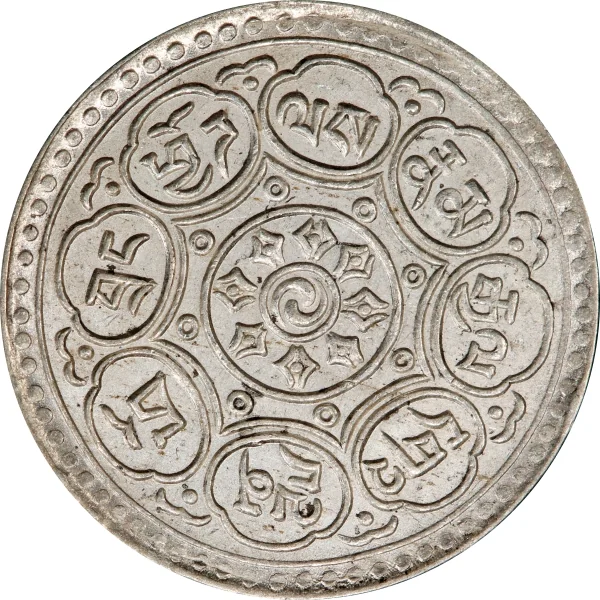
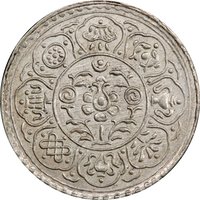
Obverse
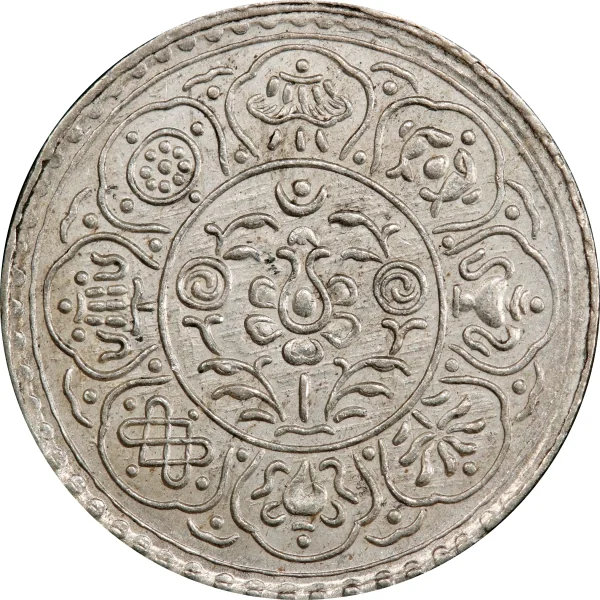
Reverse
Description:
A lotus with eight petals, each containing one of the Eight Auspicious Symbols: a parasol, conch, vase, banner, wheel, fish, knot, and lotus.
Edge
Reeded.
Mints
| Name | Mark |
|---|---|
| Tapchi Electric Machine Factory | — |
Mintings
| Year | Mint Mark | Mintage | Quality | Collection |
|---|---|---|---|---|
| 1953 | — | — |
Historical background
In 1953, Tibet's currency situation reflected a period of transitional and contested sovereignty following the entry of the People's Liberation Army (PLA) in 1950. The primary circulating currency was the Tibetan srang, a silver coinage system administered by the local government in Lhasa. This traditional currency, alongside Indian rupees and Chinese silver dayuan, facilitated trade, but the region's monetary system remained largely decentralized and historically isolated from modern banking.
This year was pivotal as the Seventeen Point Agreement, signed in 1951, theoretically affirmed Beijing's authority while guaranteeing the continuation of Tibet's existing political and monetary systems. In practice, 1953 saw the early stages of integration. The People's Bank of China (PBOC) established a branch in Lhasa, marking the initial institutional presence of the Chinese financial system. Its role was initially limited, focusing on servicing PLA troops and state trading companies, but it represented the first direct challenge to the srang's dominance.
Consequently, a dual-currency system began to emerge. The Tibetan srang remained in daily use for the local population, but the Chinese Renminbi (RMB) started circulating in official and military channels. This monetary duality created exchange complexities and foreshadowed the broader economic integration to come. The situation in 1953 was therefore one of surface-level stability under the Agreement, but with underlying tensions as two distinct monetary authorities coexisted, setting the stage for the eventual phasing out of local Tibetan currency in the years that followed.
This year was pivotal as the Seventeen Point Agreement, signed in 1951, theoretically affirmed Beijing's authority while guaranteeing the continuation of Tibet's existing political and monetary systems. In practice, 1953 saw the early stages of integration. The People's Bank of China (PBOC) established a branch in Lhasa, marking the initial institutional presence of the Chinese financial system. Its role was initially limited, focusing on servicing PLA troops and state trading companies, but it represented the first direct challenge to the srang's dominance.
Consequently, a dual-currency system began to emerge. The Tibetan srang remained in daily use for the local population, but the Chinese Renminbi (RMB) started circulating in official and military channels. This monetary duality created exchange complexities and foreshadowed the broader economic integration to come. The situation in 1953 was therefore one of surface-level stability under the Agreement, but with underlying tensions as two distinct monetary authorities coexisted, setting the stage for the eventual phasing out of local Tibetan currency in the years that followed.
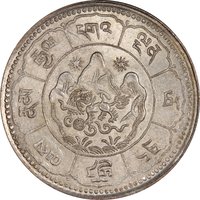
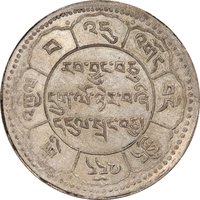
💎 Very Rare