

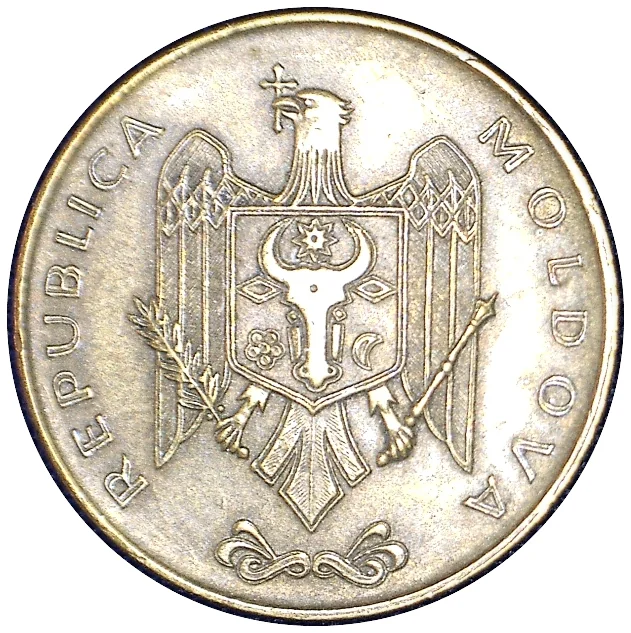
Obverse
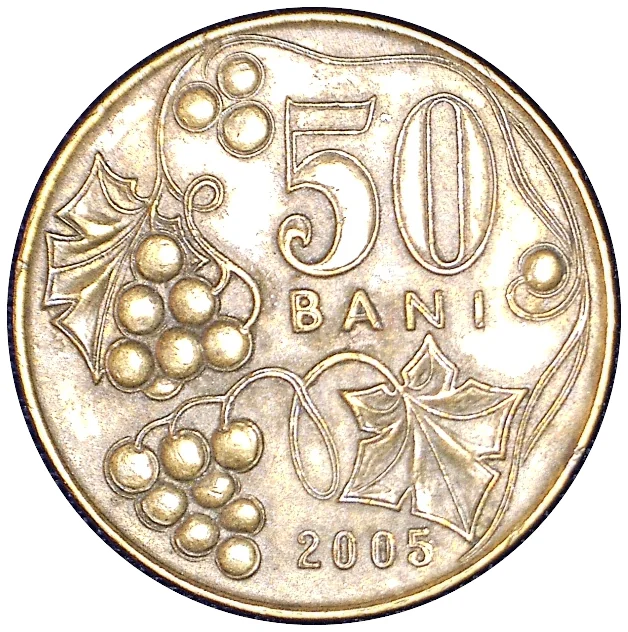
Reverse
Description:
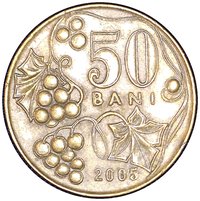
Denomination within stylized vines and grapes, year below.
Inscription:
50
BANI
2005
BANI
2005
Script: Latin
Engraver: Constantin Dumitrescu
Edge
Milled
Mintings
| Year | Mint Mark | Mintage | Quality | Collection |
|---|---|---|---|---|
| 1997 | — | — | ||
| 2003 | — | — | ||
| 2005 | — | — | ||
| 2008 | — | — |
Historical background
In 1997, Moldova's currency situation was characterized by a fragile and hard-won stability following a period of severe hyperinflation in the early 1990s. The national currency, the Moldovan leu (MDL), had been introduced in November 1993 to replace the temporary cupon and Soviet ruble, but it initially struggled. A crucial turning point came in late 1995 with the implementation of a rigorous IMF-backed stabilization program, which by 1997 had successfully tamed inflation through strict monetary control and fiscal austerity. This allowed the National Bank of Moldova (NBM) to establish a managed float exchange rate regime, bringing a much-needed sense of predictability to the financial system.
However, this stability was precarious and operated within a context of deep economic distress. Moldova was still grappling with the profound shocks of the Soviet Union's collapse, including the loss of integrated markets and a severe industrial decline. The 1997 economy was marked by widespread poverty, a large shadow economy, and a heavy dependence on agriculture and remittances from citizens working abroad. While the currency itself was no longer spiraling, the underlying productive economy remained weak, limiting the leu's strength and making the country vulnerable to external shocks.
Furthermore, the unresolved status of the Transnistria region posed a unique monetary complication. The breakaway territory continued to use a distinct currency, the Transnistrian ruble, which was not recognized by Moldova or the international community. This created a parallel monetary circuit, complicating trade and financial flows within the country's de facto borders. Thus, in 1997, Moldova presented a picture of surface-level monetary stability achieved through stringent policy, yet this stability was underpinned by a frail economic base and unresolved political fragmentation.
However, this stability was precarious and operated within a context of deep economic distress. Moldova was still grappling with the profound shocks of the Soviet Union's collapse, including the loss of integrated markets and a severe industrial decline. The 1997 economy was marked by widespread poverty, a large shadow economy, and a heavy dependence on agriculture and remittances from citizens working abroad. While the currency itself was no longer spiraling, the underlying productive economy remained weak, limiting the leu's strength and making the country vulnerable to external shocks.
Furthermore, the unresolved status of the Transnistria region posed a unique monetary complication. The breakaway territory continued to use a distinct currency, the Transnistrian ruble, which was not recognized by Moldova or the international community. This created a parallel monetary circuit, complicating trade and financial flows within the country's de facto borders. Thus, in 1997, Moldova presented a picture of surface-level monetary stability achieved through stringent policy, yet this stability was underpinned by a frail economic base and unresolved political fragmentation.
🌱 Very Common