

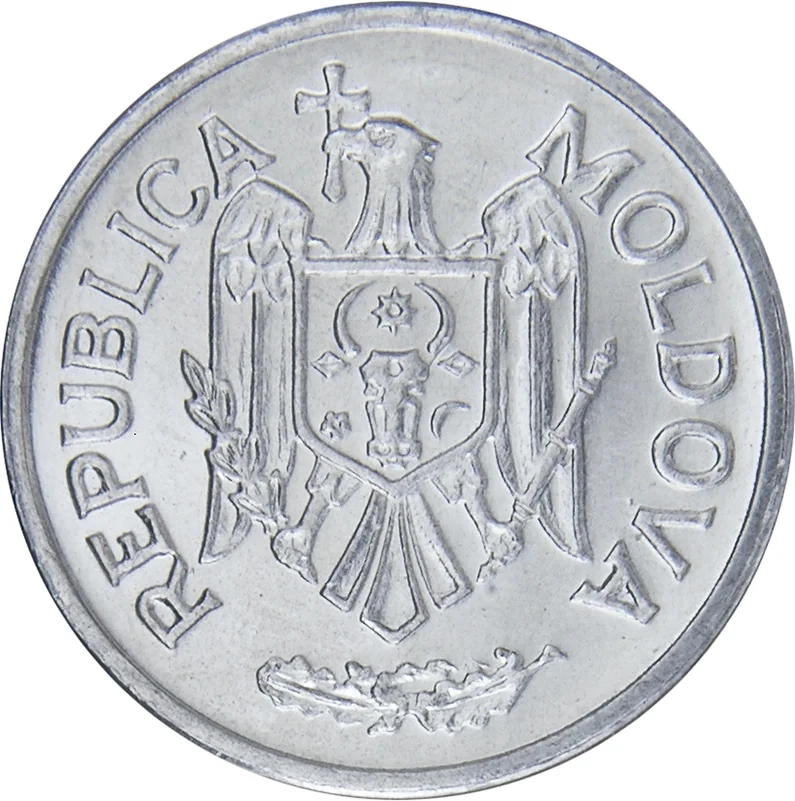
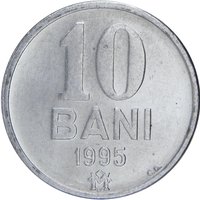
Obverse
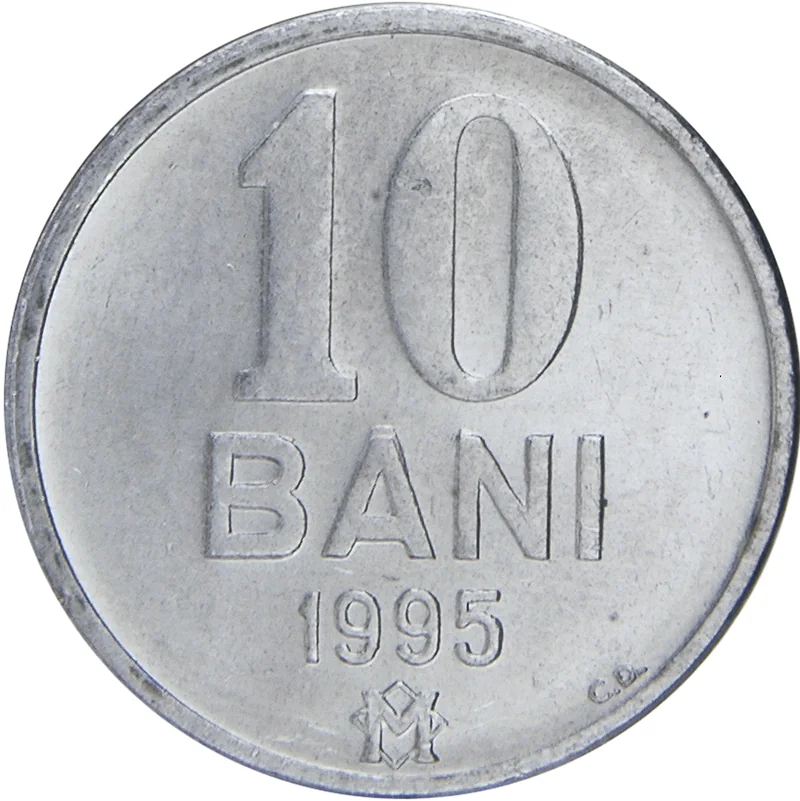
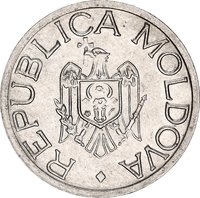
Reverse
Description:
Value above date, Moldova monogram below.
Inscription:
10
BANI
1995
M C.D.
BANI
1995
M C.D.
Script: Latin
Engraver: Constantin Dumitrescu
Edge
Plain
Mintings
| Year | Mint Mark | Mintage | Quality | Collection |
|---|---|---|---|---|
| 1995 | — | — | ||
| 1996 | — | — | ||
| 1997 | — | — | ||
| 1998 | — | — | ||
| 2000 | — | — | ||
| 2001 | — | — | ||
| 2002 | — | — | ||
| 2003 | — | — | ||
| 2004 | — | — | ||
| 2005 | — | — | ||
| 2006 | — | — | ||
| 2008 | — | — | ||
| 2010 | — | — | ||
| 2011 | — | — | ||
| 2013 | — | 14,900,000 | ||
| 2015 | — | 14,490,000 | ||
| 2016 | — | 15,000,000 | ||
| 2017 | — | 16,200,000 | ||
| 2018 | — | 4,400,000 | ||
| 2020 | — | — | ||
| 2021 | — | — | ||
| 2023 | — | — |
Historical background
In 1995, the Republic of Moldova was navigating the turbulent aftermath of the Soviet Union's collapse, grappling with severe economic contraction and hyperinflation. The national currency, the Moldovan leu (MDL), had been introduced in November 1993 to replace the Soviet and Russian rubles, marking a crucial step toward monetary independence. However, its early years were defined by instability; 1994 had seen inflation peak at over 300%, and by 1995, the government and the newly established National Bank of Moldova (BNM) were engaged in a difficult stabilization effort under an IMF-backed program.
The key focus in 1995 was on tightening monetary policy to crush hyperinflation. The BNM significantly raised interest rates and began to assert greater control over the money supply, moving away from the direct financing of government budget deficits. These harsh measures started to show results, with annual inflation falling dramatically to approximately 30% by year's end—a painful but necessary correction. The exchange rate, initially set via a dual-rate system (official and auction rates), was unified in June 1995, establishing a managed float that remained heavily influenced by the central bank's interventions to prevent excessive volatility.
Despite this progress, the underlying economy remained fragile. Industrial and agricultural output continued to decline, and the unresolved conflict in the Transnistria region, which used its own currency (the Transnistrian ruble), undermined economic unity and stability. Furthermore, widespread poverty, a growing shadow economy, and a lack of public confidence in the banking system posed significant challenges. Thus, while 1995 was a pivotal year of technical stabilization for the leu, setting the stage for future growth, the currency's environment was still one of transition and vulnerability within a struggling post-Soviet state.
The key focus in 1995 was on tightening monetary policy to crush hyperinflation. The BNM significantly raised interest rates and began to assert greater control over the money supply, moving away from the direct financing of government budget deficits. These harsh measures started to show results, with annual inflation falling dramatically to approximately 30% by year's end—a painful but necessary correction. The exchange rate, initially set via a dual-rate system (official and auction rates), was unified in June 1995, establishing a managed float that remained heavily influenced by the central bank's interventions to prevent excessive volatility.
Despite this progress, the underlying economy remained fragile. Industrial and agricultural output continued to decline, and the unresolved conflict in the Transnistria region, which used its own currency (the Transnistrian ruble), undermined economic unity and stability. Furthermore, widespread poverty, a growing shadow economy, and a lack of public confidence in the banking system posed significant challenges. Thus, while 1995 was a pivotal year of technical stabilization for the leu, setting the stage for future growth, the currency's environment was still one of transition and vulnerability within a struggling post-Soviet state.
🌱 Very Common