

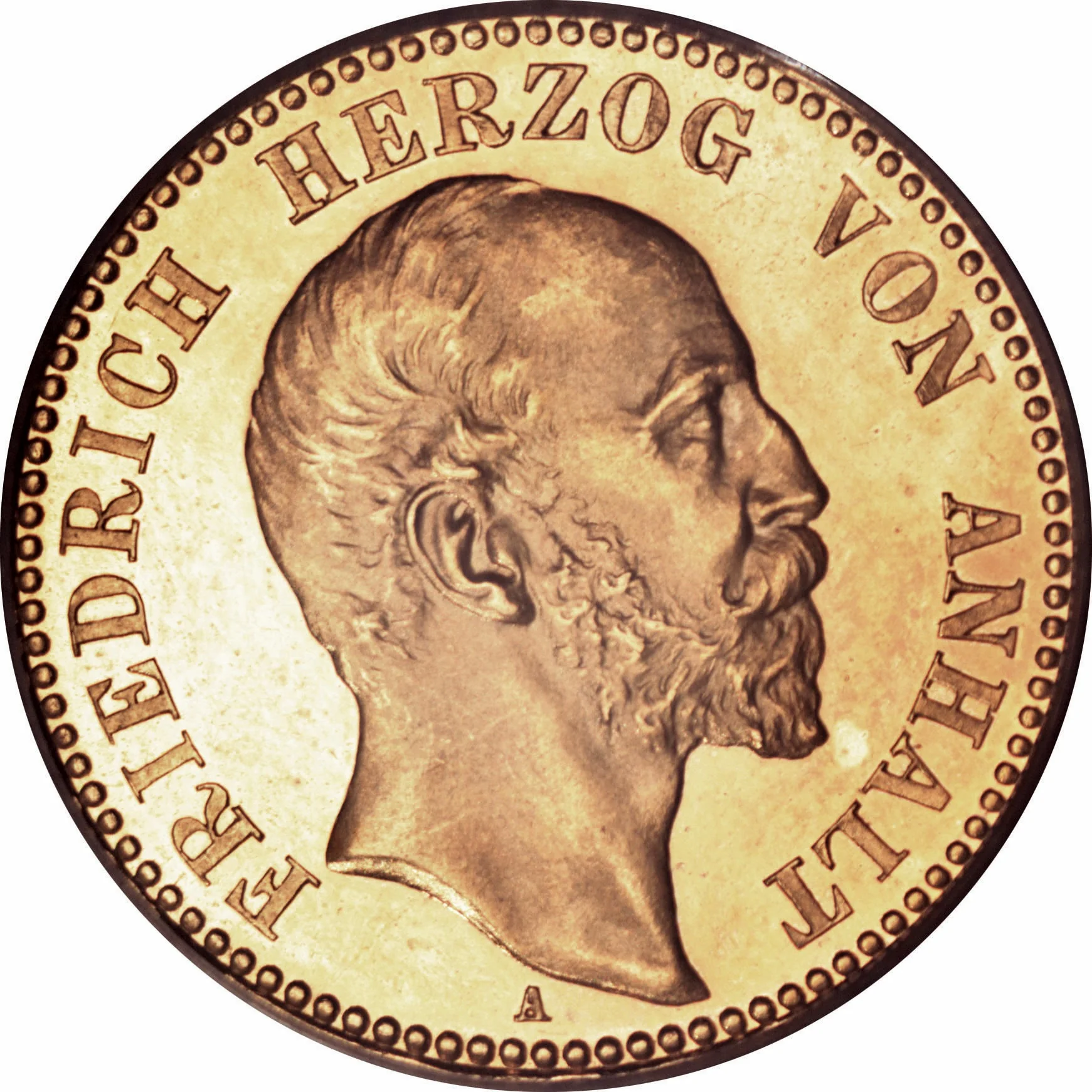
10 Mark – Anhalt-Dessau
Germany
Context
Years: 1896–1901
Country: Germany 
Issuer: Anhalt-Dessau
Ruler: Frederick I
Currency:
Demonetization: 16 August 1938
Total mintage: 40,400
Material
References
KM: #Click to copy to clipboard25
Numista: #47332
Value
Bullion value: $593.75
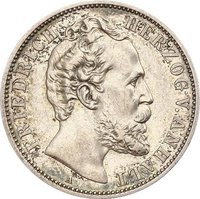
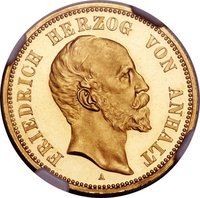
Obverse
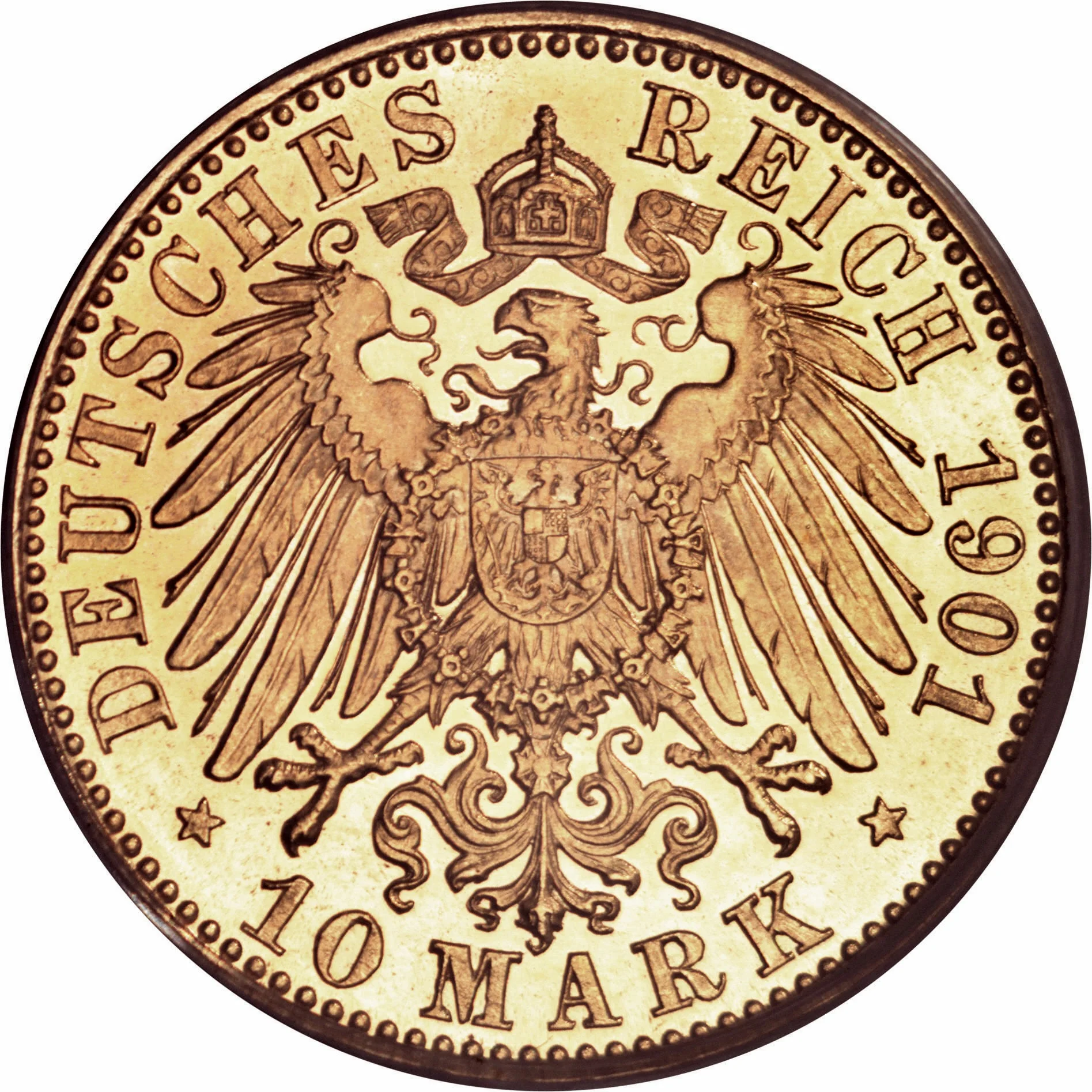
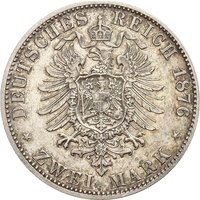
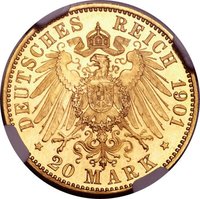
Reverse
Description:
Imperial German eagle with crown, inscriptions for date above and denomination below.
Inscription:
* DEUTSCHES REICH 1901 *
10 MARK
10 MARK
Script: Latin
Edge
Arabesque
Legend:
~ * ~
Mints
| Name | Mark |
|---|---|
| Berlin | A |
Historical background
In 1896, the currency situation in the Duchy of Anhalt-Dessau, like the rest of the German Empire, was characterized by stability and uniformity under the mark system established by the Coinage Act of 1873. Following German unification, the fragmented monetary systems of the former independent states were consolidated. Anhalt-Dessau, as a constituent state of the Empire, adopted the gold-standard Goldmark, which replaced its old regional thalers and gulden. This meant that by 1896, the Duchy's economy operated seamlessly within the national framework, using coins and banknotes issued by the Reichsbank and imperial mints.
The practical currency in circulation consisted of imperial gold coins (Mark and 10 Mark), silver subsidiary coins (½, 1, 2, and 5 Mark), and minor pfennig coins in copper-nickel. While the Anhalt state government retained the right to issue its own small-denomination Scheidemünzen (divisionary coins) for local use, these were strictly limited in quantity and value, and their designs bore the insignia of the Duchy alongside their value in the imperial mark. They were legally interchangeable at par with imperial coinage throughout Germany.
Thus, by 1896, any distinct "Anhalt-Dessau currency situation" was largely historical. The Duchy’s monetary policy was subsumed into that of the Empire, ensuring financial integration and facilitating trade. The primary economic concerns for the duchy were no longer monetary fragmentation but were instead aligned with broader imperial issues, such as maintaining the gold standard and managing the economic cycle within a rapidly industrializing national economy.
The practical currency in circulation consisted of imperial gold coins (Mark and 10 Mark), silver subsidiary coins (½, 1, 2, and 5 Mark), and minor pfennig coins in copper-nickel. While the Anhalt state government retained the right to issue its own small-denomination Scheidemünzen (divisionary coins) for local use, these were strictly limited in quantity and value, and their designs bore the insignia of the Duchy alongside their value in the imperial mark. They were legally interchangeable at par with imperial coinage throughout Germany.
Thus, by 1896, any distinct "Anhalt-Dessau currency situation" was largely historical. The Duchy’s monetary policy was subsumed into that of the Empire, ensuring financial integration and facilitating trade. The primary economic concerns for the duchy were no longer monetary fragmentation but were instead aligned with broader imperial issues, such as maintaining the gold standard and managing the economic cycle within a rapidly industrializing national economy.
✨ Legendary