

1 Penny – United Kingdom
United Kingdom
Context
Years: 1841–1860
Issuer: United Kingdom 
Ruler: Victoria
Currency:
(1158—1970)
Demonetization: 31 December 1869
Total mintage: 16,734,300
Material
References
KM: #Click to copy to clipboard739
Numista: #4721
Obverse
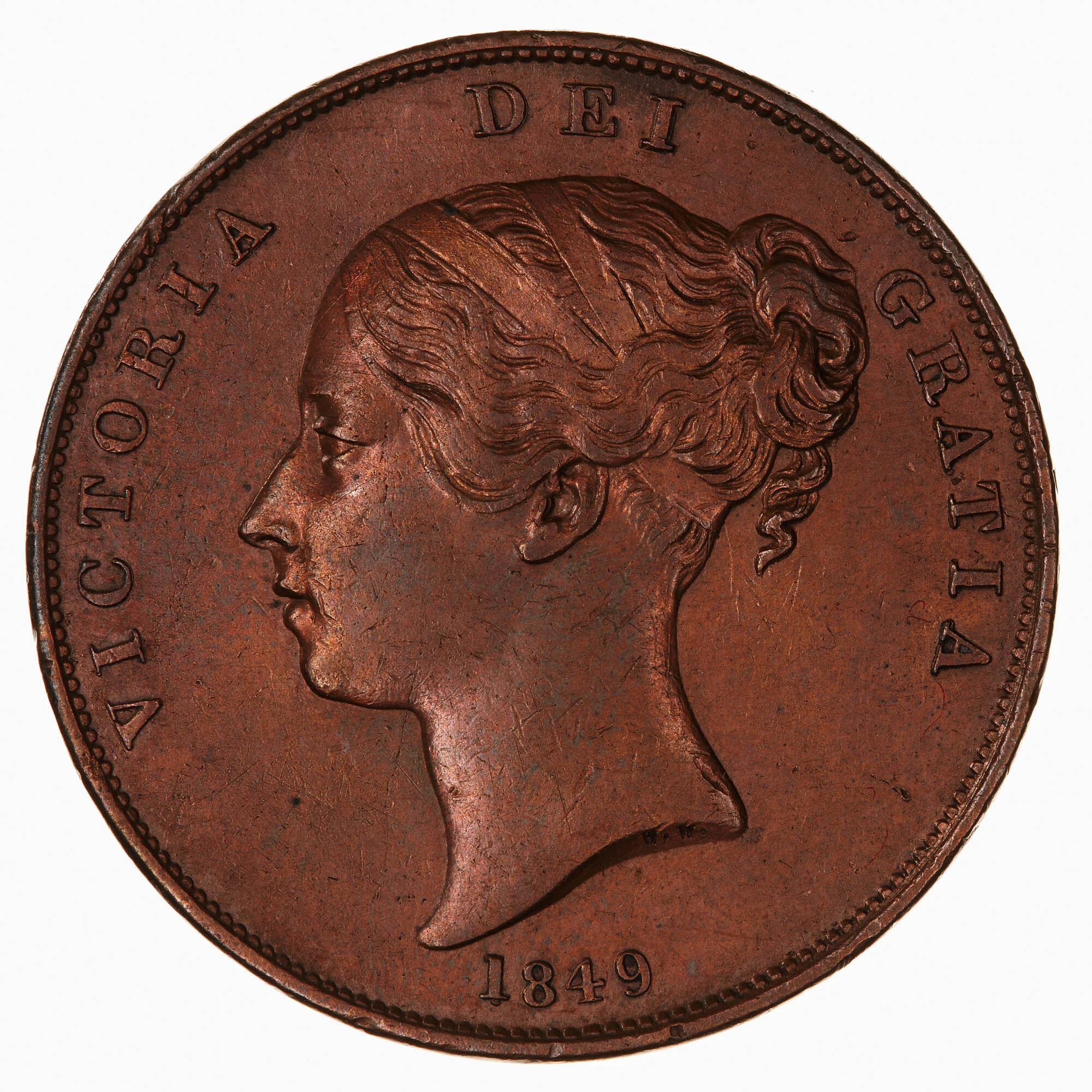
Description:
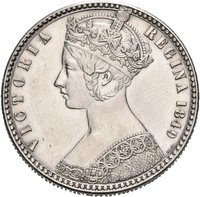
Queen Victoria's "Young Head" bust left, legend around, date below.
Inscription:
VICTORIA DEI GRATIA
1841
1841
Translation:
Victoria by the Grace of God
Script: Latin
Language: Latin
Engraver: William Wyon
Reverse
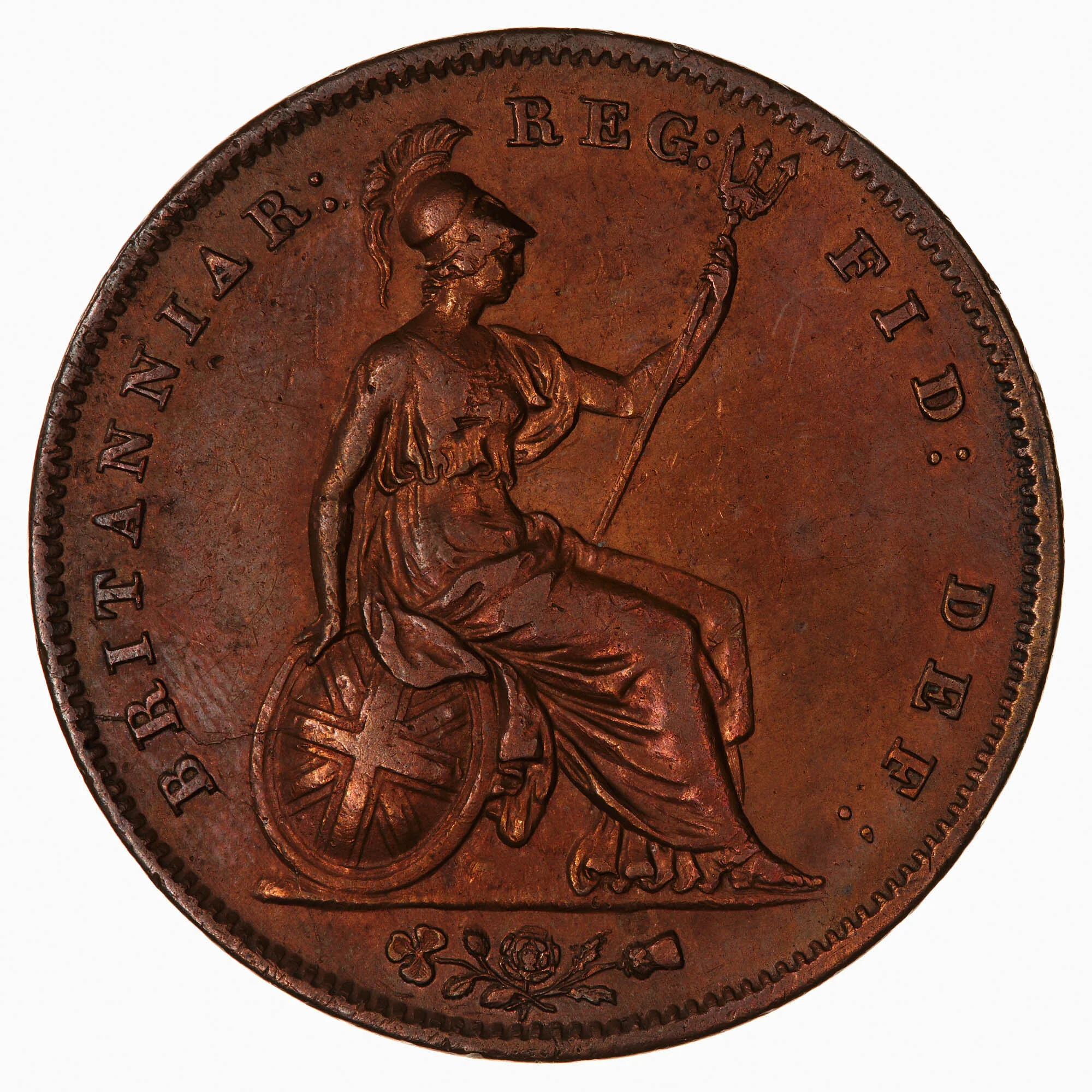
Description:
Britannia seated right, holding trident and Union Jack shield, with legend around and floral emblems below. Note: colon placements and trident varieties exist.
Inscription:
BRITANNIAR: REG FID: DEF:
Translation:
King of the Britains, Defender of the Faith
Script: Latin
Language: Latin
Engraver: William Wyon
Edge
Plain
Mints
| Name | Mark |
|---|---|
| Royal Mint (Tower Hill) | — |
Mintings
| Year | Mint Mark | Mintage | Quality | Collection |
|---|---|---|---|---|
| 1841 | — | — | Proof | |
| 1841 | — | — | ||
| 1843 | — | — | ||
| 1844 | — | 215,000 | ||
| 1844 | — | — | Proof | |
| 1845 | — | 322,500 | ||
| 1846 | — | — | ||
| 1847 | — | — | ||
| 1848 | — | 161,200 | ||
| 1849 | — | 268,800 | ||
| 1851 | — | 432,200 | ||
| 1853 | — | 1,021,400 | ||
| 1853 | — | — | Proof | |
| 1854 | — | 6,720,000 | ||
| 1855 | — | 5,273,800 | ||
| 1856 | — | 1,212,200 | ||
| 1856 | — | — | Proof | |
| 1857 | — | — | ||
| 1858 | — | — | ||
| 1859 | — | — | Proof | |
| 1859 | — | 1,075,200 | ||
| 1860 | — | 32,000 |
Historical background
In 1841, the United Kingdom operated under a bimetallic system, but was effectively on a de facto gold standard following the 1816 Coinage Act, which formally established gold as the sole standard of value and introduced the sovereign. Silver coins were legal tender only for limited amounts, functioning as subsidiary currency. However, the period was marked by monetary instability and debate. The Bank Charter Act of 1844, though three years away, was being fervently discussed as a solution to recurring financial crises, with the "Currency School" arguing for strict regulation of banknote issuance to prevent inflation and protect gold reserves.
The broader currency situation was complex, characterised by a shortage of small denomination coinage for everyday transactions. This gap was often filled by private token coinage issued by merchants and even some municipalities, as well as worn and underweight silver coins from earlier reigns. Furthermore, the banking system was fragmented: hundreds of private banks in England and Wales issued their own banknotes, leading to variability in trust and acceptance, while joint-stock banks (outside a 65-mile radius of London) also added to the diverse, and sometimes unreliable, paper currency in circulation.
Economically, the nation was still grappling with the aftermath of the Panic of 1837 and a severe depression in the early 1840s. Deflationary pressures increased the real burden of debt, causing widespread distress, particularly among the landed and agricultural classes. This economic context fuelled the intense political and economic debate between the "Currency School" and the "Banking School" over the control of money supply, a debate that would culminate in the pivotal Bank Charter Act of 1844, aiming to centralise note-issuing authority with the Bank of England and tie note issuance strictly to gold reserves.
The broader currency situation was complex, characterised by a shortage of small denomination coinage for everyday transactions. This gap was often filled by private token coinage issued by merchants and even some municipalities, as well as worn and underweight silver coins from earlier reigns. Furthermore, the banking system was fragmented: hundreds of private banks in England and Wales issued their own banknotes, leading to variability in trust and acceptance, while joint-stock banks (outside a 65-mile radius of London) also added to the diverse, and sometimes unreliable, paper currency in circulation.
Economically, the nation was still grappling with the aftermath of the Panic of 1837 and a severe depression in the early 1840s. Deflationary pressures increased the real burden of debt, causing widespread distress, particularly among the landed and agricultural classes. This economic context fuelled the intense political and economic debate between the "Currency School" and the "Banking School" over the control of money supply, a debate that would culminate in the pivotal Bank Charter Act of 1844, aiming to centralise note-issuing authority with the Bank of England and tie note issuance strictly to gold reserves.

🌱 Very Common