

1 Groschen – Principality of Lippe
Context
References
KM: #Click to copy to clipboard1
Numista: #47203
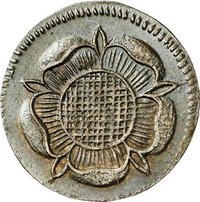
Obverse
Description:
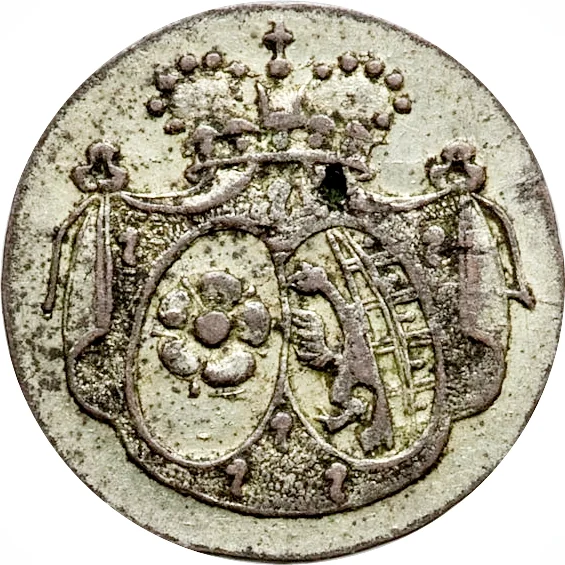
Crowned and mantled coat of arms.
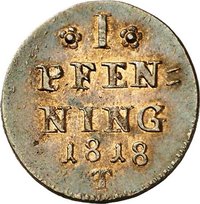
Reverse
Edge
Plain
Mints
| Name | Mark |
|---|---|
| Detmold | — |
Mintings
| Year | Mint Mark | Mintage | Quality | Collection |
|---|---|---|---|---|
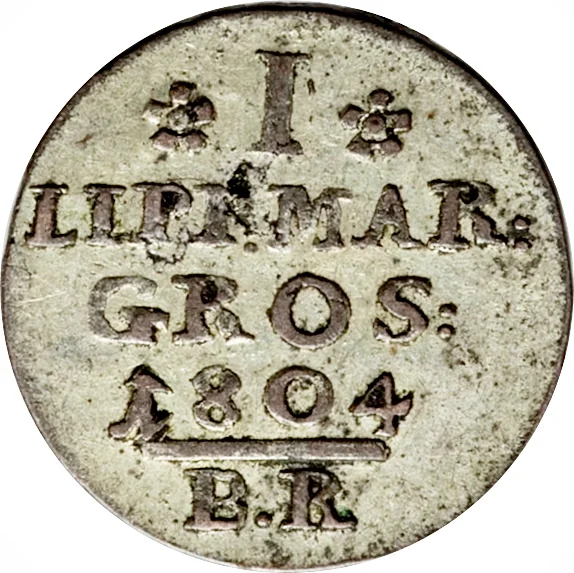
| 1804 | BR | — |
Historical background
In 1804, the currency situation in the Principality of Lippe was complex and fragmented, typical of the Holy Roman Empire's decentralized political structure. The principality did not have a fully sovereign monetary system but operated within a network of regional and convention currencies. The primary accounting unit was the Reichsthaler, divided into 24 Gute Groschen, each of 12 Pfennige. However, actual circulating coinage included a mix of coins minted by Lippe-Detmold itself, alongside numerous foreign coins from neighboring states like Hanover, Brunswick, and Prussia, as well as older imperial coins, all valued according to locally accepted conversion rates.
The Lippe mint in Detmold produced limited quantities of small change, primarily Gute Groschen and Pfennige, to facilitate local trade. These coins often had limited circulation beyond Lippe's borders. For larger transactions, the widely accepted Conventionsthaler (a silver standard used across northern Germany) and Prussian Thalers were crucial. This reliance on external "high-value" currency underscored Lippe's economic integration into wider regional networks and its lack of substantial silver reserves to mint significant quantities of its own large-denomination coins.
This monetary mosaic created practical challenges for commerce and administration, requiring published exchange lists (Kurantzettel) to navigate the values of diverse coins. The situation was inherently unstable, susceptible to fluctuations in the metallic content of foreign coins and arbitrage. Within a year, the upheaval of the Napoleonic Wars would dramatically alter this landscape; the dissolution of the Holy Roman Empire in 1806 and Lippe's subsequent entry into the Rhine Confederation would begin a process of monetary realignment toward French-influenced systems, setting the stage for the later standardization under the German Zollverein.
The Lippe mint in Detmold produced limited quantities of small change, primarily Gute Groschen and Pfennige, to facilitate local trade. These coins often had limited circulation beyond Lippe's borders. For larger transactions, the widely accepted Conventionsthaler (a silver standard used across northern Germany) and Prussian Thalers were crucial. This reliance on external "high-value" currency underscored Lippe's economic integration into wider regional networks and its lack of substantial silver reserves to mint significant quantities of its own large-denomination coins.
This monetary mosaic created practical challenges for commerce and administration, requiring published exchange lists (Kurantzettel) to navigate the values of diverse coins. The situation was inherently unstable, susceptible to fluctuations in the metallic content of foreign coins and arbitrage. Within a year, the upheaval of the Napoleonic Wars would dramatically alter this landscape; the dissolution of the Holy Roman Empire in 1806 and Lippe's subsequent entry into the Rhine Confederation would begin a process of monetary realignment toward French-influenced systems, setting the stage for the later standardization under the German Zollverein.
💎 Extremely Rare