

1000 bahts – Thailand
Add to wishlist
Non-circulating coins
Commemoration: Rama X attaining the same age of Rama I
Thailand
Obverse
Description:
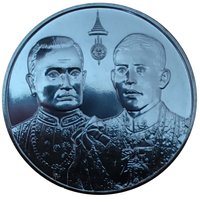
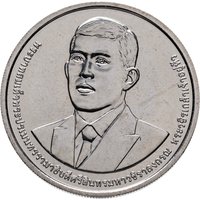
Conjoined busts of Kings Buddha Yodfa Chulaloke and Vajiralongkorn, facing slightly inward. Below, the Chakri emblem under a nine-tiered umbrella.
Reverse
Description:
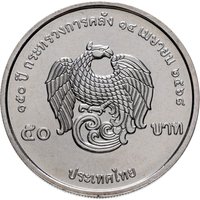
Left: King Buddha Yodfa Chulaloke's privy seal (Unalom in a lotus cartouche).
Right: King Vajiralongkorn's Royal Cypher Medal ("วปร" under the numeral ๑๐).
Right: King Vajiralongkorn's Royal Cypher Medal ("วปร" under the numeral ๑๐).
Inscription:
๑๐๐๐ บาท
๑๔ มกราคม ๒๕๔๓ ประเทศไทย
พระราชพิธีสมมงคลพระชนมายุเท่าพระบาทสมเด็จพระพุทธยอดฟ้าจุฬาโลกมหาราช
๑๔ มกราคม ๒๕๔๓ ประเทศไทย
พระราชพิธีสมมงคลพระชนมายุเท่าพระบาทสมเด็จพระพุทธยอดฟ้าจุฬาโลกมหาราช
Translation:
1000 Baht
14 January 2000, Thailand
Royal Ceremony on the Auspicious Occasion of His Majesty's Age Equaling that of King Buddha Yodfa Chulaloke the Great
14 January 2000, Thailand
Royal Ceremony on the Auspicious Occasion of His Majesty's Age Equaling that of King Buddha Yodfa Chulaloke the Great
Script: Thai
Language: Thai
Edge
Reeded.
Mintings
| Year | Mint Mark | Mintage | Quality | Collection |
|---|---|---|---|---|
| 2025 | — | — | ||
| 2025 | — | — | Proof |
Historical background
In 2025, Thailand's currency, the baht (THB), remains under significant pressure from a complex mix of domestic and international factors. Externally, the baht continues to be highly sensitive to U.S. Federal Reserve monetary policy, with sustained higher-for-longer interest rates strengthening the U.S. dollar and drawing capital away from emerging markets like Thailand. This is compounded by global economic uncertainty and subdued demand for Thai exports, a critical pillar of the economy, from key trading partners. Internally, the economy faces headwinds from high household debt, an aging demographic, and a slower-than-expected recovery in the vital tourism sector, which has struggled to regain its pre-pandemic spending levels despite robust arrival numbers.
The Bank of Thailand (BOT) faces a delicate policy dilemma, often placing it at odds with the government's stimulus ambitions. While many regional central banks have shifted toward easing, the BOT has maintained a relatively hawkish stance, keeping its policy rate elevated to curb inflation and support the baht, thereby protecting import prices and foreign reserves. This has created public tension, as the government advocates for rate cuts to lower borrowing costs and stimulate sluggish growth. The baht's volatility is therefore not just a reaction to market forces but also a reflection of this perceived policy divergence between fiscal and monetary authorities.
Looking ahead, the currency's trajectory in 2025 hinges on several unresolved issues. A decisive pivot by the U.S. Fed toward rate cuts could provide much-needed relief and reverse capital outflows. Domestically, the effectiveness of government digital wallet stimulus measures and a sustained uptick in high-value tourism and export recovery are crucial for strengthening economic fundamentals and investor confidence. Until these domestic drivers gain momentum, the baht is likely to remain vulnerable to global dollar strength, with the BOT carefully intervening to smooth excessive volatility rather than targeting a specific level, prioritizing financial stability over competitive devaluation.
The Bank of Thailand (BOT) faces a delicate policy dilemma, often placing it at odds with the government's stimulus ambitions. While many regional central banks have shifted toward easing, the BOT has maintained a relatively hawkish stance, keeping its policy rate elevated to curb inflation and support the baht, thereby protecting import prices and foreign reserves. This has created public tension, as the government advocates for rate cuts to lower borrowing costs and stimulate sluggish growth. The baht's volatility is therefore not just a reaction to market forces but also a reflection of this perceived policy divergence between fiscal and monetary authorities.
Looking ahead, the currency's trajectory in 2025 hinges on several unresolved issues. A decisive pivot by the U.S. Fed toward rate cuts could provide much-needed relief and reverse capital outflows. Domestically, the effectiveness of government digital wallet stimulus measures and a sustained uptick in high-value tourism and export recovery are crucial for strengthening economic fundamentals and investor confidence. Until these domestic drivers gain momentum, the baht is likely to remain vulnerable to global dollar strength, with the BOT carefully intervening to smooth excessive volatility rather than targeting a specific level, prioritizing financial stability over competitive devaluation.


✨ Legendary