

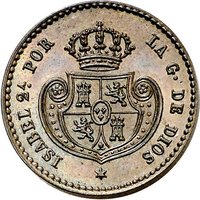
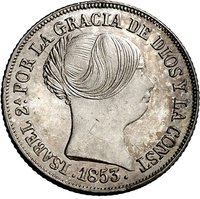
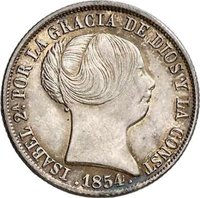
Obverse
Description:
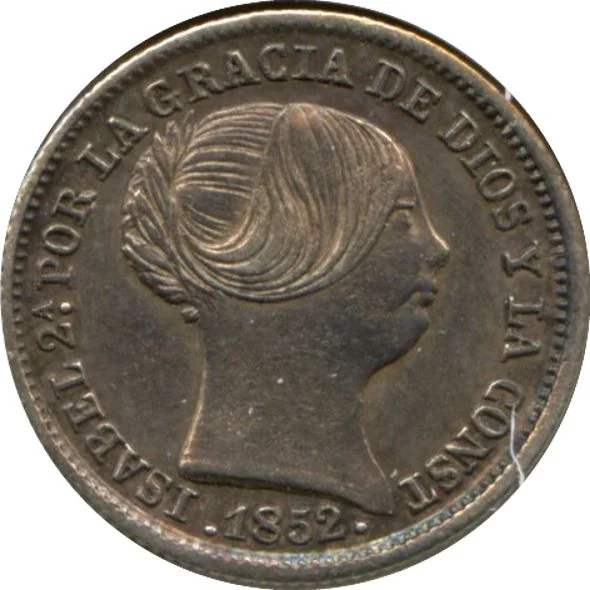
Young Isabella II facing right.
Inscription:
ISABEL 2A. POR LA GRACIA DE DIOS Y LA CONST
.1852.
.1852.
Translation:
Isabel 2nd, by the Grace of God and the Constitution.
1852.
1852.
Script: Latin
Language: Spanish
Engraver: Remigio Vega
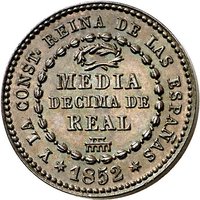
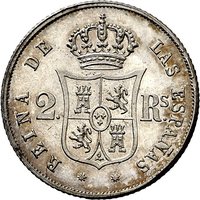
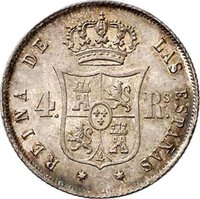
Reverse
Description:
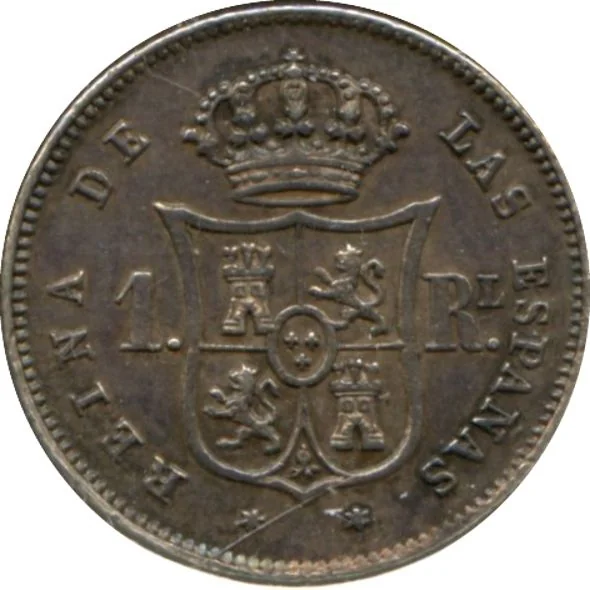
Royal arms of Spain.
Inscription:
* REINA DE LAS ESPAÑAS *
1. RL.
1. RL.
Translation:
Queen of the Spains
1. R. L.
1. R. L.
Script: Latin
Language: Spanish
Engraver: Remigio Vega
Edge
Reeded
Categories
| Symbols> Coat of Arms |
Mints
| Name | Mark |
|---|---|
| Barcelona Mint / La Seca | — |
| Royal Mint of Madrid | — |
| Royal Mint of Seville | — |
Mintings
| Year | Mint Mark | Mintage | Quality | Collection |
|---|---|---|---|---|
| 1852 | — | — | ||
| 1853 | — | — | ||
| 1854 | — | — | ||
| 1855 | — | — |
Historical background
In 1852, Spain's currency system was a complex and fragmented legacy of its turbulent early 19th century, characterized by political instability, war, and fiscal crisis. The nation operated on a bimetallic standard in theory, but in practice, it suffered from a severe shortage of precious metal coinage. The state's chronic budget deficits had led to repeated debasements and the issuance of vast quantities of low-quality fractional coinage (calderilla), as well as paper money from the Banco de España and other banks of issue. This resulted in a chaotic monetary landscape where the value and acceptance of coins and notes varied significantly by region, undermining commerce and economic confidence.
The situation was further complicated by the circulation of numerous foreign coins, particularly French francs, which were often preferred for their reliable metallic content. Domestically, the most trusted and widely used coin was the silver real and its higher unit, the peseta (equivalent to 4 reales), though the gold escudo was the official standard. The government's inability to control the money supply or guarantee the value of its currency created a dual system: transactions for large sums or international trade relied on a premium for sound metallic money, while everyday commerce was conducted with a confusing array of depreciated tokens and suspect paper.
This monetary disarray was a significant obstacle to national economic modernization and a point of political contention. Reformist voices, influenced by the monetary stability seen in France and Britain, increasingly called for a unified, decimal-based system guaranteed by the state. The year 1852 itself did not see a major reform enacted, but it existed within a period of mounting pressure that would culminate in the pivotal Monetary Law of June 26, 1864. This law would later establish the peseta as Spain's sole monetary unit, finally creating a decimal, national currency in an attempt to resolve the decades of confusion that defined the mid-century period.
The situation was further complicated by the circulation of numerous foreign coins, particularly French francs, which were often preferred for their reliable metallic content. Domestically, the most trusted and widely used coin was the silver real and its higher unit, the peseta (equivalent to 4 reales), though the gold escudo was the official standard. The government's inability to control the money supply or guarantee the value of its currency created a dual system: transactions for large sums or international trade relied on a premium for sound metallic money, while everyday commerce was conducted with a confusing array of depreciated tokens and suspect paper.
This monetary disarray was a significant obstacle to national economic modernization and a point of political contention. Reformist voices, influenced by the monetary stability seen in France and Britain, increasingly called for a unified, decimal-based system guaranteed by the state. The year 1852 itself did not see a major reform enacted, but it existed within a period of mounting pressure that would culminate in the pivotal Monetary Law of June 26, 1864. This law would later establish the peseta as Spain's sole monetary unit, finally creating a decimal, national currency in an attempt to resolve the decades of confusion that defined the mid-century period.
Series: 1852 Spain circulation coins
🌟 Uncommon