

10 Cash – Kiangsu Province
China
Context
Years: 1904–1905
Country: China 
Issuer: Kiangsu Province
Ruler: Guangxu
Currency:
(1901—1949)
Demonetized: Yes
Material
Diameter: 28 mm
Weight: 7.63 g
Thickness: 1.7 mm
Shape: Round
Composition: Copper
Standard: Silver quarter ounce
Magnetic: No
Technique: Milled
Alignment: Medal alignment
flip
References
Y: #Click to copy to clipboard160
Numista: #46781
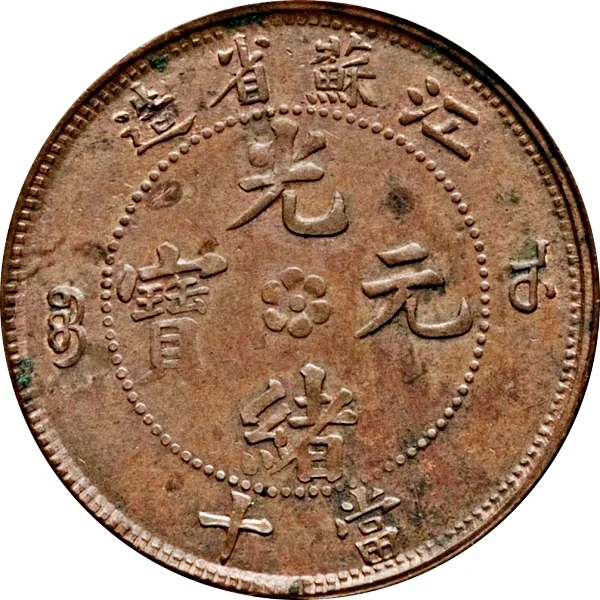
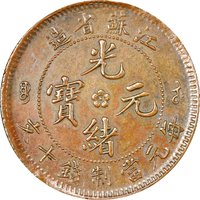
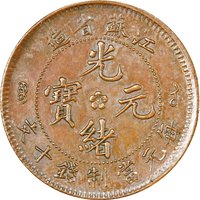
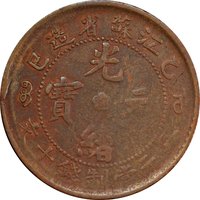
Obverse
Description:
Four Chinese ideograms read vertically, with a central flower motif, flanked by Manchu text and surrounded by additional Chinese characters.
Inscription:
造省蘇江
ᠪᠣᠣ ᠰᡠ
光
寶元
緒
十當
ᠪᠣᠣ ᠰᡠ
光
寶元
緒
十當
Translation:
Boo Su
Guang
Baoyuan
Xu
Ten Tang
Guang
Baoyuan
Xu
Ten Tang
Scripts: Chinese, Mongolian / Manchu
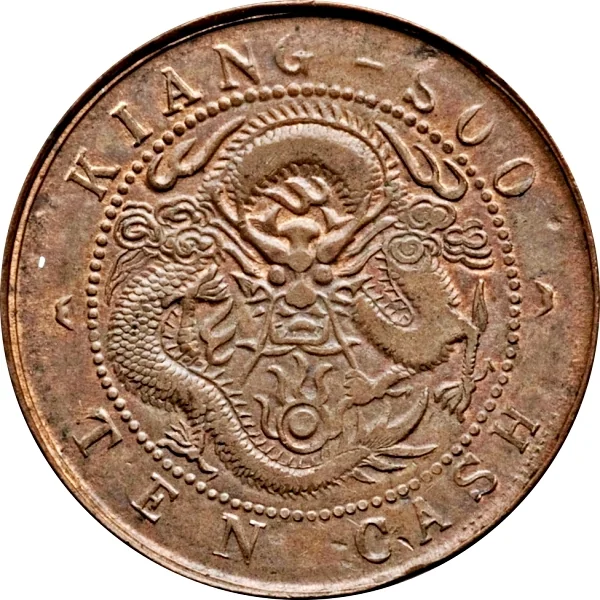
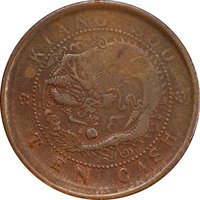
Reverse
Description:
Dragon encircling a pearl, surrounded by English text.
Inscription:
KIANG-SOO
TEN CASH
TEN CASH
Script: Latin
Edge
Plain
Categories
| Mythology> Fantastic animal |
| Plants> Flower |
Mintings
| Year | Mint Mark | Mintage | Quality | Collection |
|---|---|---|---|---|
| — | — | — |
Historical background
In 1904, Kiangsu (Jiangsu) Province, as a core economic region of the late Qing Empire, operated within a complex and chaotic multi-currency system. The primary medium for large-scale transactions and government tax payments remained the silver tael (liang), but there was no standard coin. Instead, silver circulated in the form of irregular sycee ingots, whose weight and purity varied between cities—the Shanghai tael, the Nanking tael, and others all had different values. This necessitated specialized money changers (qianzhuang) for every inter-city transaction, creating inefficiency and opportunity for fraud.
Alongside silver, a vast quantity of copper cash coins (wen) circulated for everyday retail trade. However, the supply and quality of these coins were highly unstable due to provincial mint overproduction and widespread counterfeiting, leading to fluctuating exchange rates between copper and silver. Critically, the period saw an accelerating influx of foreign silver dollars, particularly Mexican "Eagle" dollars and later British trade dollars, which entered via Shanghai's international port. Their standardized weight and reliability made them highly popular in coastal Kiangsu, further undermining the official Qing currency system.
This monetary fragmentation reflected the weakening central authority of the Qing dynasty. Provincial mints issued their own coinage, and the imperial court lacked the power to impose a uniform standard. The situation in Kiangsu, poised between the traditional inland economy and the booming international trade of Shanghai, thus epitomized the broader crisis: a traditional bimetallic system in decay, increasingly displaced by de facto foreign currency and unregulated local issues, which stifled commerce and highlighted the state's inability to control its own fiscal foundations.
Alongside silver, a vast quantity of copper cash coins (wen) circulated for everyday retail trade. However, the supply and quality of these coins were highly unstable due to provincial mint overproduction and widespread counterfeiting, leading to fluctuating exchange rates between copper and silver. Critically, the period saw an accelerating influx of foreign silver dollars, particularly Mexican "Eagle" dollars and later British trade dollars, which entered via Shanghai's international port. Their standardized weight and reliability made them highly popular in coastal Kiangsu, further undermining the official Qing currency system.
This monetary fragmentation reflected the weakening central authority of the Qing dynasty. Provincial mints issued their own coinage, and the imperial court lacked the power to impose a uniform standard. The situation in Kiangsu, poised between the traditional inland economy and the booming international trade of Shanghai, thus epitomized the broader crisis: a traditional bimetallic system in decay, increasingly displaced by de facto foreign currency and unregulated local issues, which stifled commerce and highlighted the state's inability to control its own fiscal foundations.
💎 Very Rare