

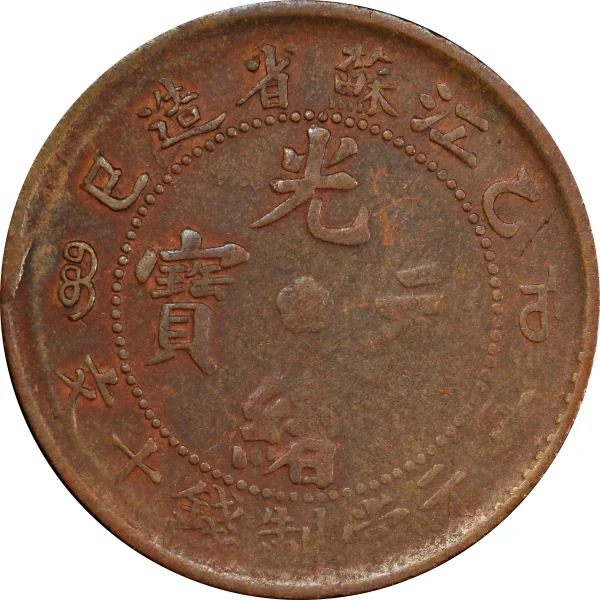
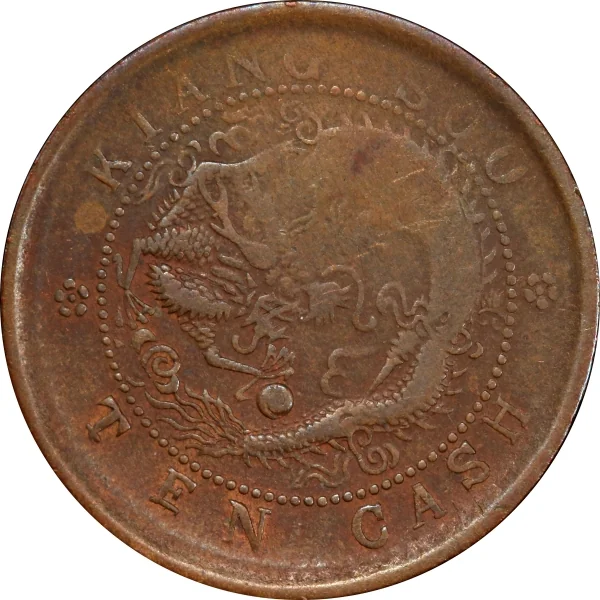
10 Cash – Kiangsu Province
China
Context
Year: 1905
Country: China 
Issuer: Kiangsu Province
Ruler: Guangxu
Currency:
(1901—1949)
Demonetized: Yes
Material
References
Y: #Click to copy to clipboard162.10-162
Numista: #287040
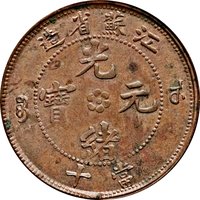
Obverse
Description:
Four Chinese ideograms read vertically, with a central flower motif, flanked by Manchu text and surrounded by additional Chinese characters.
Inscription:
造省蘇江
巳乙
ᠪᠣᠣ ᠰᡠ
光
寶元
緒
文十錢當元毎
巳乙
ᠪᠣᠣ ᠰᡠ
光
寶元
緒
文十錢當元毎
Translation:
Made in Jiangsu Province.
Yi-Si (Year 60 of the 60-year cycle).
Boo Su (Manchu for "Jiangsu").
Guangxu (Reign Title).
Yuan Bao (Coin Inscription).
Every Yuan (Dollar) equals ten Wen (Cash).
Yi-Si (Year 60 of the 60-year cycle).
Boo Su (Manchu for "Jiangsu").
Guangxu (Reign Title).
Yuan Bao (Coin Inscription).
Every Yuan (Dollar) equals ten Wen (Cash).
Scripts: Chinese, Mongolian / Manchu
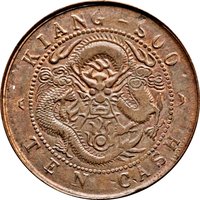
Reverse
Description:
Dragon encircling a pearl, surrounded by English text.
Inscription:
KIANG-SOO
TEN CASH
TEN CASH
Script: Latin
Edge
Plain
Categories
| Mythology> Fantastic animal |
| Plants> Flower |
Mintings
| Year | Mint Mark | Mintage | Quality | Collection |
|---|---|---|---|---|
| 1905 | — | — |
Historical background
In 1905, the currency situation in Kiangsu (Jiangsu) Province was a complex and chaotic reflection of China's late Qing dynasty monetary system, characterized by a debilitating multiplicity of concurrent currencies. The province, a wealthy commercial and agricultural hub centered on Shanghai and the Yangtze Delta, was a nexus for domestic and foreign trade. This economic activity was serviced not by a single, unified currency, but by a tangled web of silver sycee (measured in taels), foreign-minted silver dollars (especially Mexican and later British Trade Dollars), Chinese imperial and provincial copper cash coins, and a growing circulation of banknotes from native banks (qianzhuang), modern Chinese banks, and foreign commercial banks. The lack of a standard unit meant exchange rates between these forms fluctuated daily, creating significant transaction costs, uncertainty for merchants, and vulnerability to speculation.
The core of the problem lay in the silver tael system, which itself was not standardized. Different trades and cities in Kiangsu used different "tael" units, such as the Kuping tael for official treasury payments, the Caoping tael for salt merchant transactions, and the locally dominant Shanghai tael or Shanghai Sycee for commerce. This meant that 100 taels of Shanghai sycee did not equal 100 taels of Kuping sycee in pure silver content, requiring complex conversions. Meanwhile, the convenience and reliable silver content of foreign silver dollars made them highly popular for everyday commerce, but their value was still quoted against the local tael standard, adding another layer of calculation. Copper cash, the currency of the common people, faced its own crises of depreciation and counterfeiting, further straining the provincial economy.
This monetary fragmentation severely hampered large-scale commerce and state finance, creating a powerful impetus for reform. By 1905, the Qing government, influenced by provincial officials and modernizers, was actively debating and experimenting with standardization. Kiangsu was at the forefront of these efforts, with the imperial mint in Nanking producing new, standardized national silver and copper coins in an attempt to supplant the chaotic old system. However, in 1905, these modern coins were still circulating alongside the older currencies, making the province's monetary landscape a transitional and frustrating mix of the decaying traditional system and the nascent, but not yet dominant, unified currency envisioned by the state.
The core of the problem lay in the silver tael system, which itself was not standardized. Different trades and cities in Kiangsu used different "tael" units, such as the Kuping tael for official treasury payments, the Caoping tael for salt merchant transactions, and the locally dominant Shanghai tael or Shanghai Sycee for commerce. This meant that 100 taels of Shanghai sycee did not equal 100 taels of Kuping sycee in pure silver content, requiring complex conversions. Meanwhile, the convenience and reliable silver content of foreign silver dollars made them highly popular for everyday commerce, but their value was still quoted against the local tael standard, adding another layer of calculation. Copper cash, the currency of the common people, faced its own crises of depreciation and counterfeiting, further straining the provincial economy.
This monetary fragmentation severely hampered large-scale commerce and state finance, creating a powerful impetus for reform. By 1905, the Qing government, influenced by provincial officials and modernizers, was actively debating and experimenting with standardization. Kiangsu was at the forefront of these efforts, with the imperial mint in Nanking producing new, standardized national silver and copper coins in an attempt to supplant the chaotic old system. However, in 1905, these modern coins were still circulating alongside the older currencies, making the province's monetary landscape a transitional and frustrating mix of the decaying traditional system and the nascent, but not yet dominant, unified currency envisioned by the state.
⭐ Rare