


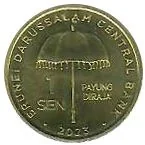

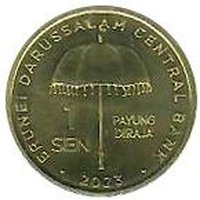
Obverse
Reverse
Edge
Plain
Mintings
| Year | Mint Mark | Mintage | Quality | Collection |
|---|---|---|---|---|
| 2023 | — | — |
Historical background
In 2023, Brunei Darussalam's currency situation remained uniquely anchored by its long-standing Currency Interchangeability Agreement with Singapore. Established in 1967, this agreement mandates that the Brunei Dollar (BND) and the Singapore Dollar (SGD) are pegged at par (1:1) and are mutually accepted as customary tender in both countries. This arrangement provides Brunei with a crucial anchor of monetary stability, directly tying its currency to the robust and well-managed monetary policy of the Monetary Authority of Singapore (MAS). Consequently, Brunei imports price stability and low inflation from its larger neighbour, shielding its small, open economy from volatile currency fluctuations and bolstering investor confidence.
The system's stability, however, is intrinsically linked to Brunei's fiscal health, which remains heavily dependent on hydrocarbon revenues. In 2023, global energy prices, though easing from 2022 peaks, continued to provide significant government revenue, supporting the nation's foreign reserves and its ability to maintain the peg. The agreement does mean Brunei cedes independent control over its monetary policy, but this is viewed as a favourable trade-off for a commodity-exporting nation, as it automatically tightens financial conditions when the MAS acts to counter inflation, helping to cool domestic demand.
Looking ahead, the key considerations for Brunei's currency in 2023 centred on long-term economic diversification beyond oil and gas. Authorities continued to emphasise initiatives under the Brunei Vision 2035 (Wawasan 2035) to develop other sectors. The success of these efforts is critical for ensuring sustainable fiscal and external balances in the future, which underpin the continued credibility and viability of the currency arrangement with Singapore. Therefore, while the currency situation itself was stable and predictable, its long-term resilience is tied to the broader structural transformation of the Bruneian economy.
The system's stability, however, is intrinsically linked to Brunei's fiscal health, which remains heavily dependent on hydrocarbon revenues. In 2023, global energy prices, though easing from 2022 peaks, continued to provide significant government revenue, supporting the nation's foreign reserves and its ability to maintain the peg. The agreement does mean Brunei cedes independent control over its monetary policy, but this is viewed as a favourable trade-off for a commodity-exporting nation, as it automatically tightens financial conditions when the MAS acts to counter inflation, helping to cool domestic demand.
Looking ahead, the key considerations for Brunei's currency in 2023 centred on long-term economic diversification beyond oil and gas. Authorities continued to emphasise initiatives under the Brunei Vision 2035 (Wawasan 2035) to develop other sectors. The success of these efforts is critical for ensuring sustainable fiscal and external balances in the future, which underpin the continued credibility and viability of the currency arrangement with Singapore. Therefore, while the currency situation itself was stable and predictable, its long-term resilience is tied to the broader structural transformation of the Bruneian economy.

💎 Extremely Rare