

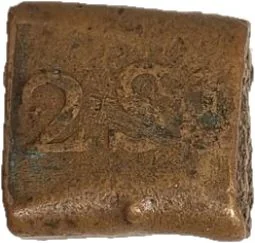
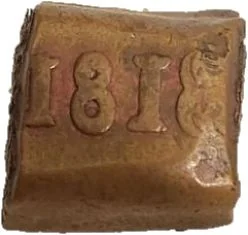
2 stuivers – Java
Add to wishlist
Indonesia
Context
Material
Weight: 29.14 g
Thickness: 9 mm
Shape: Irregular rectangular
Composition: Copper
Magnetic: No
Technique: Hammered
Alignment: Coin alignment
flip
References
KM: #
Numista: #466053
Obverse
Reverse
Edge
Rough metal scrap
Mintings
| Year | Mint Mark | Mintage | Quality | Collection |
|---|---|---|---|---|
| 1818 | — | — | ||
| 1819 | — | — |
Historical background
In 1818, the currency situation in Java was complex and transitional, shaped by the island's recent return to Dutch colonial rule following the British interregnum (1811-1816). The monetary system was a chaotic mix of physical currencies, including Spanish silver dollars (the widely trusted "real of eight"), Dutch guilders, and a vast array of local copper duit coins. A critical problem was the severe shortage of small change for daily transactions, which was partially alleviated by the continued circulation of millions of copper duit minted under the previous British administration by Governor Stamford Raffles. These coins, though essential for the local economy, were not officially sanctioned by the returning Dutch authorities, creating a legitimacy crisis.
The Dutch East Indies government, under Commissioner-General G.A.G.P. van der Capellen, faced the dual challenge of reasserting monetary sovereignty and simplifying the system. Their response was the introduction of the Java Bank in 1828, but in the immediate years leading to it, they struggled with the practicalities. A key issue was the relationship between the silver-based guilder and the copper duit. The official valuation (1 guilder = 120 duit) often conflicted with market rates, leading to instability and opportunities for arbitrage. Furthermore, the government's own attempts to mint new copper coins were insufficient in volume, forcing them to pragmatically tolerate the "illegal" British duit out of economic necessity.
Thus, the currency background of Java in 1818 is best characterized as a period of contested and fragmented pluralism. It was a system caught between colonial powers, where the official policy of the restored Dutch administration clashed with the on-the-ground reality of a money supply still heavily dependent on the legacy of British rule. This instability highlighted the need for a centralized banking and minting authority, setting the stage for the monetary reforms that would follow in the subsequent decade.
The Dutch East Indies government, under Commissioner-General G.A.G.P. van der Capellen, faced the dual challenge of reasserting monetary sovereignty and simplifying the system. Their response was the introduction of the Java Bank in 1828, but in the immediate years leading to it, they struggled with the practicalities. A key issue was the relationship between the silver-based guilder and the copper duit. The official valuation (1 guilder = 120 duit) often conflicted with market rates, leading to instability and opportunities for arbitrage. Furthermore, the government's own attempts to mint new copper coins were insufficient in volume, forcing them to pragmatically tolerate the "illegal" British duit out of economic necessity.
Thus, the currency background of Java in 1818 is best characterized as a period of contested and fragmented pluralism. It was a system caught between colonial powers, where the official policy of the restored Dutch administration clashed with the on-the-ground reality of a money supply still heavily dependent on the legacy of British rule. This instability highlighted the need for a centralized banking and minting authority, setting the stage for the monetary reforms that would follow in the subsequent decade.
✨ Legendary