

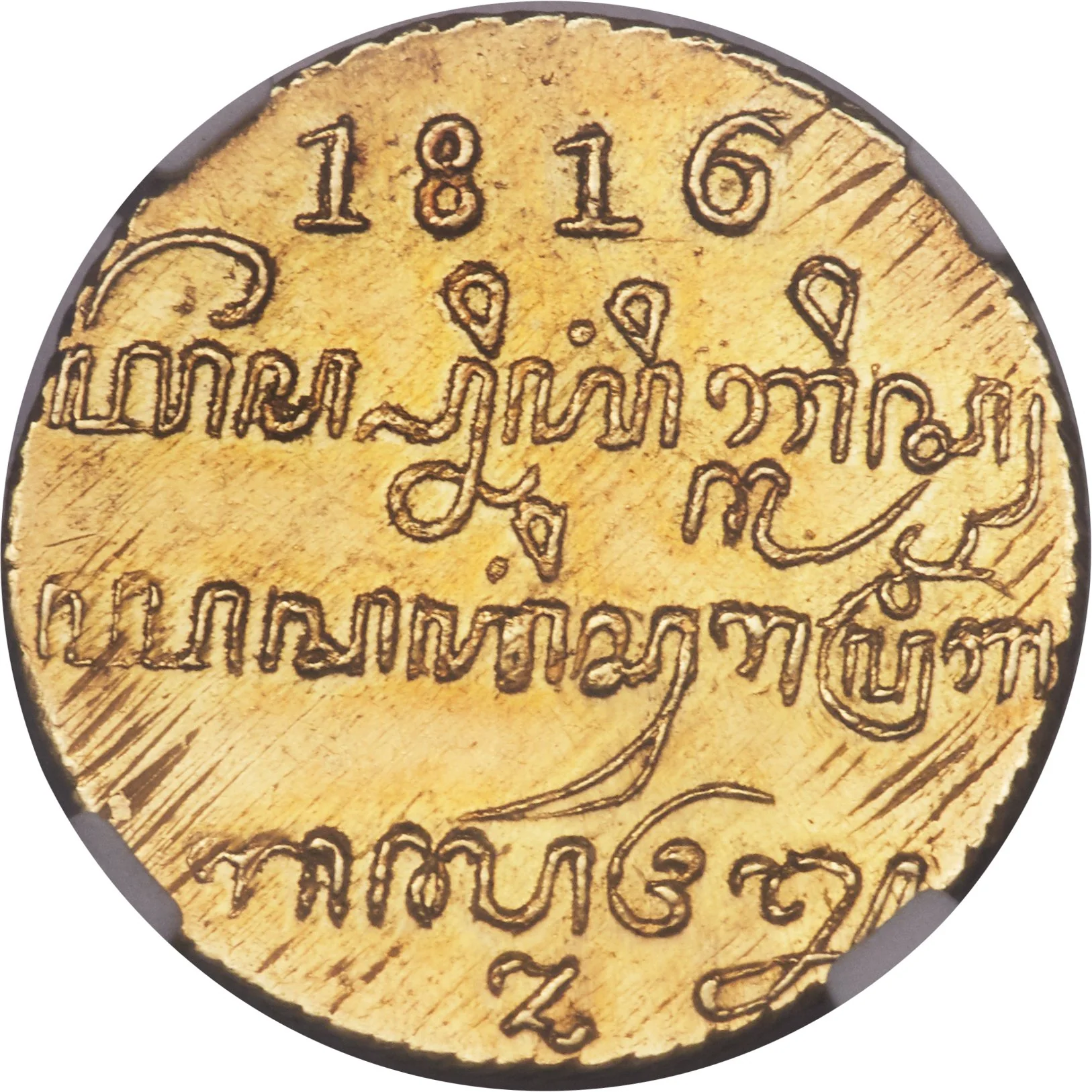
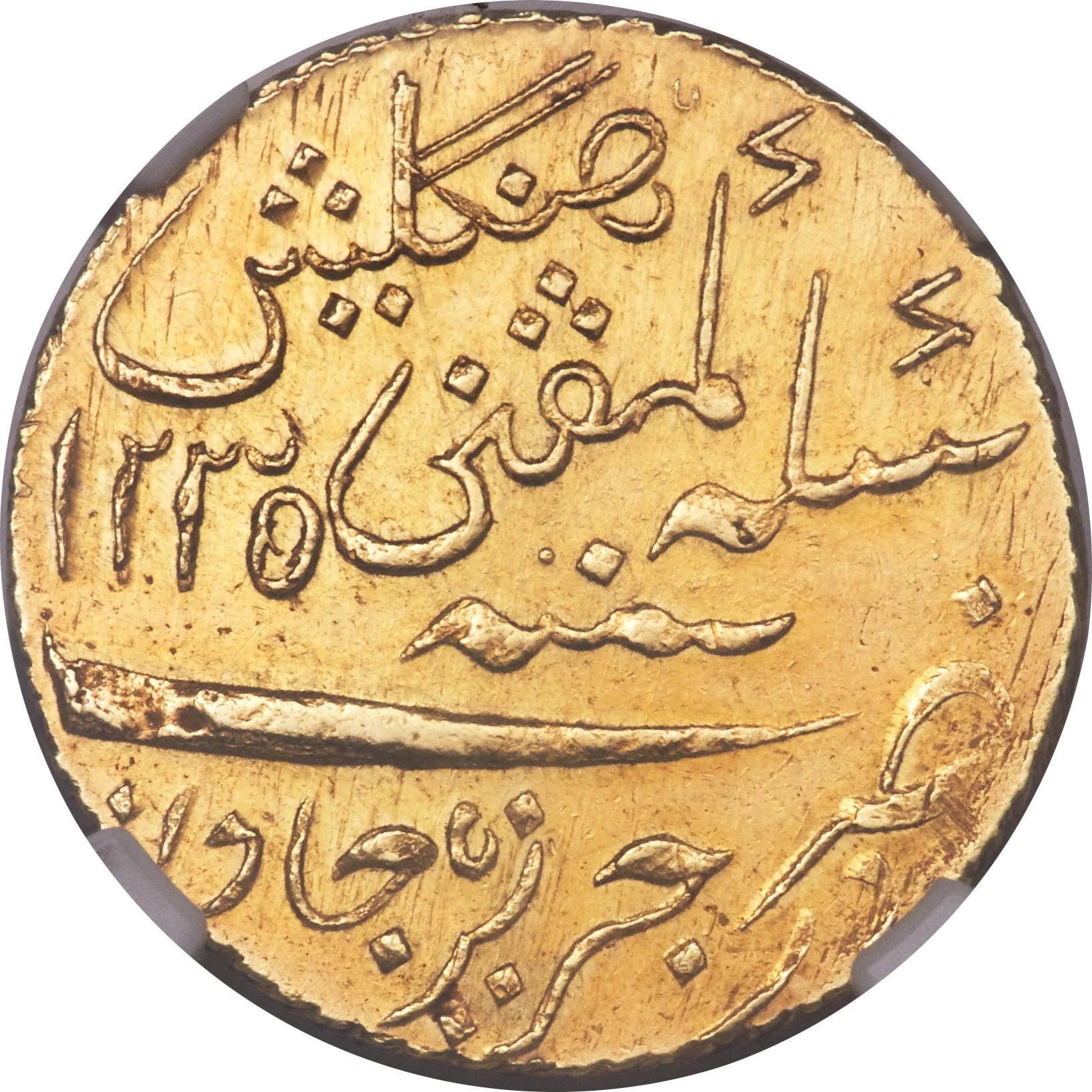
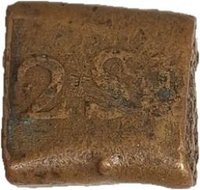
Obverse
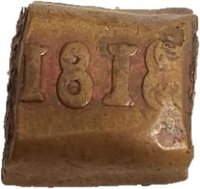
Reverse
Edge
Mintings
| Year | Mint Mark | Mintage | Quality | Collection |
|---|---|---|---|---|
| 1815 | — | — | ||
| 1816 | — | — |
Historical background
Following the British interregnum (1811-1816), Java in 1815 was in a state of profound monetary confusion, caught between multiple collapsing and competing currency systems. The island had long been saturated with a vast array of coins: Spanish-American silver dollars (reales), Dutch guilders, Javanese copper duits, and Chinese picis (lead or tin cash), all circulating with fluctuating and localised exchange rates. The British administration, under Stamford Raffles, had attempted to impose order by introducing a silver dollar standard and issuing paper money, but these measures were undermined by a severe shortage of specie (coin) and a lack of public confidence, leading to significant depreciation.
This chaotic environment was exacerbated by the impending return of Dutch colonial authority, formalised in 1816. The restored Dutch regime inherited a near-bankrupt treasury and a currency system in crisis. The British paper money was essentially worthless, and the scarcity of reliable silver coinage crippled both government finance and commercial exchange. The Dutch were thus faced with the urgent task of imposing a uniform and trustworthy currency to stabilise the economy, facilitate tax collection, and reassert administrative control over the island.
Consequently, the primary monetary challenge in 1815 was one of transition and consolidation. The Dutch solution, implemented shortly after their return, was to establish the Nederlandsch-Indische gulden (Dutch Indies guilder) as the sole standard currency, backed by the newly founded De Javasche Bank in 1828. Therefore, the situation in 1815 represents the chaotic final chapter of a fragmented pre-colonial and interim monetary era, immediately preceding a concerted European colonial effort to impose a centralised, coin-based currency system integral to the island's integration into the global capitalist economy.
This chaotic environment was exacerbated by the impending return of Dutch colonial authority, formalised in 1816. The restored Dutch regime inherited a near-bankrupt treasury and a currency system in crisis. The British paper money was essentially worthless, and the scarcity of reliable silver coinage crippled both government finance and commercial exchange. The Dutch were thus faced with the urgent task of imposing a uniform and trustworthy currency to stabilise the economy, facilitate tax collection, and reassert administrative control over the island.
Consequently, the primary monetary challenge in 1815 was one of transition and consolidation. The Dutch solution, implemented shortly after their return, was to establish the Nederlandsch-Indische gulden (Dutch Indies guilder) as the sole standard currency, backed by the newly founded De Javasche Bank in 1828. Therefore, the situation in 1815 represents the chaotic final chapter of a fragmented pre-colonial and interim monetary era, immediately preceding a concerted European colonial effort to impose a centralised, coin-based currency system integral to the island's integration into the global capitalist economy.
✨ Legendary