

1 Cash – Empire of Vietnam
Vietnam
Context

Material
Diameter: 25 mm
Weight: 3.82 g
Thickness: 1.3 mm
Shape: Round with a square hole
Composition: Brass
Magnetic: No
Technique: Cast
Alignment: Medal alignment
flip
References
KM: #Click to copy to clipboard253
Numista: #46521
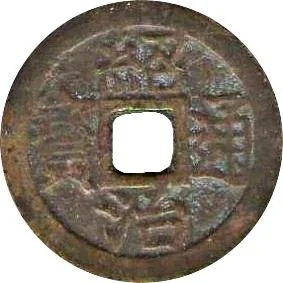
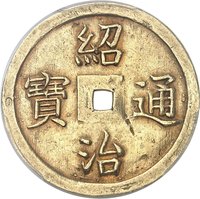
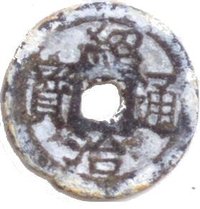
Obverse
Description:
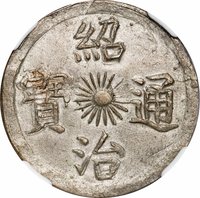
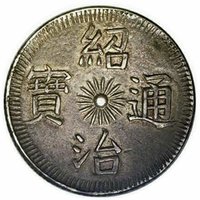
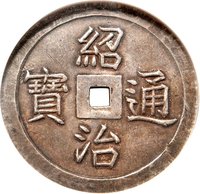
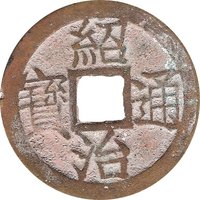
Four Chinese characters read vertically, right to left.
Inscription:
紹
寳 通
治
寳 通
治
Translation:
Tongzhi Treasure.
Scripts: Chinese (traditional, regular script)
Language: Chinese
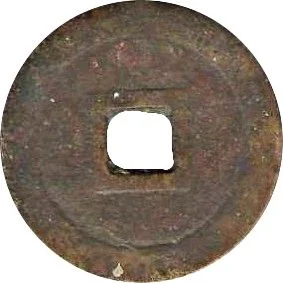
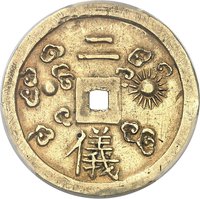
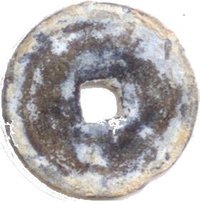
Reverse
Description:
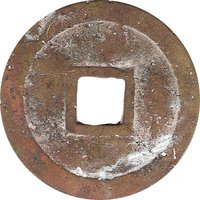
Blank (uniface).
Edge
Plain
Mintings
| Year | Mint Mark | Mintage | Quality | Collection |
|---|---|---|---|---|
| — | — | — |
Historical background
In 1841, the currency situation within the Empire of Vietnam under Emperor Thiệu Trị was characterized by profound instability and a complex, deteriorating system. The state’s finances were strained by decades of warfare, rebellion, and extensive fortification projects, leading to severe debasement of the coinage. The primary currency was copper cash coins (văn), minted in vast quantities with decreasing copper content and quality to generate seigniorage revenue. This resulted in chronic inflation, a loss of public confidence, and a thriving market for counterfeit coins, which further eroded the monetary system's integrity.
The currency landscape was not unified, operating on a dual system of officially minted coinage and a vast array of privately cast and counterfeit coins that circulated freely. Furthermore, the economy relied heavily on commodity money, particularly silver bars and gold, for large transactions and state finance. These precious metals were valued by weight (the tael or lạng) and purity, creating a disconnect between the high-value "real" economy in silver and the debased everyday coinage in copper. This bifurcation complicated taxation and commerce, as exchange rates between copper cash and silver fluctuated wildly based on quality and scarcity.
Emperor Thiệu Trị was aware of these monetary crises and attempted reforms, including issuing new series of cash coins with reign titles like "Thiệu Trị Thông Bảo." However, these efforts were largely reactive and failed to address the structural issues. The fundamental problems of budget deficits, inadequate copper supplies, and widespread counterfeiting persisted. Consequently, the currency situation of 1841 reflected a weakening imperial administration struggling to maintain economic control, a prelude to the deepening fiscal challenges that would confront the Nguyễn Dynasty in the coming decades.
The currency landscape was not unified, operating on a dual system of officially minted coinage and a vast array of privately cast and counterfeit coins that circulated freely. Furthermore, the economy relied heavily on commodity money, particularly silver bars and gold, for large transactions and state finance. These precious metals were valued by weight (the tael or lạng) and purity, creating a disconnect between the high-value "real" economy in silver and the debased everyday coinage in copper. This bifurcation complicated taxation and commerce, as exchange rates between copper cash and silver fluctuated wildly based on quality and scarcity.
Emperor Thiệu Trị was aware of these monetary crises and attempted reforms, including issuing new series of cash coins with reign titles like "Thiệu Trị Thông Bảo." However, these efforts were largely reactive and failed to address the structural issues. The fundamental problems of budget deficits, inadequate copper supplies, and widespread counterfeiting persisted. Consequently, the currency situation of 1841 reflected a weakening imperial administration struggling to maintain economic control, a prelude to the deepening fiscal challenges that would confront the Nguyễn Dynasty in the coming decades.
🌟 Limited