

100 réis (Colonization) – Brazil
Add to wishlist
Brazil
Context
Year: 1932
Issuer: Brazil
Period:
(1889—1967)
Currency:
(1799—1942)
Demonetization: 1942
Total mintage: 1,012,214
Material
Diameter: 21 mm
Weight: 5 g
Thickness: 1.8 mm
Shape: Round
Composition: Copper-nickel
Technique: Milled
Alignment: Medal alignment
flip

References
KM: #
Numista: #10308
Obverse
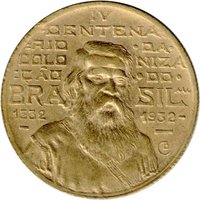
Description:
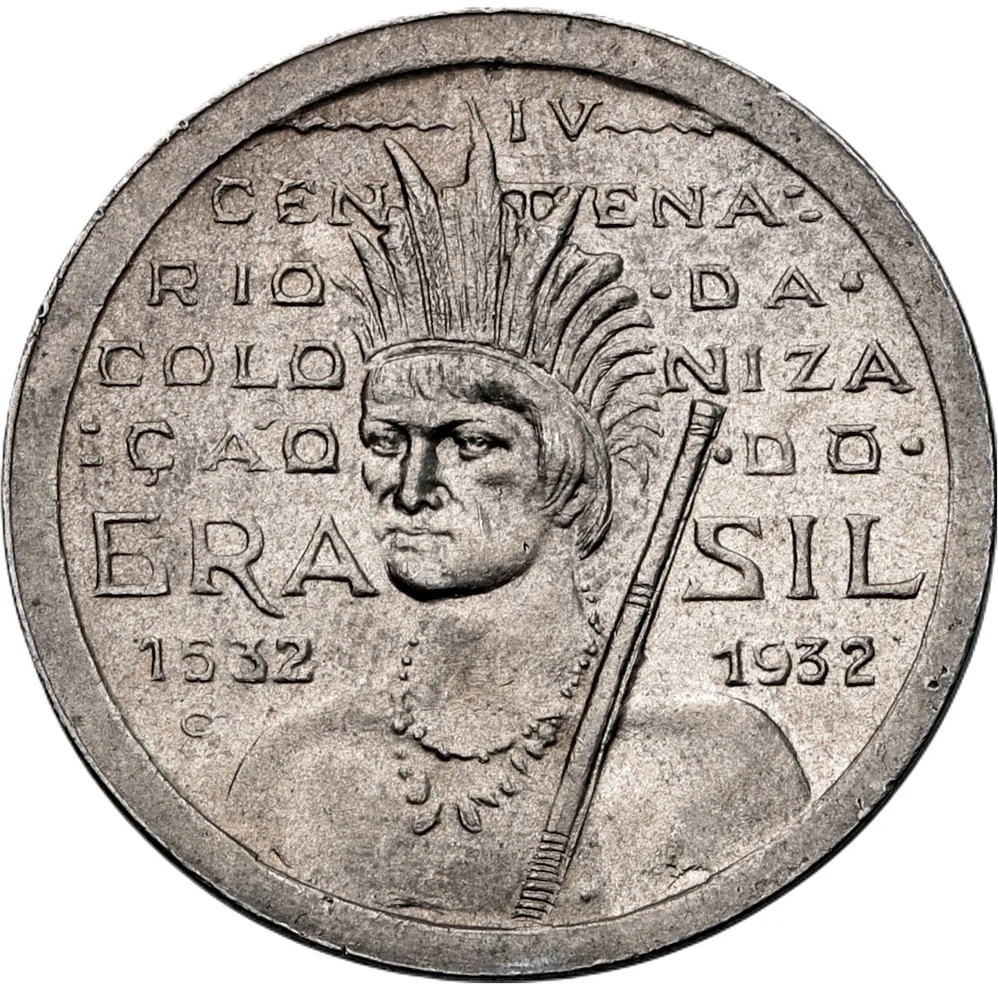
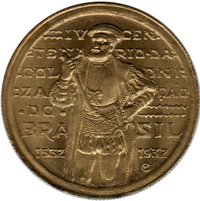
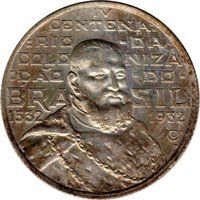
Bust of Tibiriçá, a Tupiniquim leader and Portuguese ally who helped found São Paulo in 1554.
Inscription:
IV
CENTENÁ-
RIO·DA·
COLONIZA
ÇÃO·DO·
BRASIL
1532 1932
CENTENÁ-
RIO·DA·
COLONIZA
ÇÃO·DO·
BRASIL
1532 1932
Translation:
CENTENARY
OF THE
COLONIZATION
OF
BRAZIL
1532 1932
OF THE
COLONIZATION
OF
BRAZIL
1532 1932
Script: Latin
Language: Portuguese
Engraver: Leopoldo Campos
Reverse
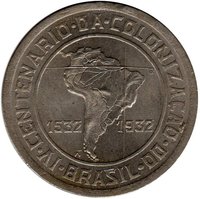
Description:
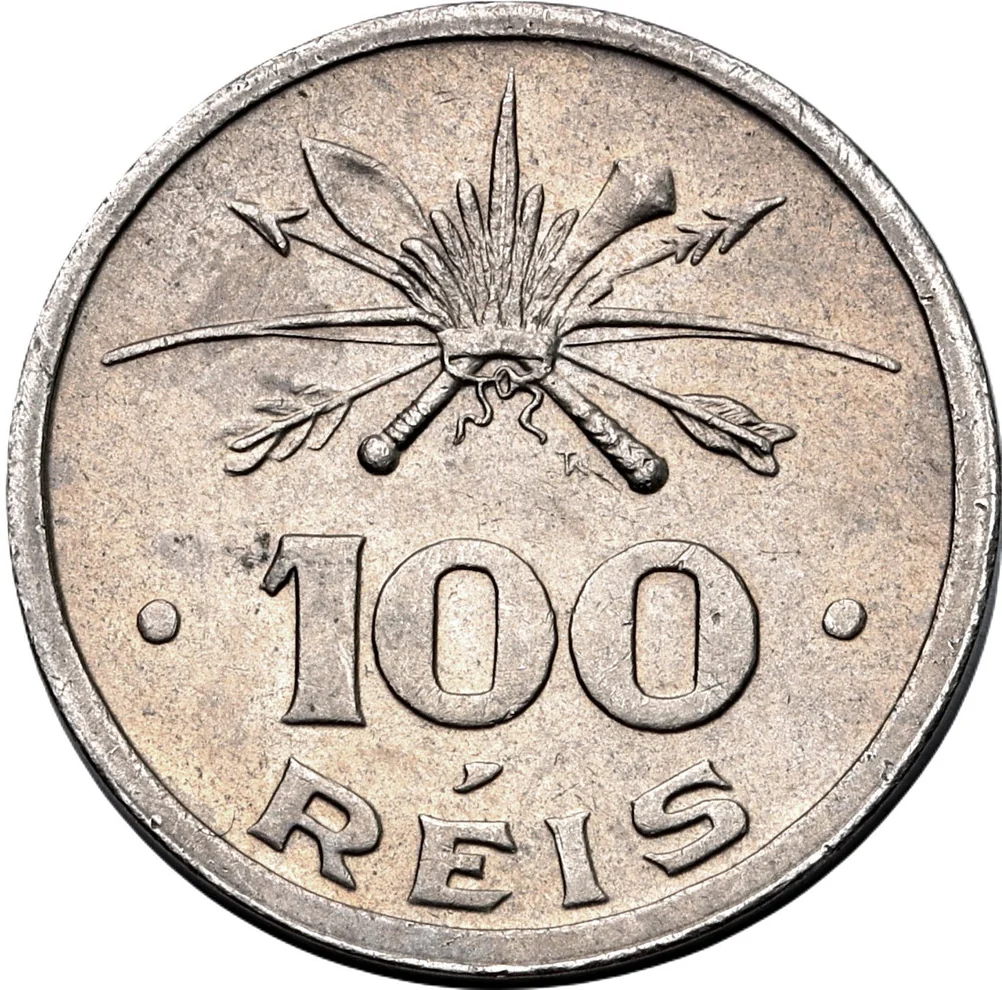
Rule through form
Inscription:
· 100 ·
RÉIS
RÉIS
Translation:
One Hundred Réis
Script: Latin
Language: Portuguese
Engraver: Walter R. Toledo
Edge
Plain
Mintings
| Year | Mint Mark | Mintage | Quality | Collection |
|---|---|---|---|---|
| 1932 | — | 1,012,214 |
Historical background
In 1932, Brazil's currency situation was characterized by the lingering instability of the First Brazilian Republic and the direct impact of the 1930 Revolution. The economy was still reeling from the collapse of the coffee valorization schemes and the onset of the global Great Depression, which had severely depleted the country's gold and foreign currency reserves. The provisional government of Getúlio Vargas, which had taken power in 1930, inherited a fragile financial system and had abandoned the gold standard, leading to a period of fluctuating exchange rates and a significant devaluation of the mil-réis. This created an environment of monetary uncertainty, complicating both domestic commerce and international trade.
The immediate monetary policy was under the direction of Finance Minister Oswaldo Aranha, who faced the dual challenge of financing the government's operations and managing the economic fallout from the Constitutionalist Revolution of 1932—a major civil war in São Paulo. To fund the war effort against the paulista rebels, the federal government resorted to printing currency, a move that injected high-powered money into an economy with constrained production. This expansion of the money supply, without corresponding economic growth, exerted strong inflationary pressures, further eroding the currency's purchasing power and deepening the fiscal crisis.
Consequently, 1932 represented a transitional and turbulent period in Brazilian monetary history. The combination of abandoned metallic standards, wartime finance, and inflationary emission set the stage for the more centralized economic interventions that would follow later in the Vargas era. The currency instability of this year highlighted the profound weaknesses in the old republican financial order and underscored the urgent need for the new government to establish greater control over the monetary and banking system, a process that would culminate in later reforms and the creation of new national institutions in the years to come.
The immediate monetary policy was under the direction of Finance Minister Oswaldo Aranha, who faced the dual challenge of financing the government's operations and managing the economic fallout from the Constitutionalist Revolution of 1932—a major civil war in São Paulo. To fund the war effort against the paulista rebels, the federal government resorted to printing currency, a move that injected high-powered money into an economy with constrained production. This expansion of the money supply, without corresponding economic growth, exerted strong inflationary pressures, further eroding the currency's purchasing power and deepening the fiscal crisis.
Consequently, 1932 represented a transitional and turbulent period in Brazilian monetary history. The combination of abandoned metallic standards, wartime finance, and inflationary emission set the stage for the more centralized economic interventions that would follow later in the Vargas era. The currency instability of this year highlighted the profound weaknesses in the old republican financial order and underscored the urgent need for the new government to establish greater control over the monetary and banking system, a process that would culminate in later reforms and the creation of new national institutions in the years to come.
Series: Vicentinas




🌱 Common