

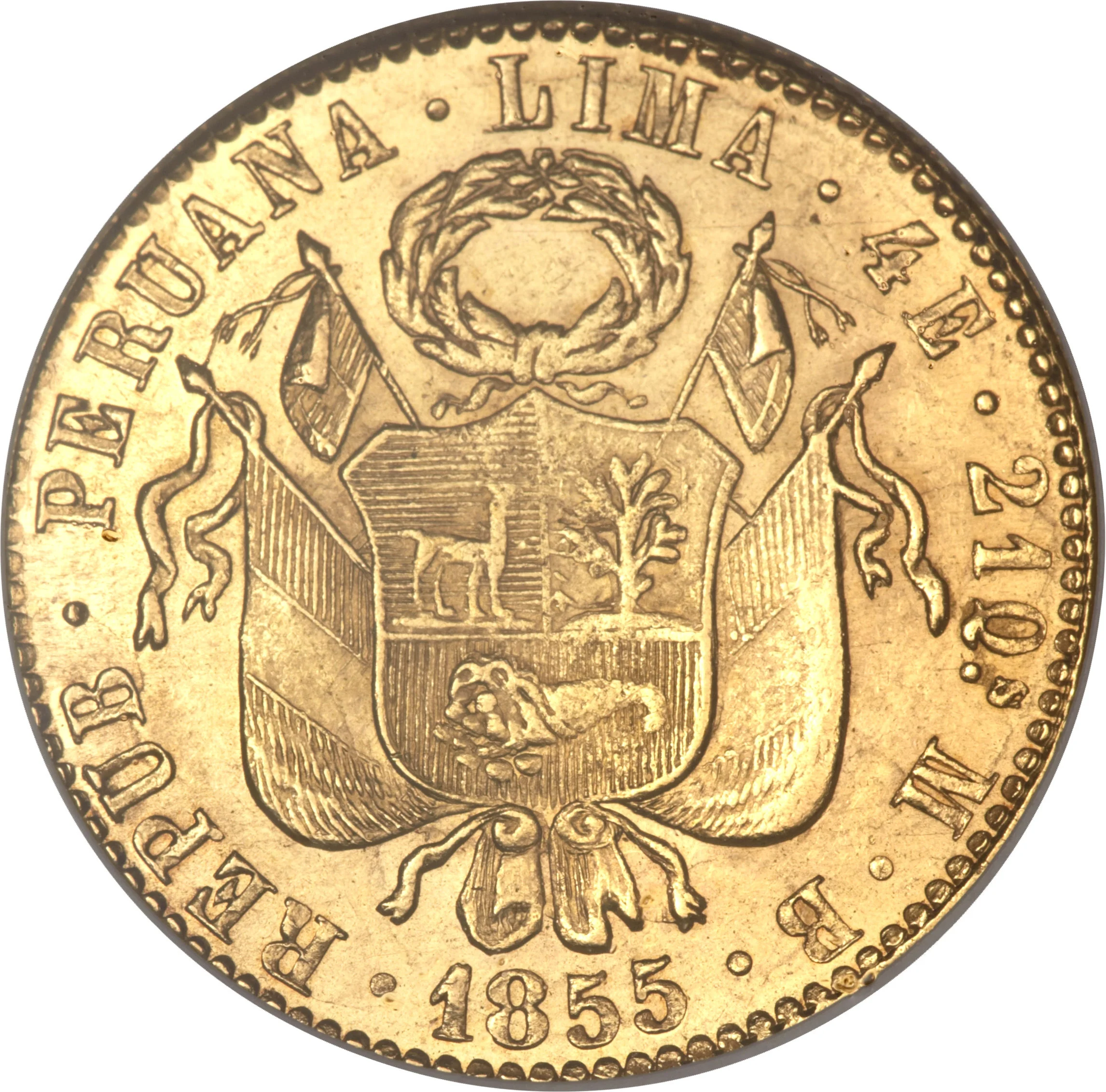
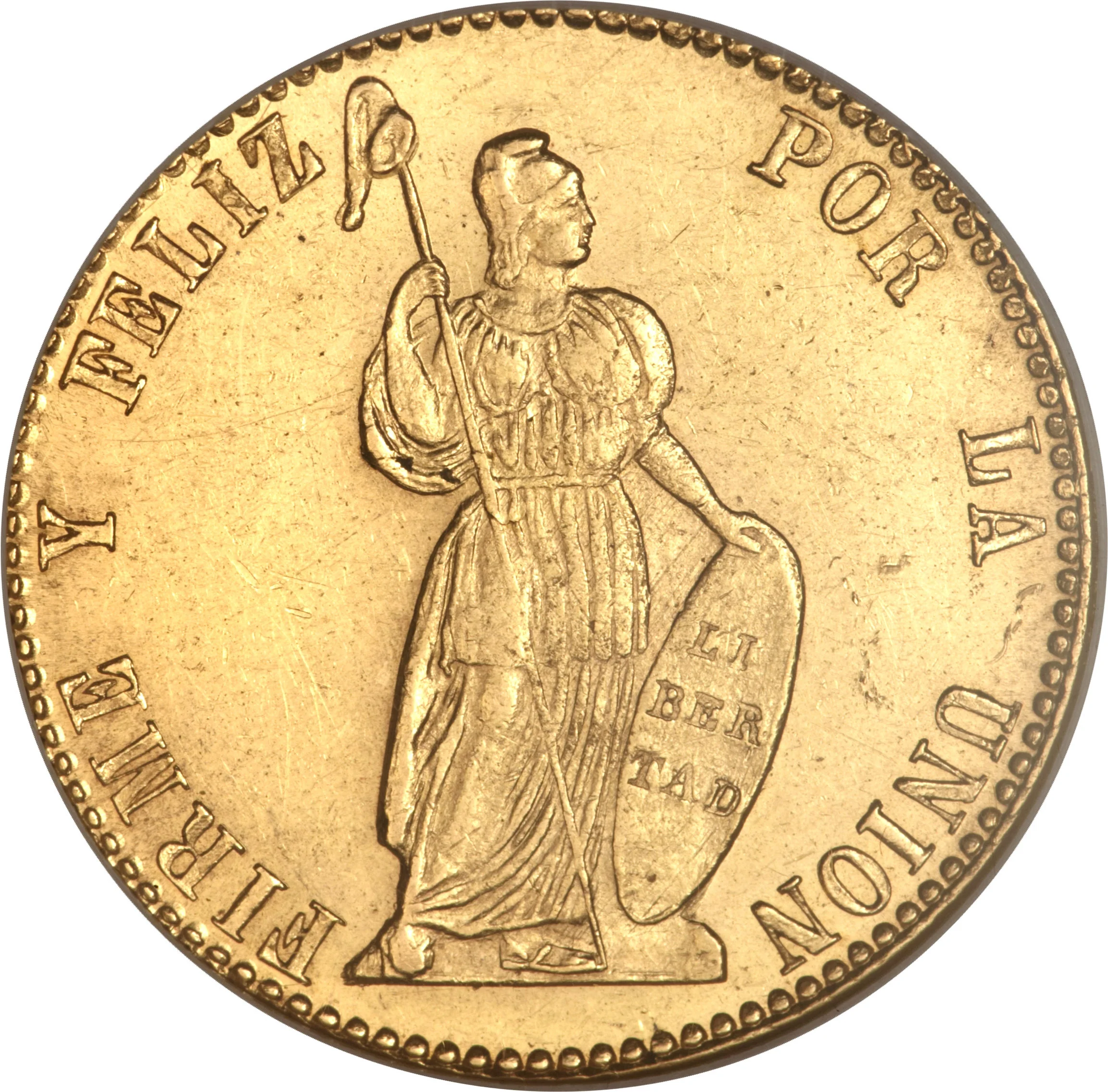
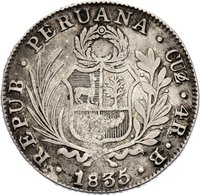
Obverse
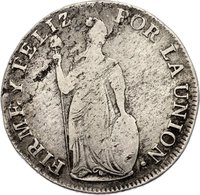
Reverse
Edge
Mints
| Name | Mark |
|---|---|
| Lima | LIMAE |
Mintings
| Year | Mint Mark | Mintage | Quality | Collection |
|---|---|---|---|---|
| 1828 | JM | — | ||
| 1850 | EMB | — | ||
| 1853 | EMB | — | ||
| 1854 | EMB | — | ||
| 1855 | EMB | — |
Historical background
In 1828, Peru’s currency situation was chaotic and inflationary, a direct legacy of the costly Wars of Independence (1820-1824) and the subsequent internal political instability. The new republic, formally established in 1824, inherited a depleted treasury and a fragmented monetary system. To finance its early existence and ongoing conflicts, such as the war with Gran Colombia (1828-1829), the government under President José de La Mar heavily resorted to printing paper money (billetes fiscales) without sufficient metallic backing. This led to a severe loss of public confidence, as the paper currency rapidly depreciated against silver and gold coins, which remained the trusted mediums for significant transactions.
The monetary landscape was a confusing duality. While the government issued devaluing paper notes for official use and to pay soldiers and bureaucrats, the everyday economy still relied on a mix of older Spanish colonial coins (like pesos and reales), newly minted republican coins, and even foreign currencies, particularly the Bolivian sol and Chilean coins, which circulated freely due to trade. The state’s attempt to establish a sole national currency, the peso, was undermined by the lack of precious metal reserves to mint enough coins and the inability to enforce the retirement of competing monies. Consequently, prices were often quoted in silver, while payments in paper money were heavily discounted, creating a complex and inefficient system for commerce.
This unstable environment severely hampered economic recovery and state-building. The inflation eroded the real value of government revenues and salaries, fostering corruption and discontent. Recognizing the crisis, authorities made early but ineffective attempts at monetary reform, including short-lived decrees to regulate exchange rates and retire paper money. However, without fiscal discipline or political consensus, these measures failed. Thus, in 1828, Peru’s currency was not a tool of national unity but a symptom of its fragile post-colonial condition, characterized by deficit financing, competing circulations, and entrenched distrust in the fledgling state’s financial promises.
The monetary landscape was a confusing duality. While the government issued devaluing paper notes for official use and to pay soldiers and bureaucrats, the everyday economy still relied on a mix of older Spanish colonial coins (like pesos and reales), newly minted republican coins, and even foreign currencies, particularly the Bolivian sol and Chilean coins, which circulated freely due to trade. The state’s attempt to establish a sole national currency, the peso, was undermined by the lack of precious metal reserves to mint enough coins and the inability to enforce the retirement of competing monies. Consequently, prices were often quoted in silver, while payments in paper money were heavily discounted, creating a complex and inefficient system for commerce.
This unstable environment severely hampered economic recovery and state-building. The inflation eroded the real value of government revenues and salaries, fostering corruption and discontent. Recognizing the crisis, authorities made early but ineffective attempts at monetary reform, including short-lived decrees to regulate exchange rates and retire paper money. However, without fiscal discipline or political consensus, these measures failed. Thus, in 1828, Peru’s currency was not a tool of national unity but a symptom of its fragile post-colonial condition, characterized by deficit financing, competing circulations, and entrenched distrust in the fledgling state’s financial promises.
✨ Legendary