

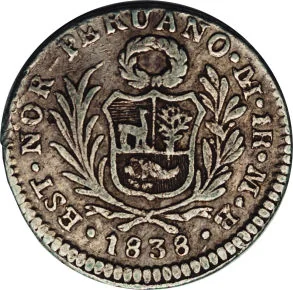
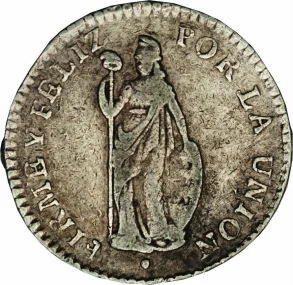
1 real – Republic of North Peru
Add to wishlist
Peru
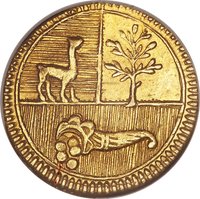
Obverse
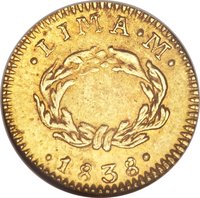
Reverse
Edge
Mints
| Name | Mark |
|---|---|
| Lima | — |
Mintings
| Year | Mint Mark | Mintage | Quality | Collection |
|---|---|---|---|---|
| 1837 | — | — | ||
| 1838 | — | — |
Historical background
The Republic of North Peru, a short-lived state existing from 1836 to 1839, was a constituent member of the Peru–Bolivian Confederation. Its currency situation in 1837 was defined by instability and transition, deeply entangled with the political project of Confederation President Andrés de Santa Cruz. The monetary system inherited the chaotic legacy of the early post-independence period, characterized by a severe shortage of official coinage and the widespread circulation of debased and counterfeit coins, alongside a complex mix of older Spanish colonial and republican issues.
In an attempt to impose order and symbolize the new union, Santa Cruz initiated a comprehensive currency reform. The Confederation began minting new silver coins at the Lima mint, featuring the coat of arms of the Confederation on one side and the denomination within a wreath on the other. These coins, denominated in the traditional pesos and reales, were intended to be the uniform currency for all three states (North Peru, South Peru, and Bolivia). However, in practice, the reform faced immense challenges. The production of the new currency was insufficient to quickly replace the old heterogeneous money in circulation, leading to a parallel system where old and new coins circulated simultaneously at fluctuating values.
Consequently, the monetary landscape in North Peru in 1837 was one of fragile and enforced unification. While the new Confederation coinage represented a political ambition for economic integration, its practical impact was limited by low mintage volumes, ongoing commercial use of older Peruvian coins, and the underlying economic strains of maintaining the Confederation itself. This instability in the currency system mirrored the political fragility of the Confederation, which would collapse by 1839, rendering the entire monetary reform ephemeral.
In an attempt to impose order and symbolize the new union, Santa Cruz initiated a comprehensive currency reform. The Confederation began minting new silver coins at the Lima mint, featuring the coat of arms of the Confederation on one side and the denomination within a wreath on the other. These coins, denominated in the traditional pesos and reales, were intended to be the uniform currency for all three states (North Peru, South Peru, and Bolivia). However, in practice, the reform faced immense challenges. The production of the new currency was insufficient to quickly replace the old heterogeneous money in circulation, leading to a parallel system where old and new coins circulated simultaneously at fluctuating values.
Consequently, the monetary landscape in North Peru in 1837 was one of fragile and enforced unification. While the new Confederation coinage represented a political ambition for economic integration, its practical impact was limited by low mintage volumes, ongoing commercial use of older Peruvian coins, and the underlying economic strains of maintaining the Confederation itself. This instability in the currency system mirrored the political fragility of the Confederation, which would collapse by 1839, rendering the entire monetary reform ephemeral.
✨ Legendary