

20 Cents – Malaya
Malaysia
Context
Material
Diameter: 23.5 mm
Weight: 5.65 g
Thickness: 1.72 mm
Shape: Round
Composition: Copper-nickel
Technique: Milled
Alignment: Medal alignment
flip
References
KM: #Click to copy to clipboard9
Numista: #4642
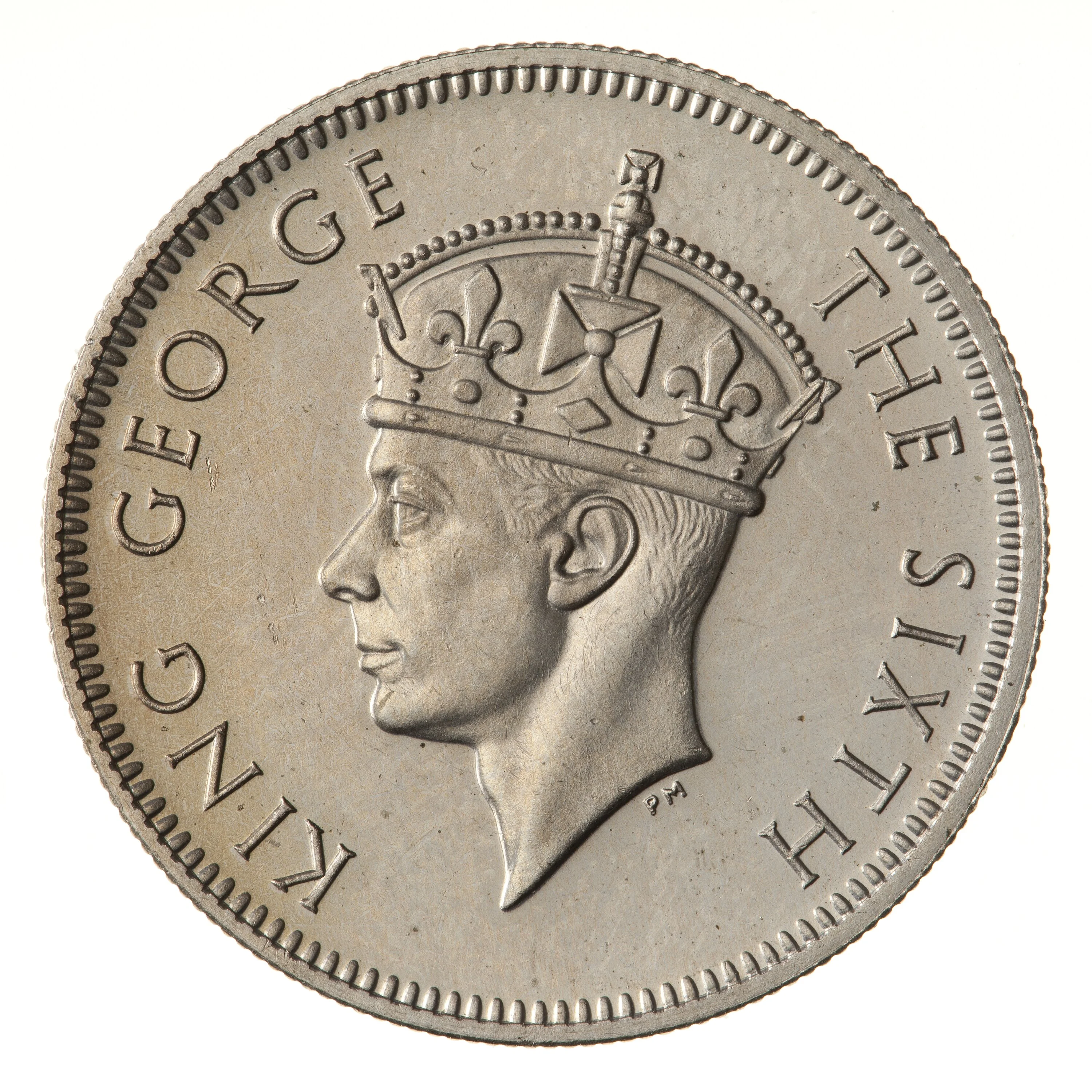
Obverse
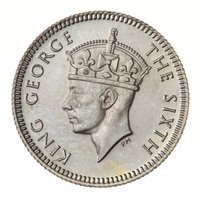
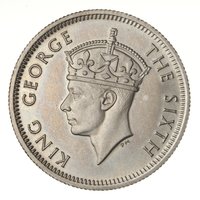
Description:
Crowned left-facing bust.
Inscription:
KING GEORGE THE SIXTH
PM
PM
Translation:
KING GEORGE THE SIXTH
BY THE GRACE OF GOD, KING OF ALL THE BRITISH DOMINIONS, DEFENDER OF THE FAITH, EMPEROR OF INDIA
BY THE GRACE OF GOD, KING OF ALL THE BRITISH DOMINIONS, DEFENDER OF THE FAITH, EMPEROR OF INDIA
Script: Latin
Language: English
Engraver: Percy Metcalfe
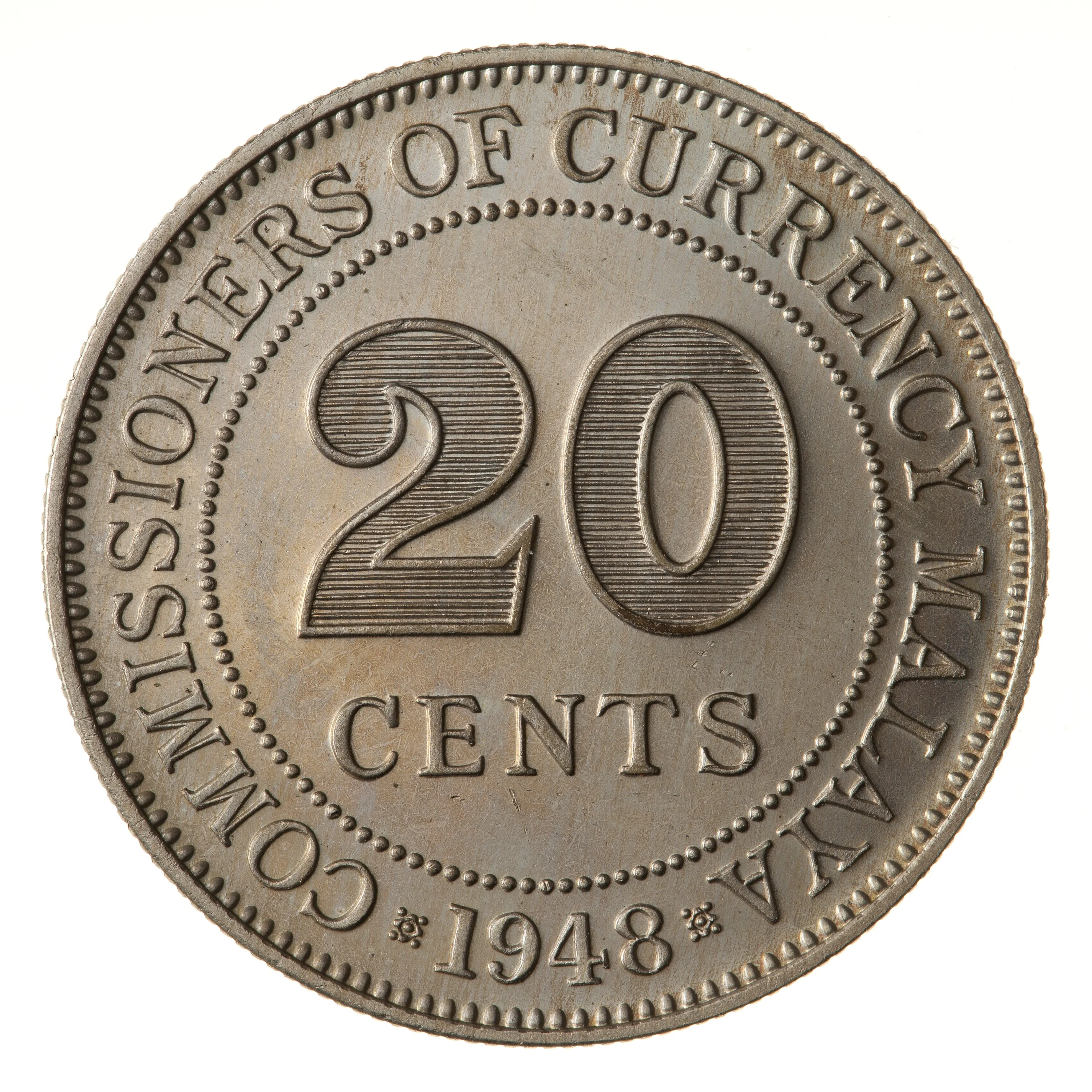
Reverse
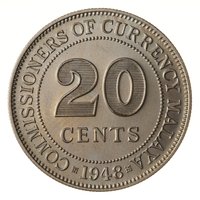
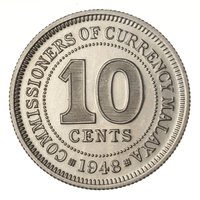
Description:
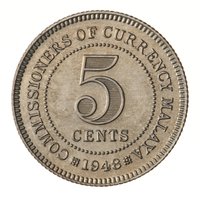
Beaded circle with value, date below.
Inscription:
COMMISSIONERS OF CURRENCY MALAYA
20
CENTS
1950
20
CENTS
1950
Script: Latin
Edge
Reeded
Mints
| Name | Mark |
|---|---|
| Royal Mint (Tower Hill) | — |
Mintings
| Year | Mint Mark | Mintage | Quality | Collection |
|---|---|---|---|---|
| 1948 | — | 40,000,000 | ||
| 1948 | — | — | Proof | |
| 1950 | — | 20,000,000 | ||
| 1950 | — | — | Proof |
Historical background
In 1948, the currency situation in Malaya was a direct legacy of the Japanese Occupation (1942-1945) and the subsequent British Military Administration (BMA). During the war, the Japanese issued "banana money" (so-called for the banana tree motif), which was forced upon the population and became hyperinflated, rendering it worthless by 1945. The returning British invalidated this currency, causing widespread financial ruin and deep distrust in paper money among the local population. The BMA then reintroduced the pre-war Malayan dollar, but its scarcity and the chaotic economic conditions led to a severe cash shortage, hampering recovery.
To restore monetary stability, the British colonial authorities established a new unified currency board system. The Malayan Union (and from 1948, the Federation of Malaya), along with Singapore, British Borneo, and Sarawak, came under the purview of the Board of Commissioners of Currency, Malaya and British Borneo. This system, launched in full by 1952 but prepared in the preceding years, was designed to be highly conservative, with the local dollar fully backed by sterling reserves held in London. This ensured a stable exchange rate fixed to the British pound, which was crucial for rebuilding the export-oriented tin and rubber industries.
Thus, in 1948, the currency was in a transitional phase, moving from post-war dislocation towards this new sterling-pegged system. The context was further complicated by the declaration of the Malayan Emergency in June 1948, as the Communist insurgency threatened the very economic infrastructure the currency system relied upon. The primary goals of monetary policy were therefore twofold: to ensure absolute stability and credibility to foster economic investment, and to support the colonial government's broader political and military campaign to restore order and control.
To restore monetary stability, the British colonial authorities established a new unified currency board system. The Malayan Union (and from 1948, the Federation of Malaya), along with Singapore, British Borneo, and Sarawak, came under the purview of the Board of Commissioners of Currency, Malaya and British Borneo. This system, launched in full by 1952 but prepared in the preceding years, was designed to be highly conservative, with the local dollar fully backed by sterling reserves held in London. This ensured a stable exchange rate fixed to the British pound, which was crucial for rebuilding the export-oriented tin and rubber industries.
Thus, in 1948, the currency was in a transitional phase, moving from post-war dislocation towards this new sterling-pegged system. The context was further complicated by the declaration of the Malayan Emergency in June 1948, as the Communist insurgency threatened the very economic infrastructure the currency system relied upon. The primary goals of monetary policy were therefore twofold: to ensure absolute stability and credibility to foster economic investment, and to support the colonial government's broader political and military campaign to restore order and control.
🌱 Very Common