


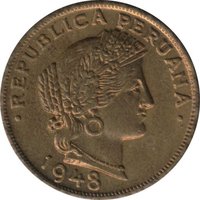
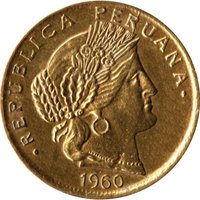
Obverse
Description:
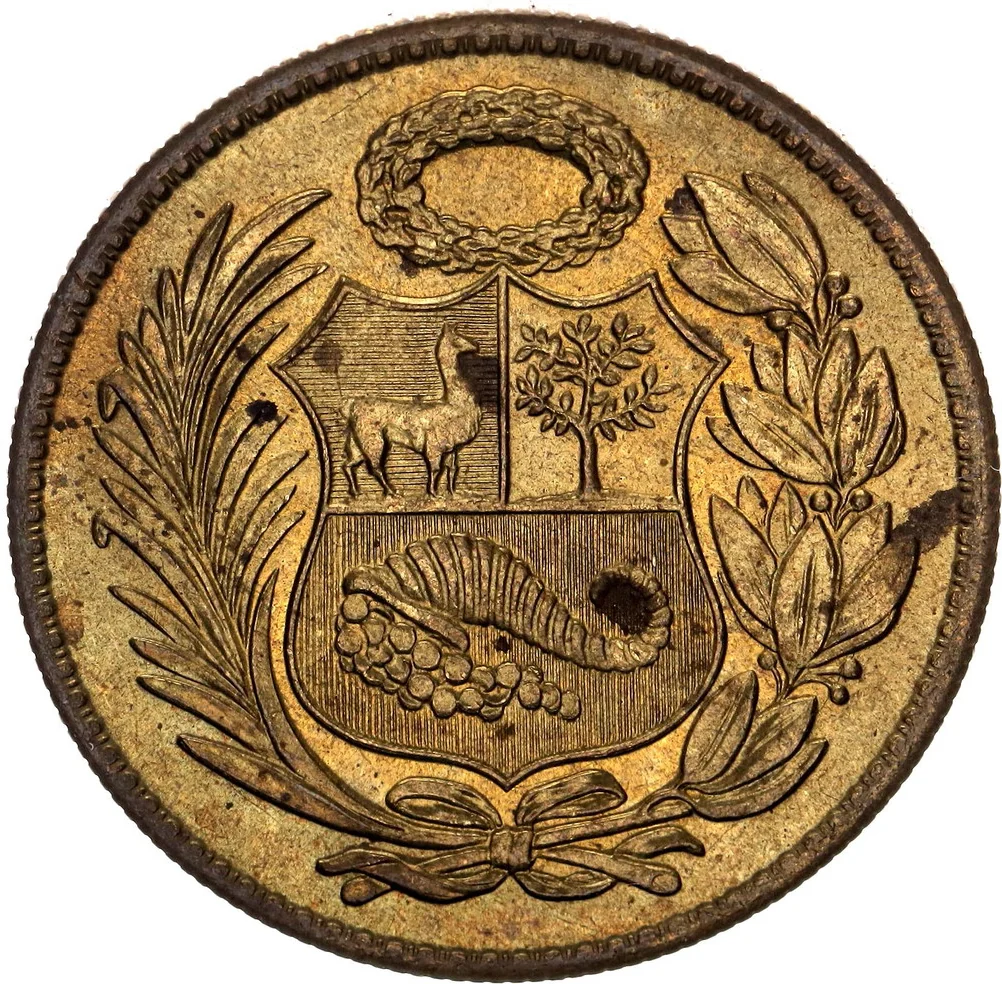
Peru's emblem features a shield divided into three sections (a vicuña, a cinchona tree, and a cornucopia), encircled by a wreath and flanked by a palm branch and a laurel branch.
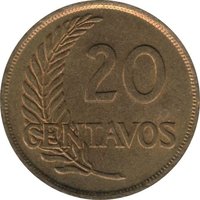
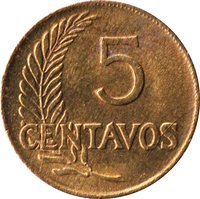
Reverse
Edge
Milled
Categories
| Symbols> Coat of Arms |
| Symbol> Cornucopia |
| Symbol> Wreath |
Mints
| Name | Mark |
|---|---|
| United States Mint of Philadelphia | — |
Mintings
| Year | Mint Mark | Mintage | Quality | Collection |
|---|---|---|---|---|
| 1943 | — | 10,000,000 | ||
| 1944 | — | — | ||
| 1945 | — | — | ||
| 1946 | — | 1,752,000 | ||
| 1947 | — | 3,302,000 | ||
| 1948 | — | 1,992,000 | ||
| 1949 | — | 751,000 | ||
| 1950 | — | 1,249,000 | ||
| 1951 | — | 2,093,999 | ||
| 1952 | — | 2,037,000 | ||
| 1953 | — | 1,243,000 | ||
| 1954 | — | 1,220,000 | ||
| 1955 | — | 1,323,000 | ||
| 1956 | — | 3,450,000 | ||
| 1957 | — | 3,086,000 | ||
| 1958 | — | — | ||
| 1959 | — | 4,975,000 | ||
| 1960 | — | 5,800,000 | ||
| 1961 | — | 5,200,000 | ||
| 1962 | — | 5,102,000 | ||
| 1963 | — | 5,499,000 | ||
| 1964 | — | — | ||
| 1965 | — | 5,504,000 | ||
| 1965 | — | — | Proof |
Historical background
In 1943, Peru's currency situation was characterized by stability and controlled inflation, a notable achievement given the global economic turbulence of World War II. The country operated under a managed exchange rate system, with the sol pegged to the U.S. dollar at a fixed rate of 6.50 soles per dollar, a parity established in 1939. This stability was largely artificial, enforced by exchange controls and capital restrictions implemented by the government of President Manuel Prado. These measures were designed to conserve foreign reserves, prevent capital flight, and ensure the availability of hard currency for essential imports, as international trade was severely disrupted by the war.
Peru's economy benefited significantly from Allied wartime demand for its strategic exports, particularly copper, cotton, lead, zinc, and rubber. This surge created a substantial inflow of U.S. dollars, boosting the Central Reserve Bank's reserves and providing a buffer that helped maintain the fixed exchange rate. However, this export boom also generated inflationary pressures domestically, as increased export income raised domestic spending while the supply of imported consumer goods remained constrained by wartime shortages. The government attempted to manage this through price controls and selective import subsidies, but a gradual rise in the cost of living was still evident.
Overall, the 1943 currency regime was one of wartime necessity, prioritizing stability over market flexibility. The fixed peg and controls successfully prevented the currency chaos seen in other regions, but they masked underlying economic distortions. The accumulation of foreign reserves during this period would later contribute to post-war monetary challenges, including renewed inflationary pressures as controls were eventually relaxed and pent-up demand was unleashed, setting the stage for economic adjustments in the late 1940s.
Peru's economy benefited significantly from Allied wartime demand for its strategic exports, particularly copper, cotton, lead, zinc, and rubber. This surge created a substantial inflow of U.S. dollars, boosting the Central Reserve Bank's reserves and providing a buffer that helped maintain the fixed exchange rate. However, this export boom also generated inflationary pressures domestically, as increased export income raised domestic spending while the supply of imported consumer goods remained constrained by wartime shortages. The government attempted to manage this through price controls and selective import subsidies, but a gradual rise in the cost of living was still evident.
Overall, the 1943 currency regime was one of wartime necessity, prioritizing stability over market flexibility. The fixed peg and controls successfully prevented the currency chaos seen in other regions, but they masked underlying economic distortions. The accumulation of foreign reserves during this period would later contribute to post-war monetary challenges, including renewed inflationary pressures as controls were eventually relaxed and pent-up demand was unleashed, setting the stage for economic adjustments in the late 1940s.
🌱 Very Common