

2 centésimos – Uruguay
Add to wishlist
Uruguay
Context
Year: 1953
Issuer: Uruguay
Issuing organization: Bank of Oriental Republic of Uruguay
Period:
(since 1825)
Currency:
(1863—1975)
Demonetization: 1 July 1975
Total mintage: 50,000,000
Material
Diameter: 17 mm
Weight: 2.5 g
Thickness: 1 mm
Shape: Round
Composition: Copper-nickel
Technique: Milled
Alignment: Medal alignment
flip
References
KM: #
Numista: #4633
Value
Exchange value: 0.02 UYP
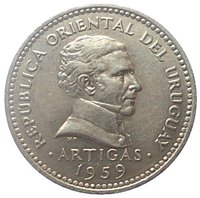
Obverse
Description:
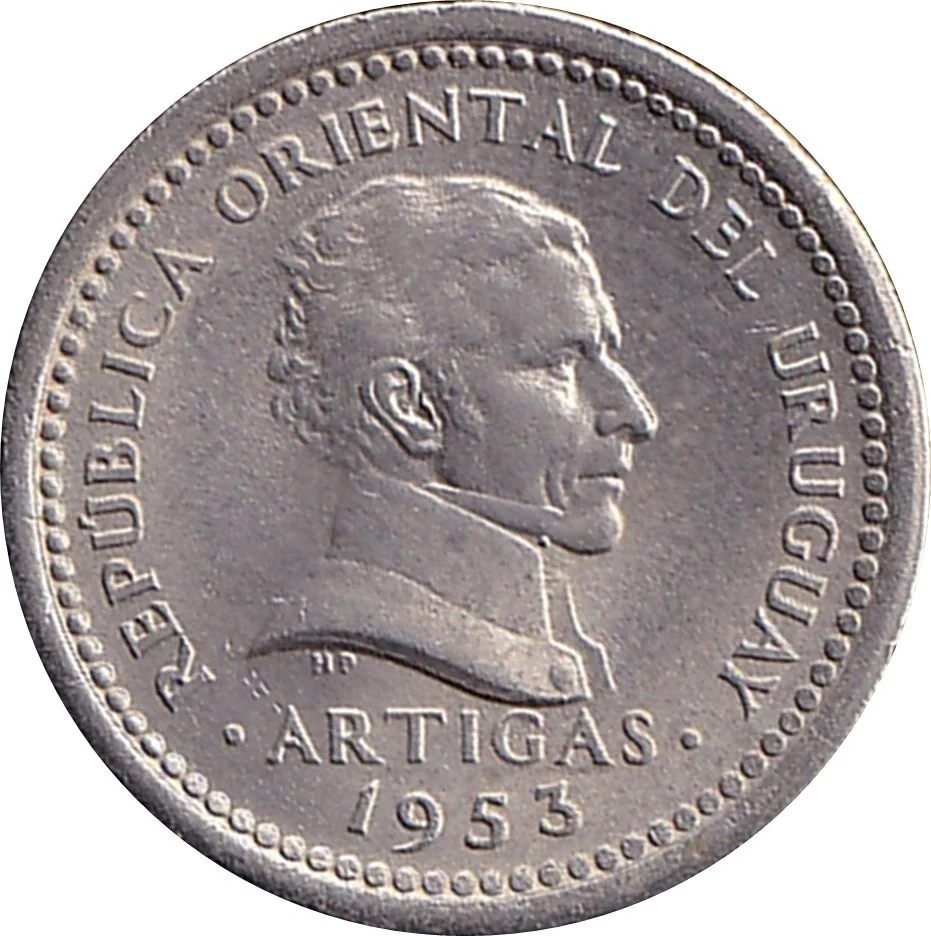
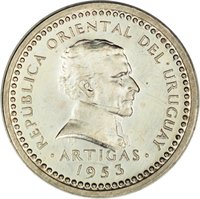
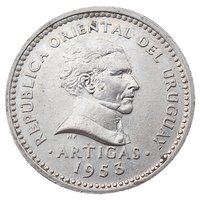
Portrait of José Artigas facing right, encircled by country name and a dotted border. Name below, date at bottom. Engraver's initials under shoulder.
Inscription:
REPÚBLICA ORIENTAL DEL URUGUAY
HP
• ARTIGAS •
1953
HP
• ARTIGAS •
1953
Translation:
Eastern Republic of Uruguay
HP
• ARTIGAS •
1953
HP
• ARTIGAS •
1953
Script: Latin
Language: Spanish
Engraver: Thomas Humphrey Paget
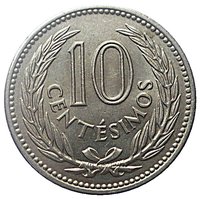
Reverse
Description:
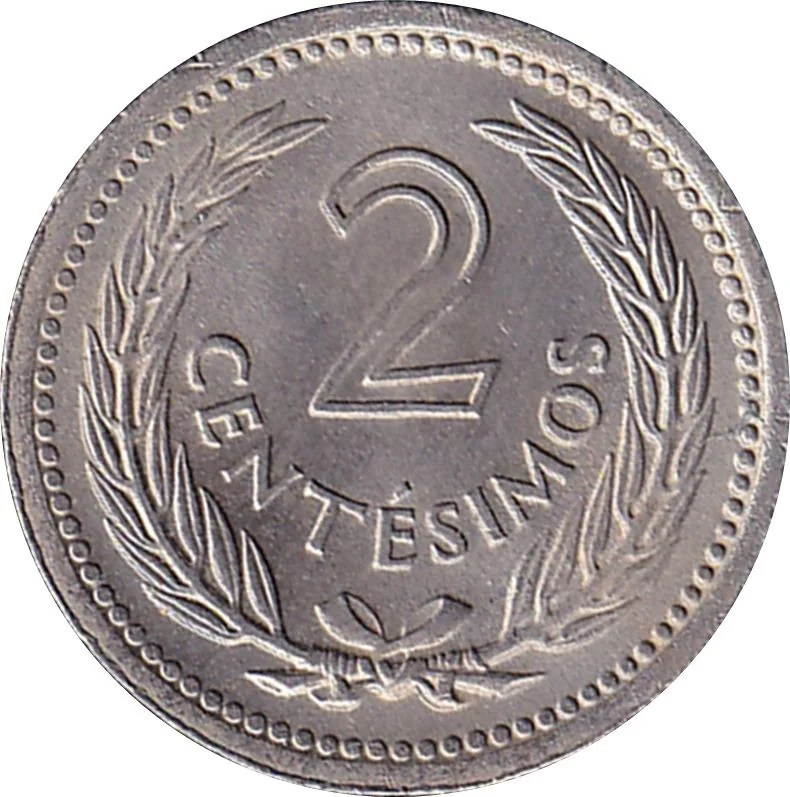
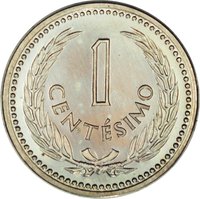
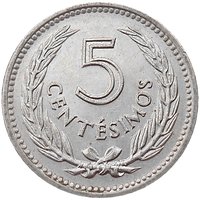
Laurel Wreath Value
Inscription:
2
CENTÉSIMOS
CENTÉSIMOS
Translation:
Two Centésimos
Script: Latin
Language: Spanish
Engraver: Thomas Humphrey Paget
Edge
Plain
Categories
| Symbol> Wreath |
| Person> Military leader |
| Person> Politician |
Mints
| Name | Mark |
|---|---|
| Royal Mint (Tower Hill) | — |
Mintings
| Year | Mint Mark | Mintage | Quality | Collection |
|---|---|---|---|---|
| 1953 | — | 50,000,000 | ||
| 1953 | — | — | Proof |
Historical background
By 1953, Uruguay was grappling with the severe economic consequences of the long-standing Batllista model, which had prioritized a generous welfare state and industrial protectionism funded primarily by booming wool and beef exports. The post-Korean War collapse in global commodity prices exposed the structural weaknesses of this system, leading to chronic fiscal deficits, dwindling foreign reserves, and persistent balance of payments crises. The peso, which had been historically stable, came under intense pressure, forcing the government to rely on a complex and unsustainable system of multiple exchange rates and stringent import controls to manage the currency and conserve hard currency.
President Andrés Martínez Trueba, leading a weak collegial executive (the Consejo Nacional de Gobierno), faced this crisis with limited tools. The Central Bank struggled to defend the official parity, leading to a thriving black market for U.S. dollars where the peso traded at a significant discount. This multi-tiered system—different rates for essential imports, non-essentials, and financial transactions—created distortions, encouraged speculation, and hampered economic planning. Inflation began to accelerate, eroding the purchasing power of wages and undermining the social peace that had characterized mid-century Uruguay.
The currency instability of 1953 was a critical symptom of a deeper economic malaise, marking the beginning of the end of Uruguay's "Switzerland of America" prosperity. Efforts to stabilize the peso were largely stopgap, as the government was politically constrained from making the sharp fiscal adjustments needed. This period set the stage for the more severe stagflation and monetary crises that would define the latter half of the 1950s and 1960s, ultimately contributing to social unrest and the political upheavals that followed.
President Andrés Martínez Trueba, leading a weak collegial executive (the Consejo Nacional de Gobierno), faced this crisis with limited tools. The Central Bank struggled to defend the official parity, leading to a thriving black market for U.S. dollars where the peso traded at a significant discount. This multi-tiered system—different rates for essential imports, non-essentials, and financial transactions—created distortions, encouraged speculation, and hampered economic planning. Inflation began to accelerate, eroding the purchasing power of wages and undermining the social peace that had characterized mid-century Uruguay.
The currency instability of 1953 was a critical symptom of a deeper economic malaise, marking the beginning of the end of Uruguay's "Switzerland of America" prosperity. Efforts to stabilize the peso were largely stopgap, as the government was politically constrained from making the sharp fiscal adjustments needed. This period set the stage for the more severe stagflation and monetary crises that would define the latter half of the 1950s and 1960s, ultimately contributing to social unrest and the political upheavals that followed.
Series: 1953 Uruguay circulation coins
🌱 Very Common