

2 euro (Mission of Constantine and Methodius to Great Moravia) – Slovakia
Add to wishlist
Circulating commemorative coins
Commemoration: 1150th Anniversary of the Advent of the Mission of Constantine and Methodius to Great Moravia
Slovakia
Obverse
Description:
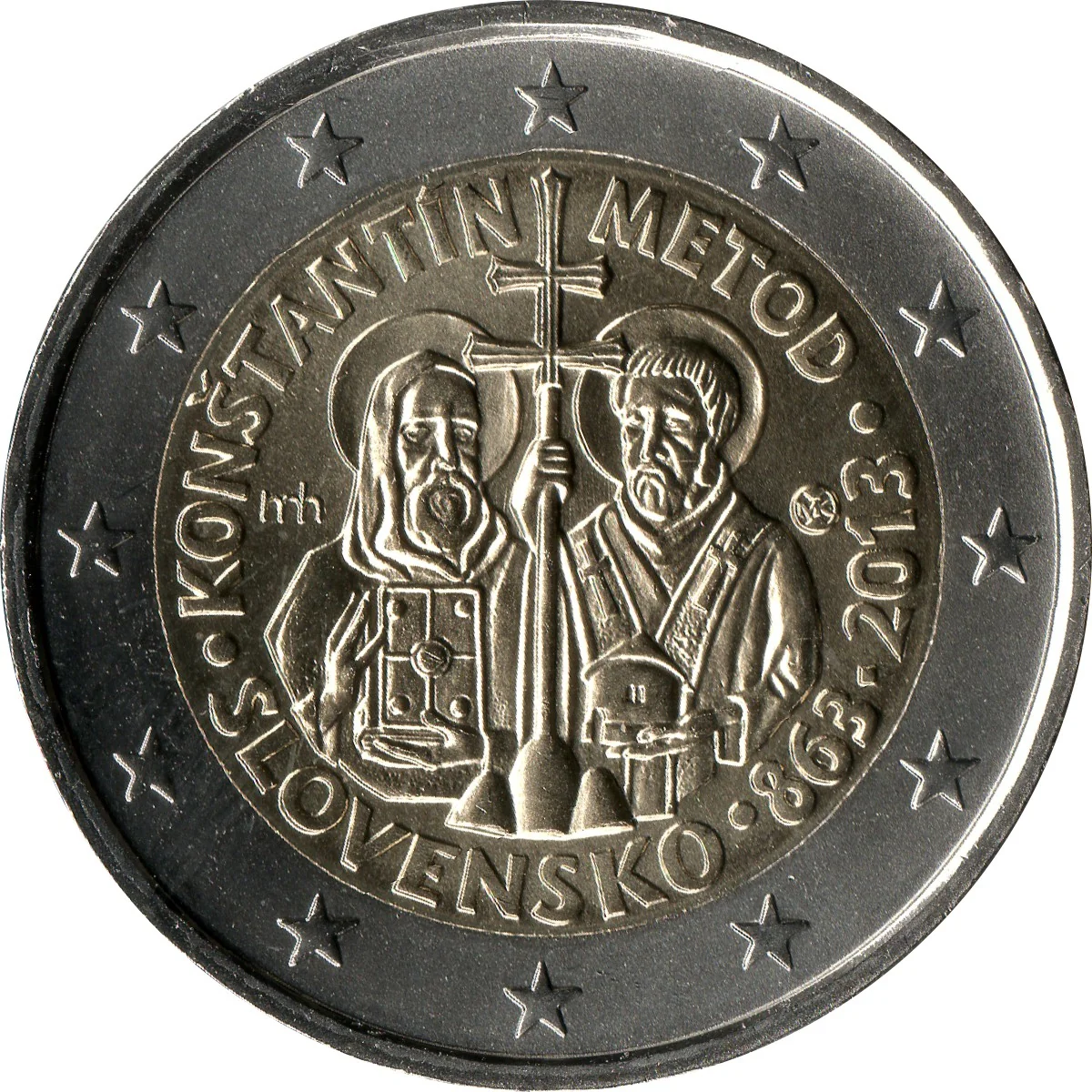
The inner coin depicts Constantine and Methodius flanking a double cross on three hills, held like a bishop's crozier, uniting symbols of statehood and Christianity to highlight their mission for Great Moravia's sovereignty. Constantine holds a book (education and faith), while Methodius stands beside a church (institutional faith). The lower edge reads "SLOVENSKO – 863 – 2013"; the upper edge has their names. The designer's initials "mh" are left, and the Kremnica Mint mark is right. The outer ring features the EU's 12 stars.
Inscription:
KONŠTANTÍN METOD
mh MK
·SLOVENSKO·863·2013·
mh MK
·SLOVENSKO·863·2013·
Translation:
CONSTANTINE METHODIUS
mh MK
·SLOVAKIA·863·2013·
mh MK
·SLOVAKIA·863·2013·
Script: Latin
Language: Slovak
Engravers: Miroslav Hric, Dalibor Schmidt
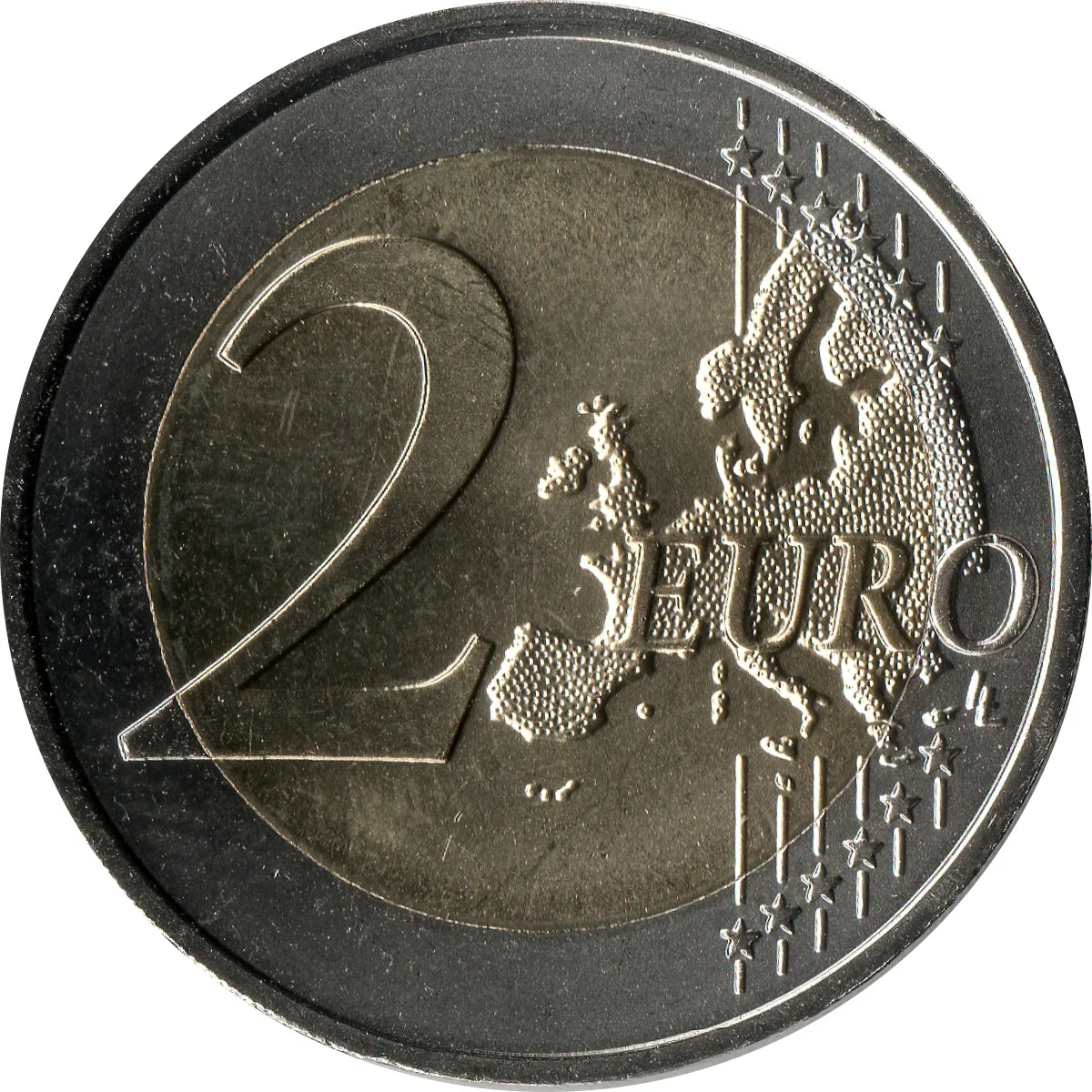
Reverse
Edge
Categories
| Symbol> Cross |
| Person> Religious figure |
| Map |
Mints
| Name | Mark |
|---|---|
| Kremnica | — |
Mintings
| Year | Mint Mark | Mintage | Quality | Collection |
|---|---|---|---|---|
| 2013 | MK | 10,300 | Proof | |
| 2013 | MK | 978,700 | ||
| 2013 | MK | 7,000 | BU |
Historical background
In 2013, Slovakia was a member of the European Union and had been part of the Eurozone since adopting the euro on January 1, 2009. As such, the country no longer had an independent national currency or monetary policy, having ceded control over interest rates and money supply to the European Central Bank (ECB). The primary currency situation for Slovakia in 2013 was therefore defined by its full integration into the euro area's framework, which provided stability and eliminated exchange rate risk with its major trading partners but also meant it had no unilateral tools to devalue its currency to boost competitiveness.
The broader context, however, was shaped by the ongoing aftermath of the European sovereign debt crisis. While Slovakia itself maintained relatively sound public finances and avoided a bailout, debates within the country focused on its role in Eurozone rescue mechanisms. A significant domestic political event occurred in 2011 when the government fell over a vote to expand the European Financial Stability Facility, highlighting public and political ambivalence about underwriting loans for more indebted southern Eurozone members. By 2013, these tensions had eased somewhat, but the experience reinforced Slovakia's position as a fiscally conservative member advocating for strict rules within the currency union.
Economically, Slovakia's use of the euro in 2013 was generally seen as a success story, supporting strong export-led growth driven primarily by its automotive industry. The fixed exchange rate provided a stable environment for foreign direct investment. However, the country also faced the common Eurozone challenge of internal devaluation—needing to improve competitiveness not through currency adjustment but through domestic reforms, wage restraint, and increased productivity. Thus, Slovakia's currency situation was one of embedded stability but within a union still navigating the profound structural imbalances exposed by the preceding crisis.
The broader context, however, was shaped by the ongoing aftermath of the European sovereign debt crisis. While Slovakia itself maintained relatively sound public finances and avoided a bailout, debates within the country focused on its role in Eurozone rescue mechanisms. A significant domestic political event occurred in 2011 when the government fell over a vote to expand the European Financial Stability Facility, highlighting public and political ambivalence about underwriting loans for more indebted southern Eurozone members. By 2013, these tensions had eased somewhat, but the experience reinforced Slovakia's position as a fiscally conservative member advocating for strict rules within the currency union.
Economically, Slovakia's use of the euro in 2013 was generally seen as a success story, supporting strong export-led growth driven primarily by its automotive industry. The fixed exchange rate provided a stable environment for foreign direct investment. However, the country also faced the common Eurozone challenge of internal devaluation—needing to improve competitiveness not through currency adjustment but through domestic reforms, wage restraint, and increased productivity. Thus, Slovakia's currency situation was one of embedded stability but within a union still navigating the profound structural imbalances exposed by the preceding crisis.
Series: Slovakia 2 euro commemoratives
🌱 Very Common