

3 schilling – Republic of Danzig
Add to wishlist
Poland
Context
Years: 1809–1812
Country: Poland
Issuer: Republic of Danzig
Period:
(1807—1814)
Currency:
Demonetized: Yes
Total mintage: 900,000
Material
References
KM: #
Numista: #46308
Obverse
Description:
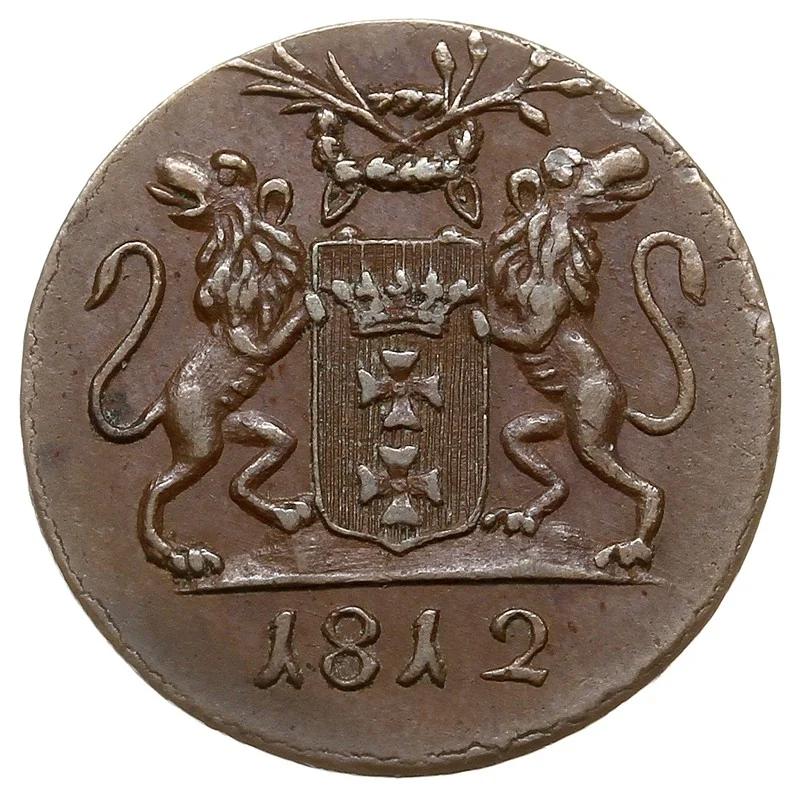
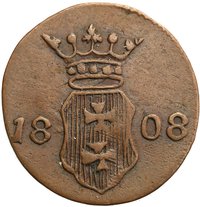
Two lions supporting the Danzig coat of arms, with the date beneath.
Inscription:
1812
Script: Latin
Reverse
Edge
Plain
Categories
| Symbols> Coat of Arms |
Mints
| Name | Mark |
|---|---|
| Gdańsk | — |
Mintings
| Year | Mint Mark | Mintage | Quality | Collection |
|---|---|---|---|---|
| 1809 | M | 360,000 | ||
| 1812 | M | 540,000 |
Historical background
The currency situation in the Free City of Danzig in 1809 was defined by political upheaval and economic necessity. Following its siege and capture by French and allied forces in 1807, Danzig was established as a semi-independent city-state under the protection of the French Empire and the Kingdom of Saxony. This separation from Prussia severed its ties to the stable Prussian Thaler system, creating an immediate monetary vacuum. The city's authorities, under French oversight, were compelled to issue their own provisional currency to facilitate local trade and pay for the substantial costs of the French garrison.
Consequently, in 1808, the Danzig Senate authorized the issuance of paper money known as Danziger Banco-Zettel. These notes were denominated in Thalers and Groschen, attempting to maintain a familiar accounting system, but they were essentially fiat currency backed by the city's credit and specific tax revenues. The situation was inherently unstable due to the enormous financial burden of French war contributions and requisitions. By 1809, these pressures led to significant over-issuance, causing the paper currency to rapidly depreciate against silver-based coins like the Prussian Thaler, which remained in circulation but became increasingly hoarded.
Thus, in 1809, Danzig operated under a strained dual-currency system. The circulating Banco-Zettel paper money was losing value, while scarce silver specie commanded a high premium. This inflation eroded public trust and complicated commerce, reflecting the broader economic distress of a city-state struggling to finance its imposed role as a French fortress. The currency crisis of 1809 was a direct symptom of Danzig's precarious political position, caught between Napoleonic demands and the collapse of its traditional economic frameworks.
Consequently, in 1808, the Danzig Senate authorized the issuance of paper money known as Danziger Banco-Zettel. These notes were denominated in Thalers and Groschen, attempting to maintain a familiar accounting system, but they were essentially fiat currency backed by the city's credit and specific tax revenues. The situation was inherently unstable due to the enormous financial burden of French war contributions and requisitions. By 1809, these pressures led to significant over-issuance, causing the paper currency to rapidly depreciate against silver-based coins like the Prussian Thaler, which remained in circulation but became increasingly hoarded.
Thus, in 1809, Danzig operated under a strained dual-currency system. The circulating Banco-Zettel paper money was losing value, while scarce silver specie commanded a high premium. This inflation eroded public trust and complicated commerce, reflecting the broader economic distress of a city-state struggling to finance its imposed role as a French fortress. The currency crisis of 1809 was a direct symptom of Danzig's precarious political position, caught between Napoleonic demands and the collapse of its traditional economic frameworks.
💎 Very Rare