

Obverse
Description:
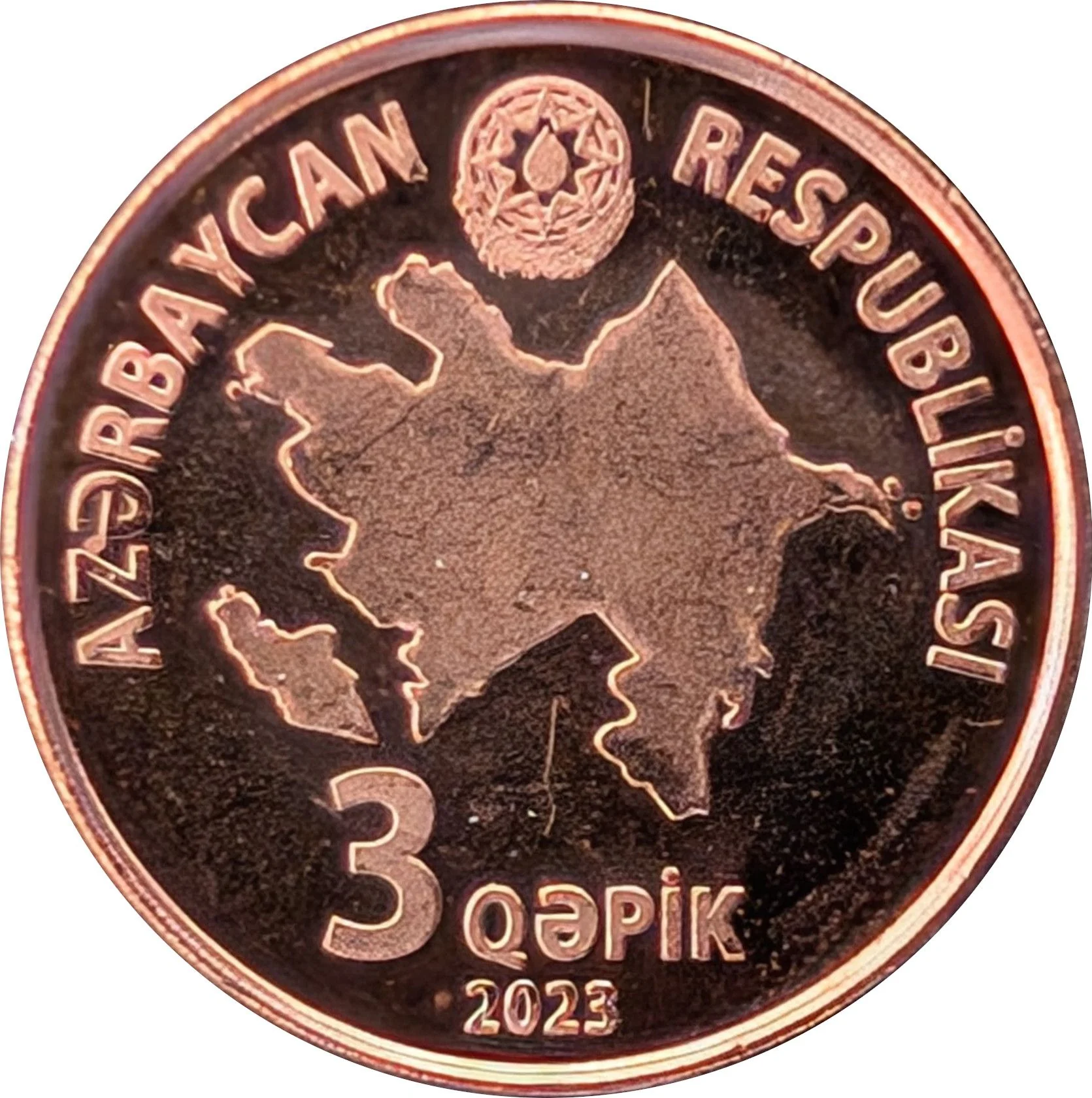
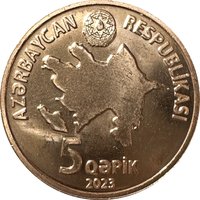
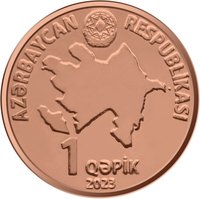
Map of Azerbaijan with legend above featuring the state emblem, plus denomination and date below.
Inscription:
AZƏRBAYCAN RESPUBLİKASI
3 QƏPİK
2023
3 QƏPİK
2023
Translation:
REPUBLIC OF AZERBAIJAN
3 QƏPİK
2023
3 QƏPİK
2023
Script: Latin
Language: Azerbaijani
Engraver: Robert Kalina
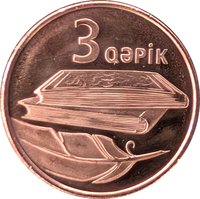
Reverse
Description:
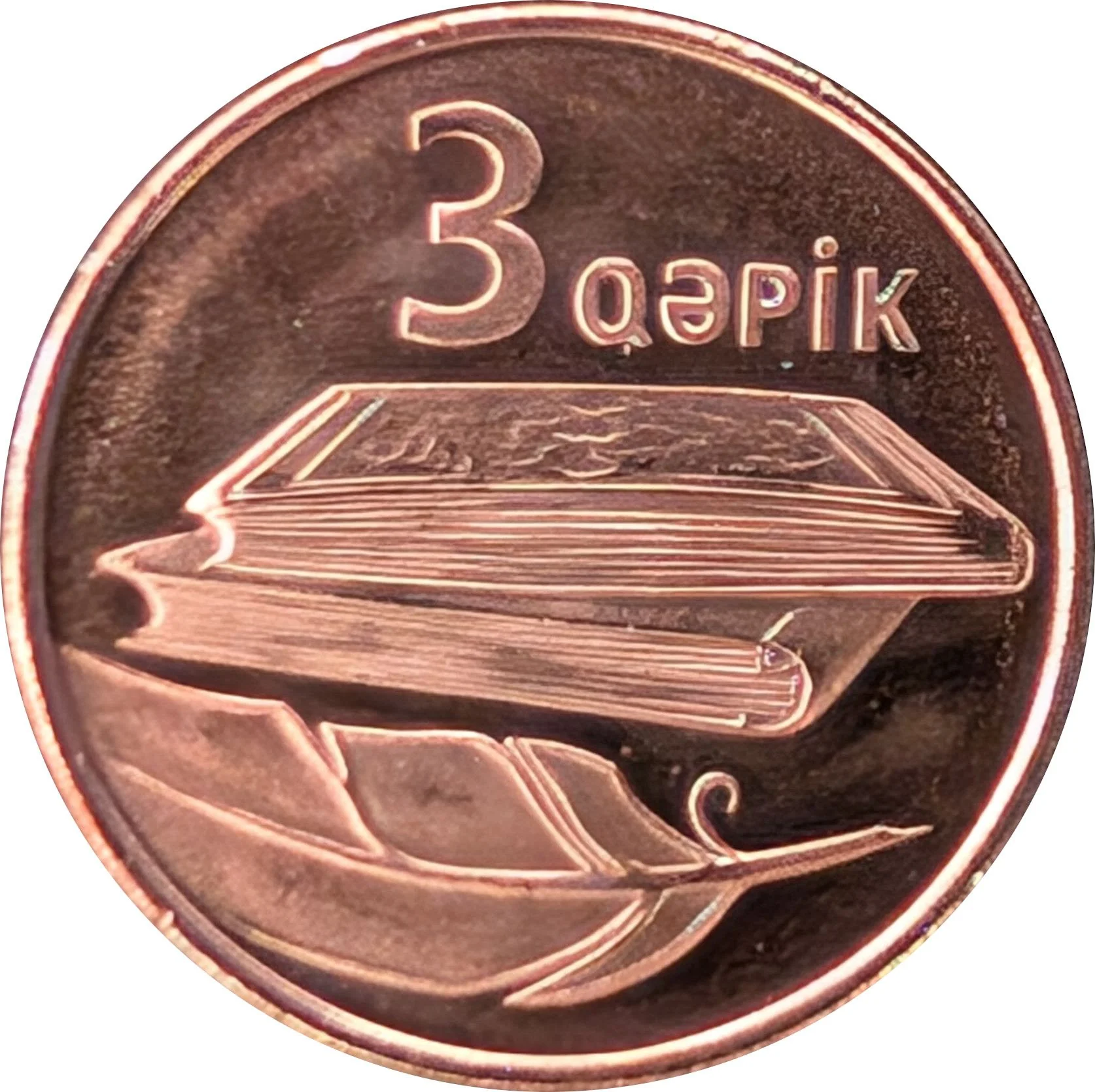
Books, quill, higher value.
Inscription:
3 QƏPİK
Translation:
3 Qəpik
Script: Latin
Language: Azerbaijani
Engraver: Robert Kalina
Edge
Smooth with a groove
Categories
| Map |
Mintings
| Year | Mint Mark | Mintage | Quality | Collection |
|---|---|---|---|---|
| 2023 | — | — |
Historical background
In 2023, Azerbaijan's currency, the manat (AZN), demonstrated remarkable stability, continuing a trend established after the dual devaluations of 2015 and 2017. This stability was primarily anchored by robust hydrocarbon revenues, driven by elevated global energy prices following the Russia-Ukraine conflict. High oil and gas exports significantly bolstered the country's foreign exchange reserves, which surpassed $66 billion, providing the Central Bank of Azerbaijan (CBA) with substantial firepower to defend the official exchange rate peg, which is closely managed against a US dollar-biased currency basket.
The primary challenge for the CBA throughout the year was managing strong inflationary pressures, which averaged 13.9% in 2022 and remained elevated, though moderating, in 2023. To combat this, the CBA maintained a tight monetary policy, gradually increasing the discount rate to 9% by year's end. This policy aimed to curb domestic demand and reduce dollarization, encouraging the public to hold manat-denominated assets. The stability of the currency, therefore, came with the trade-off of higher borrowing costs within the domestic economy.
Looking forward, the currency situation in 3 highlighted Azerbaijan's ongoing economic transition. While energy revenues guaranteed short-term stability, authorities continued long-term initiatives to diversify the economy away from hydrocarbons and develop the local financial market. The stability of the manat provided a predictable environment for this diversification agenda, but also underscored the economy's continued deep dependence on the energy sector for its macroeconomic and exchange rate equilibrium.
The primary challenge for the CBA throughout the year was managing strong inflationary pressures, which averaged 13.9% in 2022 and remained elevated, though moderating, in 2023. To combat this, the CBA maintained a tight monetary policy, gradually increasing the discount rate to 9% by year's end. This policy aimed to curb domestic demand and reduce dollarization, encouraging the public to hold manat-denominated assets. The stability of the currency, therefore, came with the trade-off of higher borrowing costs within the domestic economy.
Looking forward, the currency situation in 3 highlighted Azerbaijan's ongoing economic transition. While energy revenues guaranteed short-term stability, authorities continued long-term initiatives to diversify the economy away from hydrocarbons and develop the local financial market. The stability of the manat provided a predictable environment for this diversification agenda, but also underscored the economy's continued deep dependence on the energy sector for its macroeconomic and exchange rate equilibrium.
⭐ Rare