

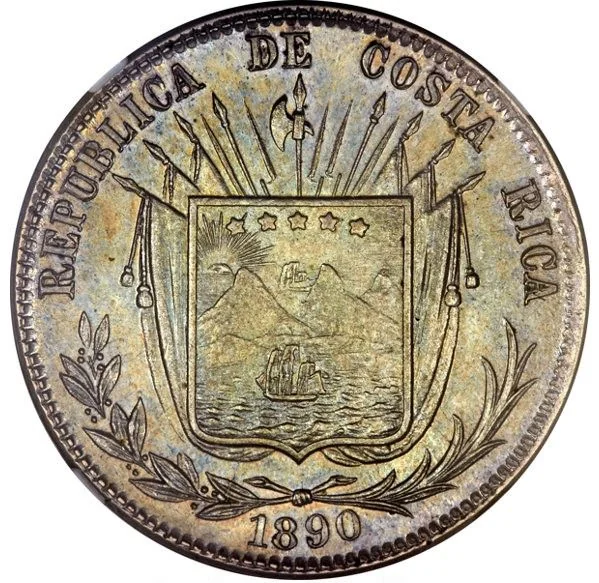
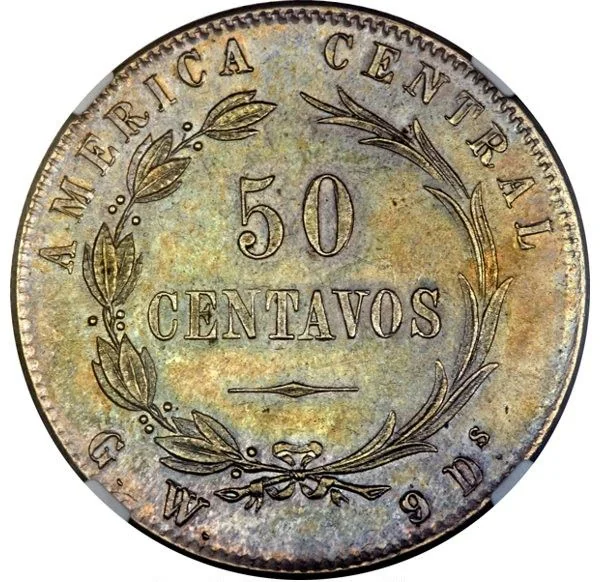
50 centavos – Costa Rica
Add to wishlist
Costa Rica
Context
Years: 1880–1890
Issuer: Costa Rica
Period:
(1848—1948)
Currency:
(1863—1896)
Demonetization: 24 October 1896
Total mintage: 694,000
Material
References
KM: #
Numista: #46137
Value
Bullion value: $23.53
Obverse
Description:
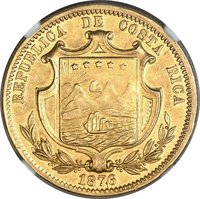
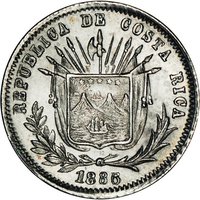
Coat of arms with wreath, legend above and date below.
Inscription:
REPUBLICA DE COSTA RICA
1890
1890
Translation:
REPUBLIC OF COSTA RICA
1890
1890
Script: Latin
Language: Spanish
Engraver: Guillermo Witting
Reverse
Description:
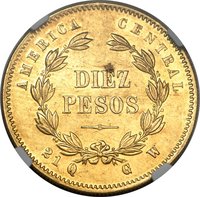
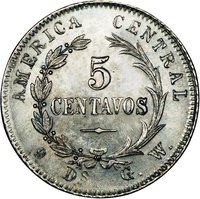
Wreath with value. Top: legend. Bottom: fineness and assayer's initials.
Inscription:
AMERICA CENTRAL
50 CENTAVOS
G. W. 9 Ds
50 CENTAVOS
G. W. 9 Ds
Translation:
CENTRAL AMERICA
50 CENTAVOS
G. W. 9 Ds
50 CENTAVOS
G. W. 9 Ds
Script: Latin
Language: Spanish
Engraver: Guillermo Witting
Edge
Categories
| Symbols> Coat of Arms |
| Symbol> Wreath |
Mints
| Name | Mark |
|---|---|
| Casa Nacional de Moneda de Costa Rica | — |
Mintings
| Year | Mint Mark | Mintage | Quality | Collection |
|---|---|---|---|---|
| 1880 | — | 389,000 | ||
| 1885 | — | — | ||
| 1886 | — | 97,000 | ||
| 1887 | — | 208,000 | ||
| 1890 | — | — |
Historical background
In the 1880s, Costa Rica’s currency situation was characterized by significant instability and complexity, rooted in the mid-19th century adoption of a bimetallic standard. The country officially used both silver pesos and gold pesos, but the fixed exchange rate between gold and silver did not reflect their fluctuating market values. This led to Gresham's Law in practice, where "bad money drives out good"—undervalued gold coins were hoarded or exported, while overvalued silver coins flooded into circulation, causing a chronic shortage of sound currency for government and large commercial transactions.
This monetary confusion was exacerbated by the widespread circulation of foreign coins, particularly Peruvian and Bolivian silver, which further degraded the quality of the money in everyday use. The government attempted to address the crisis by authorizing the issuance of low-denomination fractional paper money, known as billetes de café, by private banks. While this eased small-scale commerce, it did not solve the fundamental structural problem and added another layer of heterogeneity to an already fragmented system. The state's own finances were strained, limiting its ability to impose a definitive solution.
Consequently, the decade was a transitional period of economic debate and legislative attempts at reform. The instability hindered foreign investment and complicated the financing of major infrastructure projects, most notably the Atlantic railroad. The pressing need for a unified and reliable currency set the stage for the major monetary reform that would follow in the 1890s, culminating in the adoption of the gold standard and the creation of a new national currency, the colón, in 1896.
This monetary confusion was exacerbated by the widespread circulation of foreign coins, particularly Peruvian and Bolivian silver, which further degraded the quality of the money in everyday use. The government attempted to address the crisis by authorizing the issuance of low-denomination fractional paper money, known as billetes de café, by private banks. While this eased small-scale commerce, it did not solve the fundamental structural problem and added another layer of heterogeneity to an already fragmented system. The state's own finances were strained, limiting its ability to impose a definitive solution.
Consequently, the decade was a transitional period of economic debate and legislative attempts at reform. The instability hindered foreign investment and complicated the financing of major infrastructure projects, most notably the Atlantic railroad. The pressing need for a unified and reliable currency set the stage for the major monetary reform that would follow in the 1890s, culminating in the adoption of the gold standard and the creation of a new national currency, the colón, in 1896.
⭐ Rare