

5 centavos – Costa Rica
Add to wishlist
Costa Rica
Context
Years: 1885–1887
Issuer: Costa Rica
Period:
(1848—1948)
Currency:
(1863—1896)
Demonetization: 24 October 1896
Total mintage: 922,195
Material
References
KM: #
Numista: #25750
Value
Bullion value: $2.39
Obverse
Description:
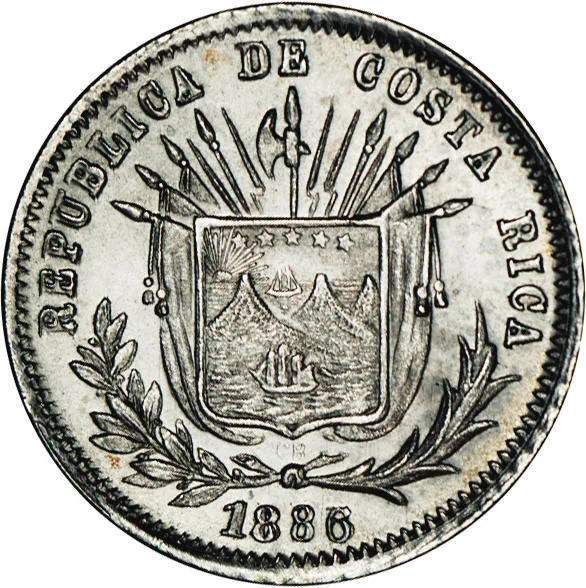
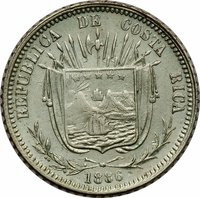
Coat of arms with wreath, legend above and date below.
Inscription:
REPUBLICA DE COSTA RICA
1886
1886
Translation:
REPUBLIC OF COSTA RICA
1886
1886
Script: Latin
Language: Spanish
Engraver: Guillermo Witting
Reverse
Description:
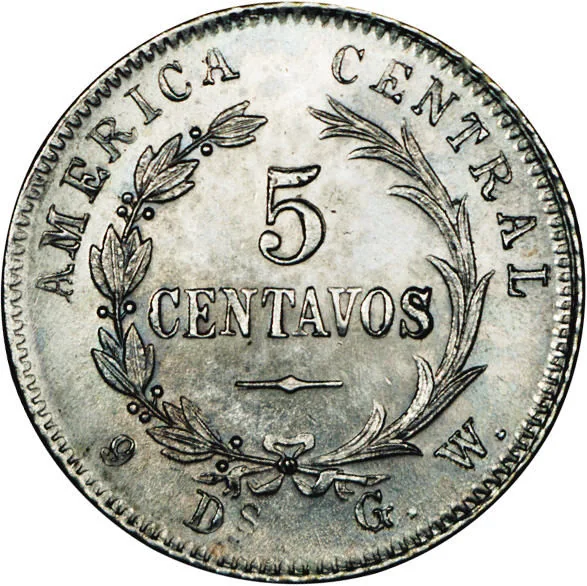
Wreath with value. Top: legend. Bottom: fineness and assayer's initials.
Inscription:
AMERICA CENTRAL
5 CENTAVOS
9 Ds G.W.
5 CENTAVOS
9 Ds G.W.
Translation:
CENTRAL AMERICA
5 CENTAVOS
9 Ds G.W.
5 CENTAVOS
9 Ds G.W.
Script: Latin
Language: Spanish
Engraver: Guillermo Witting
Edge
Categories
| Symbols> Coat of Arms |
| Symbol> Wreath |
Mints
| Name | Mark |
|---|---|
| Casa Nacional de Moneda de Costa Rica | — |
Mintings
| Year | Mint Mark | Mintage | Quality | Collection |
|---|---|---|---|---|
| 1885 | — | 180,000 | ||
| 1886 | — | 251,000 | ||
| 1887 | — | 491,195 |
Historical background
In 1885, Costa Rica’s currency system was a complex and unstable mixture of foreign and domestic coins, reflecting its integration into the global economy and its internal fiscal challenges. The primary circulating medium included silver pesos from Peru, Bolivia, and Chile, alongside British gold sovereigns and French Napoleons. However, the most critical component was the Costa Rican silver peso, which had been significantly debased. Years of fiscal shortfalls, particularly to finance infrastructure projects like the Atlantic Railway, led the government to issue low-weight silver coins, causing their intrinsic value to fall below their face value. This created a classic system of bimetallism plagued by Gresham’s Law, where "bad" (debased) money drove "good" (full-weight) money out of circulation, as people hoarded or exported the higher-value coins.
The situation was further complicated by the widespread use of paper money. To address chronic budget deficits, the government had authorized the issuance of banknotes by private banks, most notably the Banco de la Unión. These notes were not fully convertible into specie (gold or silver) on demand, leading to a loss of public confidence and a fluctuating discount against metal coins. Consequently, everyday transactions operated with a confusing multiplicity of values, as merchants and citizens had to constantly negotiate the worth of coins from different nations, debased domestic pesos, and discounted paper bills, creating significant inefficiency and uncertainty for commerce.
This monetary disarray occurred within a broader context of economic transformation. Costa Rica’s export boom, first in coffee and later in bananas, was tying the country more closely to international financial markets, particularly London. The instability of 1885 highlighted the urgent need for a unified and trustworthy currency system, a pressure that would culminate just over a decade later. In 1896, President Rafael Yglesias would enact a major monetary reform, abandoning the silver standard and placing the country on the gold standard with a new currency, the colón, named after Christopher Columbus, in an effort to stabilize the economy and simplify exchange.
The situation was further complicated by the widespread use of paper money. To address chronic budget deficits, the government had authorized the issuance of banknotes by private banks, most notably the Banco de la Unión. These notes were not fully convertible into specie (gold or silver) on demand, leading to a loss of public confidence and a fluctuating discount against metal coins. Consequently, everyday transactions operated with a confusing multiplicity of values, as merchants and citizens had to constantly negotiate the worth of coins from different nations, debased domestic pesos, and discounted paper bills, creating significant inefficiency and uncertainty for commerce.
This monetary disarray occurred within a broader context of economic transformation. Costa Rica’s export boom, first in coffee and later in bananas, was tying the country more closely to international financial markets, particularly London. The instability of 1885 highlighted the urgent need for a unified and trustworthy currency system, a pressure that would culminate just over a decade later. In 1896, President Rafael Yglesias would enact a major monetary reform, abandoning the silver standard and placing the country on the gold standard with a new currency, the colón, named after Christopher Columbus, in an effort to stabilize the economy and simplify exchange.
🌟 Limited