

1 Ruble – Soviet Union
Circulating commemorative coins
Commemoration: 1980 Summer Olympics, Moscow
Russia
Context
Year: 1980
Country: Russia 
Issuer: Soviet Union 
Period:
(1922—1991)
Currency:
(1961—1991)
Demonetization: 31 December 2002
Total mintage: 4,490,000
Material
Diameter: 31 mm
Weight: 12.8 g
Thickness: 2.3 mm
Shape: Round
Composition: Copper-nickel
Technique: Milled
Alignment: Medal alignment
flip
References
Y: #Click to copy to clipboard178
Numista: #4599
Value
Exchange value: 1 SUR
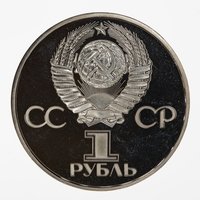
Obverse
Description:
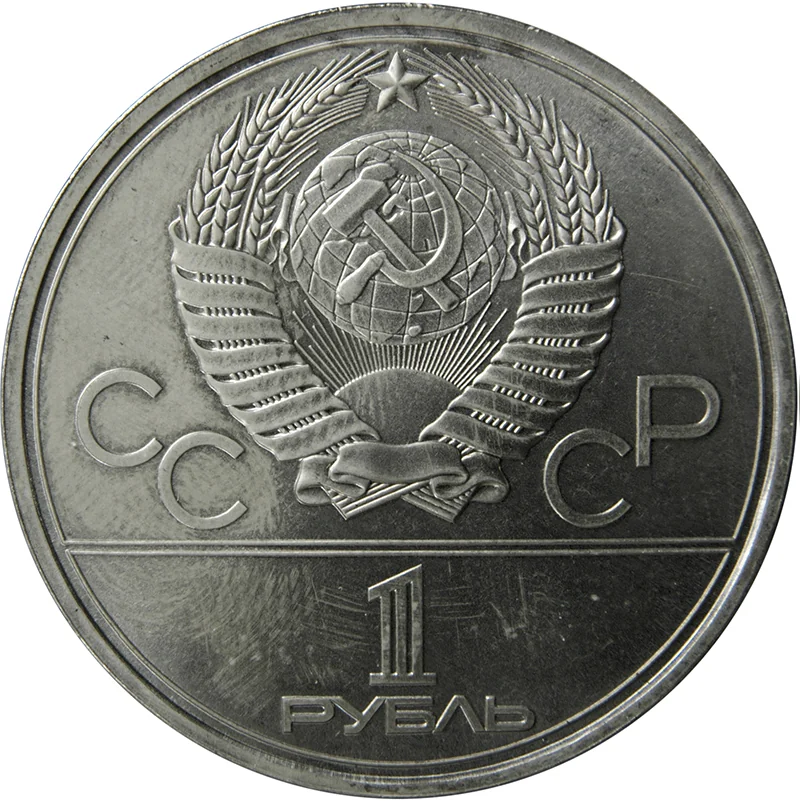
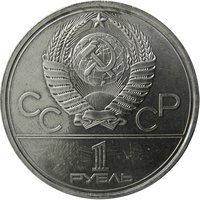
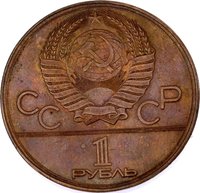
The Soviet Union's coat of arms; value.
Inscription:
СС СР
1
РУБЛЬ
1
РУБЛЬ
Translation:
ONE RUBLE USSR
Script: Cyrillic
Language: Russian
Engraver: Sergey Mikhaylovich Ivanov
Reverse
Description:
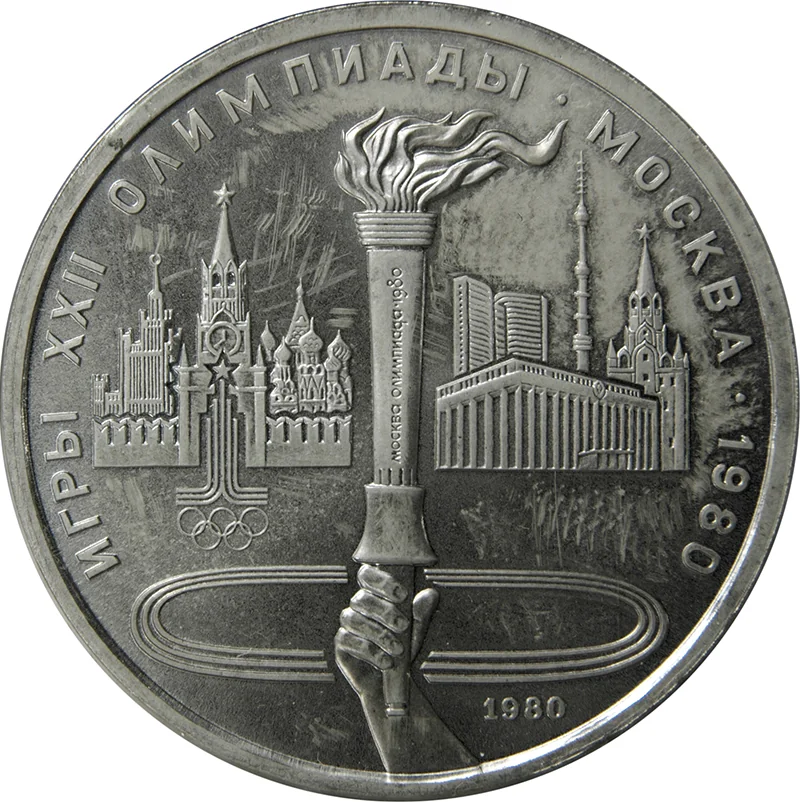
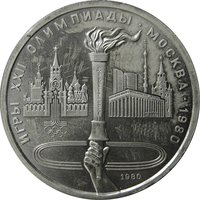
Olympic Flame
Inscription:
ИГРЫ XXII ОЛИМПИАДЫ • МОСКВА • 1980
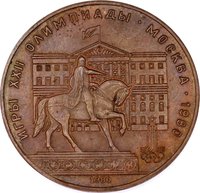
москва олимпиада • 1980
1980
москва олимпиада • 1980
1980
Translation:
GAMES OF THE XXII OLYMPIAD • MOSCOW • 1980
MOSCOW OLYMPIAD • 1980
1980
MOSCOW OLYMPIAD • 1980
1980
Script: Cyrillic
Language: Russian
Engraver: Nikolay Alexandrovich Nosov
Edge
Smooth with inscription
Legend:
ОДИН РУБЛЬ • ОДИН РУБЛЬ •
Translation:
ONE RUBLE • ONE RUBLE •
Language: Russian
Categories
| Building> Tower |
| Sport> Summer Olympic Games |
| Symbol> Hammer and sickle |
Mints
| Name | Mark |
|---|---|
| Saint Petersburg | — |
Mintings
| Year | Mint Mark | Mintage | Quality | Collection |
|---|---|---|---|---|
| 1980 | — | 4,490,000 | ||
| 1980 | — | — | Proof | |
| 1980 | — | — | Prooflike |
Historical background
By 1980, the Soviet Union's currency situation was defined by a stark duality between the domestic ruble and foreign exchange. Internally, the State Bank (Gosbank) maintained strict control over the ruble, which was not a convertible currency. Its value was administratively set by the state, bearing no relation to market forces or global exchange rates. While this system provided surface-level stability, with fixed prices for basic goods, it masked growing economic distortions. Chronic shortages of desirable consumer goods created a situation where money often had limited purchasing power, leading to forced savings and a vibrant black market where the ruble traded at a fraction of its official rate.
Externally, the USSR faced a severe hard currency shortage. To finance imports of vital Western technology and grain, the state relied almost entirely on exports of raw materials, particularly oil and gas. The global oil price shocks of the 1970s had initially provided a windfall, but by 1980, prices were volatile and beginning a long decline. This exposed a critical vulnerability: the Soviet economy generated minimal hard currency from manufactured exports, which were globally uncompetitive. Consequently, the state hoarded gold and foreign currencies like US dollars and Deutsche Marks, operating a complex system of special "certificate rubles" for foreign trade and tightly restricted access to hard currency for its own citizens.
This bifurcated system was increasingly unsustainable. The massive military spending of the late Cold War, combined with the inefficiencies of central planning and the growing cost of subsidizing client states, drained resources. The "era of stagnation" under Brezhnev saw declining growth, while the war in Afghanistan (beginning in 1979) imposed further financial strain. By 1980, the currency regime was a brittle facade, propped up by energy exports and repression of market forces. It could not satisfy consumer demand or foster technological innovation, setting the stage for the fiscal crises that would contribute to the Union's collapse a decade later.
Externally, the USSR faced a severe hard currency shortage. To finance imports of vital Western technology and grain, the state relied almost entirely on exports of raw materials, particularly oil and gas. The global oil price shocks of the 1970s had initially provided a windfall, but by 1980, prices were volatile and beginning a long decline. This exposed a critical vulnerability: the Soviet economy generated minimal hard currency from manufactured exports, which were globally uncompetitive. Consequently, the state hoarded gold and foreign currencies like US dollars and Deutsche Marks, operating a complex system of special "certificate rubles" for foreign trade and tightly restricted access to hard currency for its own citizens.
This bifurcated system was increasingly unsustainable. The massive military spending of the late Cold War, combined with the inefficiencies of central planning and the growing cost of subsidizing client states, drained resources. The "era of stagnation" under Brezhnev saw declining growth, while the war in Afghanistan (beginning in 1979) imposed further financial strain. By 1980, the currency regime was a brittle facade, propped up by energy exports and repression of market forces. It could not satisfy consumer demand or foster technological innovation, setting the stage for the fiscal crises that would contribute to the Union's collapse a decade later.
🌱 Very Common